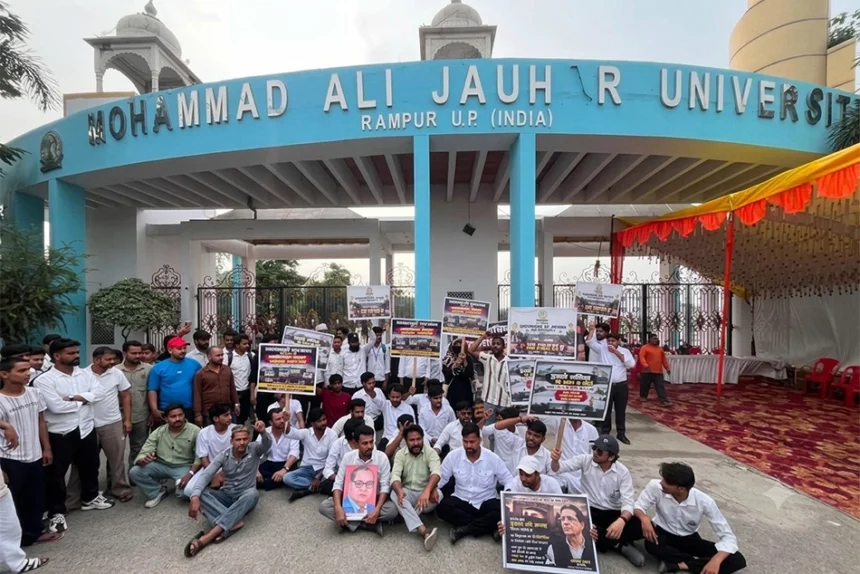

The recent protests at Mohammad Ali Jauhar University highlight a growing concern over the treatment of educational institutions associated with the Muslim community under the current Indian government. The Rampur Development Authority’s demolition notice targeting 38 out of 40 university buildings raises critical questions about social inclusion, discrimination, and the future of Muslim education in India.
Background of the Protest
Students at Mohammad Ali Jauhar University in Rampur are currently engaged in a sit-in protest against a notice issued by the Rampur Development Authority (RDA), which calls for the demolition of 38 of the university’s 40 buildings. This order, if executed, would effectively shutter the institution, which is significant for many students, particularly those from marginalized communities. Azam Khan, the university’s trust chairman and a political figure from the Samajwadi Party currently imprisoned, has become a symbol of the resistance against this order.
Mehroza Khan, a law student at the university, articulated the fears of many when she stated, “Our career and future are at stake. We have decided to stage this sit-in because we want the government to reconsider its decision to demolish the university.” This sentiment encapsulates the anxiety among students who rely on the university for affordable education and specific concessions available only at this institution.
Legal and Political Context
The RDA justifies its demolition order by claiming that the majority of the university’s structures were built without proper permissions—allegations the university administration disputes. They argue that some buildings were constructed before the area fell under RDA jurisdiction and had previously been sanctioned by local authorities. This clash over legal grounds adds another layer to a politically charged environment, where demolitions are increasingly seen as tools of exclusion targeting the Muslim community.
Political analysts note that this goes beyond mere regulatory compliance; it follows a disturbing trend observed since the rise of the Bharatiya Janata Party (BJP) and Hindutva politics, which many claim seeks to undermine institutions associated with Muslims. They assert that the government’s focus on demolishing these educational structures aims to erode the foundation of education accessible to Muslim youth, reinforcing social and economic marginalization.
Cultural Implications of Demolitions
Many activists and commentators draw parallels between the current situation and previous historical injustices, citing instances of communal tension and the systematic targeting of Muslim identity in India. The recent rise in demolitions is reminiscent of the Ram Janmabhoomi movement, which weaponized historical grievances for contemporary political gains. These demolitions not only uproot educational foundations but also symbolize broader attempts to challenge the presence and identity of the Muslim community in the cultural landscape of India.
As the slogan “Building the Nation” gains traction in the political discourse, it confers a troubling implication. What was once a call for development and infrastructure has morphed into a narrative that glorifies the destruction of structures associated with Islam. Critics argue that this trend fosters polarization and marginalization rather than unity and progress, emphasizing that a genuinely inclusive nation should be rooted in respectful coexistence and equal opportunities for all communities.
Why It Matters
This situation underlines significant issues of systemic discrimination against Indian Muslims, reinforcing patterns of exclusion that have long-term societal ramifications. Educational institutions like Mohammad Ali Jauhar University serve as vital lifelines for many students, particularly in underprivileged communities. The demolition order and similar actions not only threaten educational access but also perpetuate economic disparities and social injustices that can fracture societal cohesion. For a nation striving for equitable growth, addressing these issues is critical to ensuring fair opportunities for every citizen, regardless of their religious or cultural background.
Frequently Asked Questions
What is the situation at Mohammad Ali Jauhar University?
Students are protesting against a demolition notice from the Rampur Development Authority that threatens to raze 38 of the university’s buildings, jeopardizing their education and futures.
Why does the RDA want to demolish these buildings?
The RDA claims that many of the university’s structures were built without the necessary permissions, although the university disputes this, asserting past approvals from local authorities.
What are the implications of the demolition for students?
The demolition could close down the university, displacing students who benefit from financial concessions and specialized programs not readily available at other institutions, especially for marginalized communities.
How does this fit into the broader political landscape in India?
These actions are viewed as part of a broader pattern of discrimination and exclusion targeting the Muslim community, reflecting a trend of undermining educational and cultural institutions associated with Islam under the current political regime.