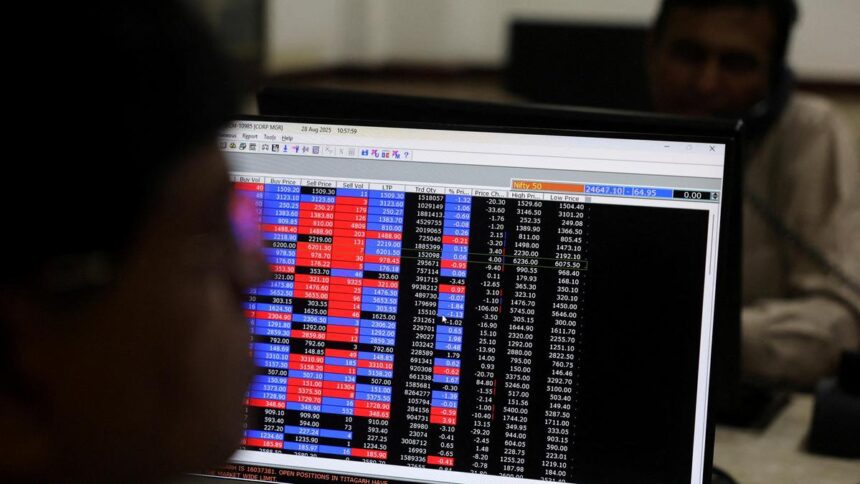

The latest quarterly results of brokerage firms in India reveal a remarkable year-on-year profit growth despite the ongoing market slowdown. Contributing factors include increased margin funding and diversification into various business avenues, suggesting resilience amid external pressures.
Profit Growth Amid Market Challenges
Brokerage firms have showcased impressive financial results for the July-September quarter, with many reporting significant increases in their profits compared to the same period last year. Notably, Groww’s parent company, Billionbrains Garage Ventures, saw a 54% increase in consolidated profit after tax (PAT), reaching ₹725.65 crore. This was accompanied by a 47.4% rise in revenue from operations to ₹1,501.53 crore.
However, the combined average daily equity cash-market turnover on the National Stock Exchange (NSE) and Bombay Stock Exchange (BSE) witnessed an 11.7% decline to ₹1.29 lakh crore from the previous quarter. Contributing to the subdued market activity were rising global bond yields, foreign investor outflows, and regulatory changes, alongside heightened oil prices. The introduction of the closing auction session (CAS) in August coincided with a downturn in derivatives trading, which typically plays a significant role in brokerage revenues.
Individual Brokerage Performance Highlights
Angel One also reported robust growth, with PAT rising by 58.2% to ₹335 crore and total revenue up 18.9% to ₹1,427 crore. The firm attributed this strong profitability surge to operational leverage and an expanding customer base, which grew by 17.3% to nearly 400 crore. Interestingly, gross broking income, a critical revenue stream, constituted about 55% of its total revenue, slightly down from 60% a year earlier.
HDFC Securities joined the trend, marking a 26.3% year-on-year PAT increase to ₹264.66 crore, coupled with a 37.6% rise in revenue from operations. Similarly, Anand Rathi Share and Stock Brokers recorded a 50.3% increase in PAT, reaching ₹41.94 crore, bolstered by a 36% rise in interest income from their margin trading facility (MTF).
Conversely, not all firms thrived in this quarter. 5paisa Capital reported a revenue growth of only 11.8%, with a concerning 25.5% decline in PAT to ₹7.06 crore. Geojit Financial Services also experienced challenges, with consolidated PAT dropping approximately 26% year-on-year to ₹16.54 crore despite a minor revenue increase.
Market Dynamics and Future Outlook
The declining share of equity derivatives in revenue highlights a need for firms to adapt to changing market conditions, particularly post-CAS introduction. Groww noted that the downturn in derivatives’ revenue contribution was a temporary adjustment and expressed optimism about recovery once the Securities and Exchange Board of India (SEBI) implements its reviewed measures.
Brokerage firms are increasingly diversifying revenue sources. For instance, both Groww and Angel One reported growth in their margin trading and wealth management services, which may provide a cushion against volatility in equity markets. The overall positive financial performance suggests that brokerage firms are navigating the current landscape effectively, implementing strategies to mitigate risks associated with market fluctuations.
What This Means
The results from these brokerage firms reflect a broader resilience in the Indian financial sector despite challenges. The growth in profits indicates effective business strategies and a commitment to diversification. For investors and market participants, understanding these dynamics is crucial, as they signal how brokerage firms are positioning themselves amid uncertainty. The declining turnover raises concerns about market liquidity, but it also presents an opportunity for firms to innovate and adapt to new trends, particularly in margin funding and wealth management services.
Frequently Asked Questions
What factors contributed to the profit growth of Indian brokerage firms in Q3 2026?
Brokerage firms reported profit growth driven by higher contributions from margin funding, effective business strategies, and a shift towards diverse income sources even as market activity slowed.
How did the market turnover change in the July-September quarter?
The average daily equity cash-market turnover on the NSE and BSE fell by 11.7% sequentially to ₹1.29 lakh crore, influenced by rising global bond yields and foreign investor outflows.
Which brokerage firms reported significant profit increases?
Notable profit increases were reported by Groww’s parent company with a 54% rise, Angel One with a 58.2% rise, and HDFC Securities with a 26.3% rise in their respective PAT.
What challenges did some brokerage firms face?
Some firms, like 5paisa Capital and Geojit Financial Services, experienced declining profits despite mild increases in revenue due to tougher market conditions and reduced trading activity.