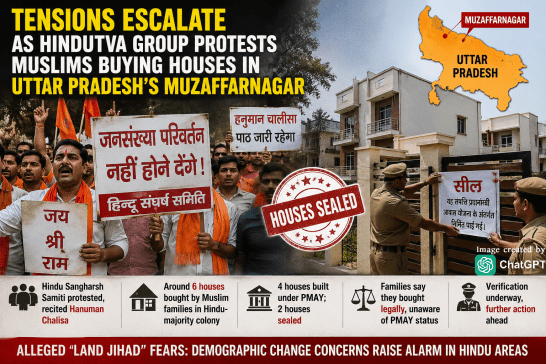

Tensions erupted in Janakpuri Colony, Muzaffarnagar, when members of the Hindu Sangharsh Samiti protested against Muslim families who purchased homes in the area. Allegations arose regarding the potential alteration of the demographic composition due to these transactions, raising concerns about social exclusion and discrimination against Muslims in predominantly Hindu neighborhoods.
The Protest and Its Immediate Impact
On July 25, 2026, the situation escalated as the Hindu Sangharsh Samiti, a group advocating for Hindu interests, staged a protest outside the homes of Muslim families in Janakpuri. The group recited the Hanuman Chalisa in front of the houses, prompting police and local authorities to intervene. A preliminary inspection revealed that Muslim families had acquired approximately six houses in this Hindu-majority locality, with officials stating that four of these properties were constructed under the Pradhan Mantri Awas Yojana (PMAY), a government housing scheme aimed at providing affordable housing.
Administrative Actions and Reactions
Acting on the protests, local authorities sealed two of the houses, alleging they were in violation of government rules pertaining to the PMAY scheme. The occupants were instructed to vacate the properties, igniting a response from the affected families who asserted their legal rights to the homes. One homeowner contested the actions, claiming he purchased the property for Rs 23.25 lakh, with no prior indication that it fell under the PMAY scheme. This situation has triggered an inquiry that is still underway, as police continue to investigate the complaints made by the protestors.
The Broader Context of Discrimination
Critics point to the Janakpuri incident as symptomatic of a larger trend across India, where similar protests have arisen against Muslims acquiring properties in Hindu-dominated areas. This phenomenon is often labeled as “land jihad,” with proponents of this view alleging it is a deliberate strategy to change the demographic landscape in favor of Muslim populations. The political implications of such claims have become a contentious subject, influencing public discourse and exacerbating communal tensions. As intimidation tactics become apparent, instances of economic boycotts and marginalization against Muslim communities seem to be on the rise, further compounding their exclusion from social and economic spheres.
Why It Matters
The events in Janakpuri underscore the growing polarization within Indian society, particularly concerning communal identities and real estate. Understanding these dynamics is crucial for analysts, policymakers, and developers engaged in urban planning, as demographic shifts and communal tensions can significantly affect property values, investment strategies, and community relations. For the AI industry, these incidents illuminate the need to develop technologies and algorithms that recognize and mitigate biases in urban development and housing policies. Public sentiment on such issues can influence civic applications, necessitating developers to approach the topic with sensitivity and an awareness of historical contexts.
Frequently Asked Questions
What sparked the protest in Janakpuri Colony?
The protest was sparked by members of the Hindu Sangharsh Samiti who alleged that Muslim families were purchasing homes to change the area’s demographic composition, leading to tensions within the community.
What action did local authorities take during the incident?
Local authorities sealed two houses purchased by Muslim families, alleging they were constructed under the PMAY scheme and instructed the occupants to vacate the properties pending an investigation.
What are the implications of accusations of “land jihad”?
Accusations of “land jihad” contribute to heightened communal tensions and can lead to social exclusion, economic boycotts, and marginalization of Muslim communities in Hindu-majority areas, complicating property ownership dynamics.
How do these events reflect broader societal trends in India?
The incidents illustrate a growing polarization between religious communities in India, highlighting concerns over demographic changes, social integration, and the rising influence of nationalist sentiments in public life.