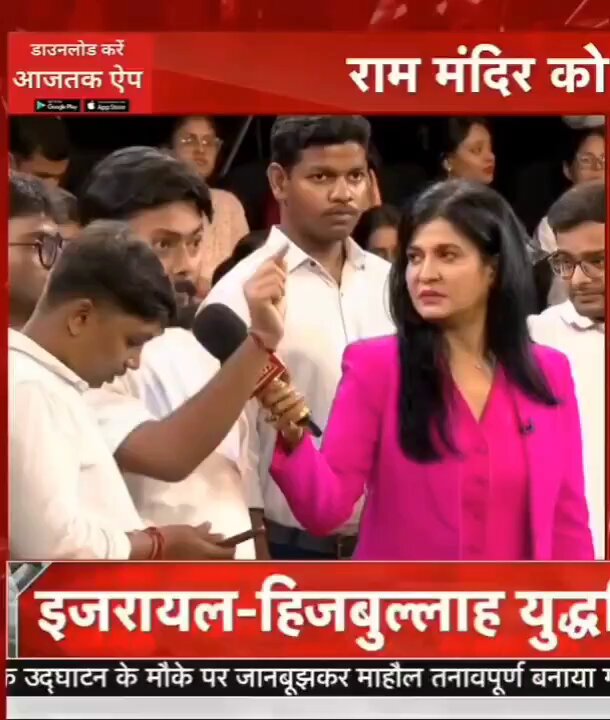

Recent debates on Indian television highlight a troubling trend: the manipulation of audience participation to create a predetermined narrative. Political commentator Mohammed Zubair (@zoo_bear) has pointed out that during a debate on the Ram Mandir donation controversy, the so-called “Gen Z” audience consisted predominantly of individuals aligned with the ruling BJP, raising questions about the authenticity of public discourse in Indian media.
Channel Selection and Topic Framing
Zubair asserts that Indian news channels often choose topics strategically to corner opposition parties. In the case of the Ram Mandir debate, the subject matter was framed in such a way that it inherently favored government positions. Such topic selection serves to reinforce the government’s narrative while limiting opportunities for opposition voices to effectively challenge or critique governmental actions.
Anchor Dynamics and Questioning Style
The role of anchors in these debates cannot be overstated. As Zubair notes, television hosts, such as Anjana Om Kashyap, often exhibit a bias in their questioning style. They tend to rigorously interrogate opposition leaders, while simultaneously deflecting critical questions aimed at the government. This creates an imbalance where the ruling party is shielded from scrutiny, thus shaping the public perception of political realities.
Audience Composition and Perception
Perhaps the most controversial aspect highlighted by Zubair is the composition of the audience itself. What is presented as an independent group of young people is, in fact, largely composed of individuals affiliated with the Bharatiya Janata Party (BJP) or its student wing, the Akhil Bharatiya Vidyarthi Parishad (ABVP). This raises significant concerns about the authenticity of the interactions and the so-called ‘public opinion’ being represented in these debates. Such orchestrated participation undermines the concept of genuine audience engagement, reducing it to a mere facade.
Why This Matters
The orchestration of political debates and the manipulation of audience participation have profound implications for democracy in India. By skewing discourse in favor of the ruling party, these practices limit accountability and critical engagement from citizens. Such an environment can foster the perception of legitimacy for government actions, irrespective of their merit. For Indian readers, the integrity of public debate is vital for the health of democracy. Ensuring that diverse voices are heard and that the media operate without bias is essential for the future of democratic discourse in India.
Frequently Asked Questions
What is the Ram Mandir donation controversy?
The Ram Mandir donation controversy revolves around the fundraising for the construction of a temple in Ayodhya, a site that has been a flashpoint of religious and political tensions in India. Discussions often involve scrutiny of the government’s transparency and the sources of funds.
Who is Anjana Om Kashyap?
Anjana Om Kashyap is a prominent Indian journalist and television news anchor known for her role in various political debate shows. She has been criticized for exhibiting bias in her questioning style, predominantly directing tough questions towards opposition leaders while favoring the ruling party.
What is the ABVP and its significance?
The Akhil Bharatiya Vidyarthi Parishad (ABVP) is a student organization affiliated with the BJP. It has a significant presence on college campuses across India and has been involved in various campaigns promoting the BJP’s ideological stance among young people.
Why is audience composition important in political debates?
Audience composition affects the authenticity and representativeness of public discourse. If audiences are not genuinely representative of the broader population, it can lead to biased narratives that misrepresent public opinions, impacting the democratic process and accountability of political entities.