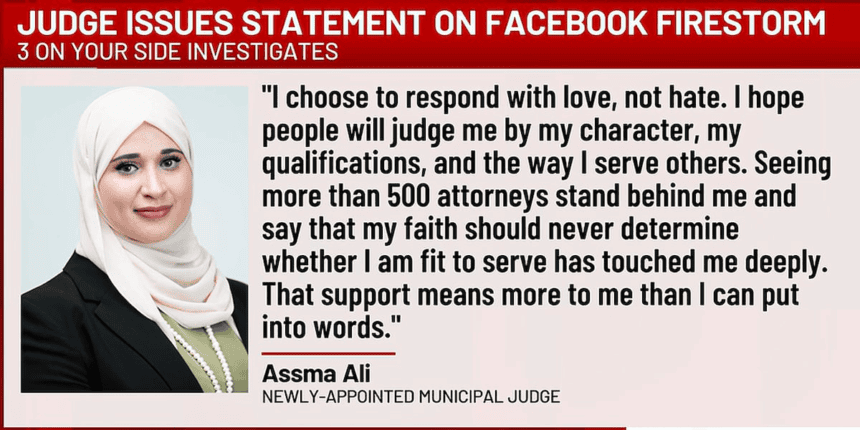

Assma Ali, a recently appointed municipal judge in Benoit, Mississippi, has become the target of online threats and harassment linked to her Muslim faith. This incident raises broader questions about discrimination and online hate in contemporary society.
Background of the Controversy
Assma Ali, an immigration attorney from Ridgeland, was appointed as a municipal judge in Benoit just last week. Her appointment has drawn fierce backlash from conservative activists who baselessly claim she may try to enforce Sharia law due to her Muslim identity. Critics of her appointment have largely made these accusations without providing any substantial evidence, simply relying on her religious background to fuel their claims.
Ali is an American-born citizen and holds a degree from Mississippi Christian School of Law. She has publicly stated her commitment to adhering to both the Constitution and state law, underscoring her qualifications for the role. Notably, she has sought legal counsel to assist her as she navigates this wave of harassment and online threats.
Challenges Faced by Ali
The backlash has been severe enough that Ali has had to step back from public appearances. In her statement, she chose to respond to the online vitriol with a message of love and understanding rather than hate. “I hope people will judge me by my character, my qualifications, and the way I serve others,” Ali remarked, highlighting the support she has received from over 500 attorneys affirming that her faith should not be a disqualifying factor for her judicial service. This underscores the growing concerns over the intersection of professional qualifications and personal belief systems in judicial appointments.
Political Repercussions and Support
The discrimination Ali is facing has also drawn political reactions, such as a call from DeSoto County State Senator Michael McLendon for her recall based on her religion and alleged support for socialist candidates. It is noteworthy that Ali has only made a couple of political donations in the past decade, including contributions to two specific candidates with progressive leanings. In 2022, she donated to Rana Abdelhamid, a congressional candidate who was associated with the Democratic Socialists of America, and in 2020, she supported Mike Espy in his Senate campaign.
This situation reveals how political affiliation and personal beliefs can be weaponized in public discourse, influencing perceptions of individuals based on limited information. Ali’s experiences illustrate the precarious position many face when their identities intersect with their professional roles, particularly in politically charged environments.
Why It Matters
This controversy surrounding Assma Ali is not just a localized incident; it highlights broader societal issues regarding discrimination and the treatment of minorities, particularly Muslims, in the United States. It reflects an ongoing struggle against hate speech and online harassment that can lead to real-world consequences for individuals based on their faith or background.
The way we approach judicial appointments must be informed by principles of equity and respect for all individuals, regardless of their religious affiliations. Similarly, Ali’s situation can serve as a cautionary tale about the implications of online discourse and the responsibilities that come with free expression in digital spaces.
Frequently Asked Questions
What actions did Assma Ali take in response to harassment?
Assma Ali has stepped back from public life and hired an attorney to help her deal with the threats and harassment resulting from her appointment.
What qualifications does Assma Ali have as a judge?
Assma Ali is an immigration attorney who graduated from the Mississippi Christian School of Law and was appointed as a municipal judge in Benoit.
What have critics said about Ali’s appointment?
Critics, primarily conservative activists, have accused her of possibly enforcing Sharia law based solely on her Muslim faith, without presenting any evidence for these claims.
What is the significance of the backing Ali received from other attorneys?
The support from over 500 attorneys indicates a strong professional acknowledgment that personal faith should not disqualify someone from serving in public office and highlights the legal community’s stance against religious-based discrimination.