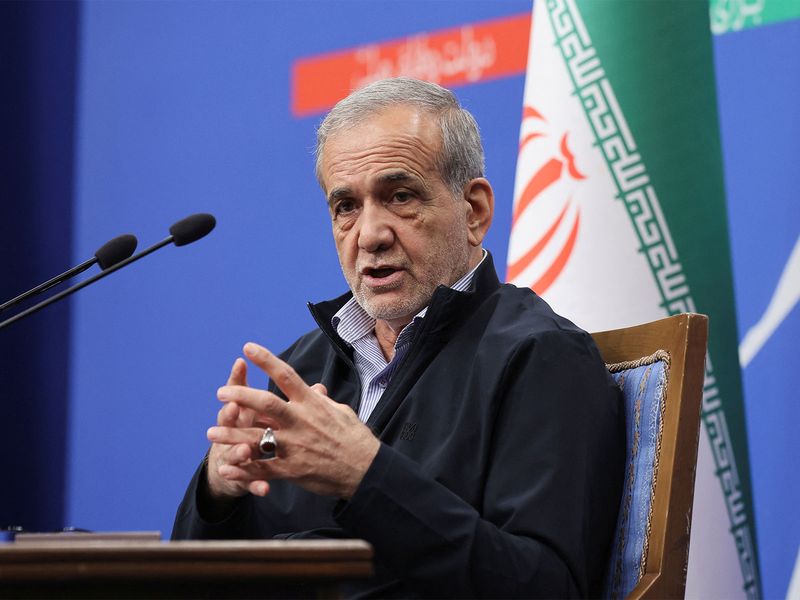

Iranian President Masoud Pezeshkian has accused the United States and Israel of attempting to sway Persian Gulf states against Tehran, exploiting the country’s internal challenges amid escalating regional conflicts. His remarks underline the ongoing tensions and Iran’s determination to maintain unity and defend its interests.
Accusations Against the West
During an interview with Iranian state television, President Pezeshkian stated that Israel and the United States are trying to turn neighboring Gulf nations against Iran. He emphasized the necessity for Tehran to confront these external pressures while addressing its internal issues, which he suggests are diverse and complex. “America and Israel are exploiting this situation,” he remarked, stressing the urgency of Iranian solidarity to counteract these manipulations.
Call for Islamic Solidarity
In his broadcast, Pezeshkian highlighted the significance of unity among Muslims, regardless of sectarian differences. He referred to teachings from the Holy Book, asserting that “all Muslims are brothers,” aiming to foster a sense of solidarity that he believes is vital in the face of external threats. This approach seeks to mend relationships with neighboring nations amid rising tensions, aiming for a collective Islamic front.
Maritime Conflicts and Defense Readiness
Pezeshkian addressed the ongoing maritime conflicts in the strategically crucial Strait of Hormuz, asserting that Iran’s military actions are solely targeted towards vessels deemed non-compliant with regulations. He insisted that Iran’s measures are mischaracterized and remain within the bounds of international agreements. “We firmly defend the memorandum we signed,” he stated, reiterating Iran’s readiness to engage in military confrontations if necessary, while blaming Israel for the persistent hostilities in the region.
Why It Matters
The tensions between Iran and its rivals, predominantly the United States and Israel, have implications not only for the immediate geopolitical landscape but also for global energy markets, maritime safety, and the security dynamics of the West Asia region. These relationships are foundational to understanding shifts in diplomatic alliances and conflicts that can reverberate across international waters. Furthermore, Pezeshkian’s emphasis on unifying Muslim nations showcases the potential for collaborative action among Islamic countries in response to perceived external threats, impacting future geopolitical maneuvers.
Frequently Asked Questions
What are the main geopolitical tensions involving Iran?
Iran faces significant geopolitical tensions primarily from the United States and Israel, both of which have been accused of trying to destabilize Iranian relations with neighboring Gulf states. These tensions are exacerbated by military confrontations in key areas like the Strait of Hormuz.
What is Iran’s position on Islamic solidarity?
President Pezeshkian advocates for Islamic solidarity, asserting that all Muslims, regardless of sect, should unite. He emphasizes this as a necessity to counteract divisions encouraged by external adversaries.
What actions has Iran taken in response to maritime threats?
Iran has engaged in military actions against vessels in the Strait of Hormuz that it claims have violated maritime regulations. Pezeshkian insists that these actions are part of Iran’s rights to defend its interests in this strategic shipping corridor.
Is there internal discord within Iran’s government?
Pezeshkian has dismissed claims of discord between the civilian administration and the Islamic Revolutionary Guard Corps (IRGC), asserting that the Iranian government remains united and cohesive, which is vital in addressing external pressures and challenges.