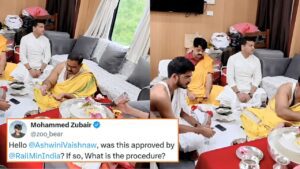
Recently, a video showing a group performing a Rudrabhishek ceremony aboard an Indian train sparked widespread discussion and controversy on social media. Initially raised by fact-checker Mohammed Zubair on X (formerly Twitter), the incident raised questions concerning railway regulations and the appropriateness of religious practices in public transport settings.
Background of the Incident
The video, which went viral, depicted individuals conducting a religious ritual inside what appeared to be a train compartment. Mohammed Zubair, known for his critical stance on various issues, tagged Railway Minister Ashwini Vaishnaw in his tweet, seeking clarification on whether the ceremony had received official approval from the railway authorities. His inquiry quickly caught the attention of thousands, leading to a massive online debate regarding the legality and appropriateness of such gatherings on trains.
Zubair questioned the procedure through which the ceremony was sanctioned, raising the prospect that this could indicate a possible violation of railway policy. His tweet presented a dilemma for the authorities, highlighting a perceived clash between personal freedoms and public regulations within the Indian railway system.
The Railway’s Clarification
In a rapid response, the Northern Railway clarified that the ritual was not conducted in a standard passenger coach but rather in a luxury saloon coach, which had been commercially booked through IRCTC by a private party. According to the Northern Railway, the saloon coach was booked on July 8 for a one-way journey from New Delhi to Mumbai onboard Train No. 12926 Paschim Express. The booking involved an advance payment of Rs 308,580, which emphasized that the ceremony was held in a permitted setting and not a flagrant disregard for rules.
The Northern Railway further stated that the party had permission for the commercial use of the saloon coach, asserting that punctuality, safety, and the comfort of all passengers were still being prioritized during the journey. Furthermore, no complaints regarding disturbances or safety were raised by fellow passengers, suggesting the ceremony was conducted in a manner that was unobtrusive.
Social Media Backlash and Discussion
The clarification from Northern Railway shifted the focus of the conversation from possible misconduct by railway authorities to the actions of Zubair himself. Netizens expressed frustration toward Zubair for raising what they perceived as a non-issue, pointing out that a legitimate booking with a considerable fee negated any accusations of impropriety.
Comments section quickly filled with discussions around religious freedoms, with many defending the right to perform ceremonies in a private setting, such as a booked saloon coach. This incident highlighted the complexities involved when personal liberties intersect with public regulations, particularly in a diverse society like India where such practices carry significant cultural weight.
Why This Matters
This incident reflects the ongoing tensions in India regarding religious practices in public spaces. It raises critical questions about the balance between individual rights and regulatory frameworks. With India’s diverse population, the railway system becomes a microcosm of larger societal dynamics, where issues of governance, cultural heritage, and personal freedoms collide. As social media plays an increasingly influential role in shaping public discourse, incidents like these can swiftly escalate, often leading to polarized reactions among citizens. Understanding the nuances and managing the expectations of varied constituents remain vital for authorities to navigate these situations effectively.
Frequently Asked Questions
What is a Rudrabhishek ceremony?
A Rudrabhishek is a Hindu ritual that involves the worship of Lord Shiva, typically involving the chanting of mantras, and the offering of specific items, often conducted during significant events or festivals.
Is it legal to hold religious ceremonies on trains in India?
Generally, holding religious ceremonies in public transport settings could be subject to regulations aimed at ensuring passenger comfort and safety. However, if a private space, like a booked saloon coach, is used, it typically falls under the jurisdiction of the booking terms and conditions provided by the Indian Railways.
How did the public respond to the incident?
Public reaction was initially focused on questioning the appropriateness of the ceremony, but after the Railway’s clarification, many shifted their frustration toward the fact-checker’s public questioning without full context, finding the arranged ceremony permissible.
What are the implications of this incident for railway policies?
This incident may prompt railway authorities to evaluate their policies regarding private bookings and the types of activities permitted therein, balancing operational efficiency with cultural sensitivities.