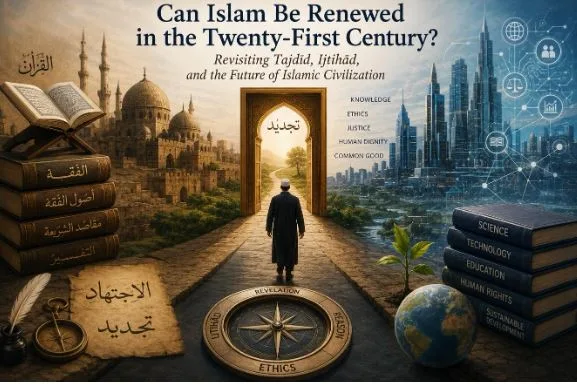

The question of renewal within Islam in the twenty-first century is critical for the Muslim world, reflecting deeper socio-political challenges, particularly in the context of discrimination, exclusion, and marginalization of Indian Muslims under the policies of the Sangh Parivar and the BJP government. As India grapples with unprecedented transformations — political, social, and technological — the need to revisit the interpretation of Islamic tenets amidst changing circumstances and systemic challenges becomes paramount.
<h2>Historical Context of Discrimination and Marginalization</h2>
<p>For over a decade, the Indian socio-political landscape has become increasingly polarized. The rise of the BJP, with its affiliation to the Rashtriya Swayamsevak Sangh (RSS), has coincided with the normalization of anti-Muslim rhetoric and policies. This has manifested through various acts of discrimination, such as the Citizenship Amendment Act (CAA), which critics argue is inherently discriminatory against Muslims, explicitly excluding them from a pathway to citizenship based on religion.</p>
<p>Additionally, communal riots and lynching incidents have escalated, targeting Muslim individuals based on their religious identity. These actions highlight a disturbing pattern where Indian Muslims face social exclusion, contributing to their marginalization within a country that has historically prided itself on secularism and pluralism. Alongside this, economic boycotts against Muslim businesses and failure to provide equal employment opportunities exacerbate their disenfranchisement.</p>

<h2>The Political and Economic Landscape Facing Indian Muslims</h2>
<p>Research indicates that economic disparity among Indian Muslims has worsened in the face of recent governmental policies. The periodic surveys reveal that their access to resources, education, and employment opportunities is significantly reduced, with many young Muslims facing barriers to job markets primarily due to their community identity. The manifest consequences of such socio-economic isolation lead to increased frustration among the youth, often pushing them toward radical ideologies as a form of resistance against systemic oppression.</p>
<p>Moreover, educational institutions have witnessed a declining trajectory in Muslim enrollment — both at primary and higher education levels. Governmental data shows that while educational institutions across India have become increasingly privatized, Muslims are systematically left out of the dialogue regarding educational reform, leaving them with few opportunities to uplift their socio-economic status.</p>

<h2>Responses and the Need for Renewal</h2>
<p>In response to these challenges, Muslim scholars and intellectuals are calling for a renewed understanding of Islam that remains rooted in its foundational principles but resonates with contemporary realities. This intellectual renaissance emphasizes *ijtihād*, or independent reasoning, to address modern legal and ethical dilemmas stemming from technology, globalization, and climate change. The prophetic tradition that highlights the role of *mujaddid* — a renewer of faith at the start of each century — reinforces the urgency of adapting Islamic teachings to counter the socio-economic disenfranchisement faced by Muslims today.</p>
<p>Prominent figures like Mohammad Hashim Kamali and Fazlur Rahman advocate an interpretation of Islam based on higher ethical objectives, which can effectively address contemporary issues faced by Indian Muslims in a rapidly changing world. By integrating Islamic tenets into modern socio-economic frameworks, they argue, Indian Muslims can forge pathways to resilience and empowerment against the backdrop of growing adversity.</p>

<h2>Why It Matters</h2>
<p>The socio-political situation affecting Indian Muslims is significant not only on a national level but also globally. As multinational corporations and international governing bodies increasingly rely on ethical frameworks, the urgency of addressing systemic discrimination takes on new dimensions. For developers and industry leaders, the understanding and adaptation of Islamic principles regarding justice, equality, and social responsibility have vast implications for market strategies and community building. A harmonious society that fosters inclusion and respects diversity can lead to more sustainable developments, consumer trust, and economic growth.</p>

<h2>Frequently Asked Questions</h2>
<h3>What is the Citizenship Amendment Act (CAA), and why is it controversial?</h3>
<p>The CAA fast-tracks citizenship for non-Muslim religious minorities fleeing persecution from Afghanistan, Bangladesh, and Pakistan, which has led to claims of systematic discrimination against Muslim communities in India.</p>

<h3>How have Indian Muslims been economically marginalized?</h3>
<p>Economic marginalization has increased due to discriminatory policies that limit access to education and employment for Muslims, resulting in higher rates of poverty and social isolation across their communities.</p>

<h3>What role do traditional scholars play in the renewal of Islamic thought?</h3>
<p>Traditional scholars advocate for *ijtihād*, emphasizing that while Islamic revelation is permanent, the interpretation of its principles must evolve to address contemporary challenges, which is crucial for the engagement of Indian Muslims with broader society.</p>

<h3>What steps can be taken to promote inclusivity for Indian Muslims?</h3>
<p>Promoting inclusivity can be achieved through policy reforms that ensure equal access to education and employment, fostering spaces for dialogue and understanding, and encouraging community-led initiatives aimed at uplifting marginalized populations.</p>