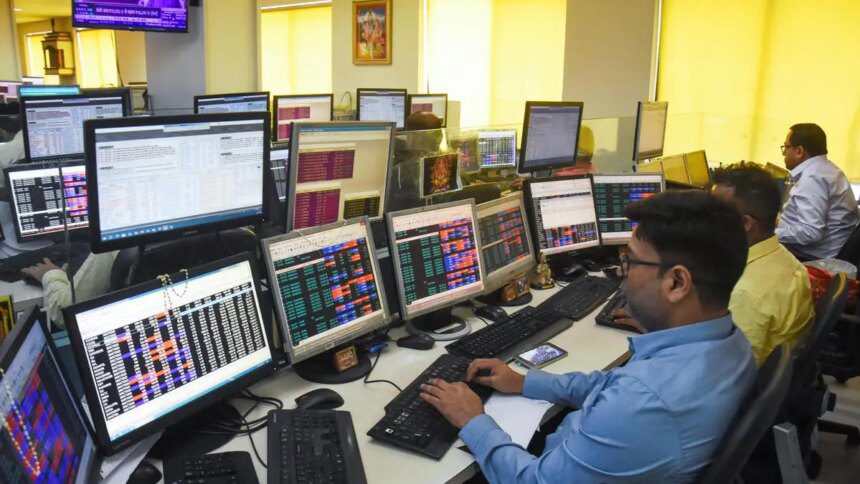

Indian benchmark indices opened lower on October 27, 2026, as selling pressure in technology and metals stocks weighed down the market. Despite this bearish trend, select sectors like fast-moving consumer goods and defence have shown resilience.
Market Opening and Current Trends
The BSE Sensex began the day at 73,484.38, a decline from Monday’s close of 73,606.75, trading at 73,276.08 at 9:20 AM, down by 330.67 points or 0.45%. In parallel, the NSE Nifty50 started at 22,708.80, falling to 22,671.25, marking a decrease of 81.95 points or 0.36%. Analysts attribute this dip largely to the volatility associated with the monthly derivatives expiry on the NSE, suggesting heightened intraday swings might follow.
Sector Performance Analysis
The trading landscape has been marked by contrasts. While technology stocks faced significant downward pressure, certain sectors displayed positive movement. For instance, Tata Consumer Products led the early gainers, climbing 3.04% to ₹965.00. Other notable gainers included Bharat Electronics, Max Healthcare, BSE Limited, and Shriram Finance, whose stocks rose by 1.35%, 1.25%, 0.99%, and 0.70%, respectively. Conversely, leading declines were observed in Infosys, which dropped by 2.51%, while JSW Steel, Asian Paints, and TCS followed suit with respective declines of 1.40%, 1.28%, and 1.15%.
Global Influences and Economic Indicators
The underperformance of Indian IT stocks is notable given positive trends on Wall Street. The Dow Jones, S&P 500, and Nasdaq recorded gains of 0.3%, 0.7%, and 0.8%, respectively, fueled by a surge in semiconductor stocks due to Anthropic’s IPO filing. Market experts suggest that while US gains may indicate a broader sentiment, Indian technology stocks will remain sensitive to domestic factors like quarterly guidance and client spending.
Additionally, the Indian economy faces external headwinds, particularly with crude oil prices hovering near $115 per barrel amidst geopolitical tensions in West Asia. The influence of these factors is compounded by the US Federal Reserve’s impending policy meeting, which is poised to shape financial conditions globally. The market anticipates no change in rates but closely watches guidance on inflation, which could influence investor sentiment across emerging markets.
What This Means
The dynamics introduced by the monthly derivatives expiry could lead to increased volatility in the short term, requiring investors to be discerning in their trading strategies. The bifurcation between performing sectors and underperforming stocks indicates a selective market where resilience might be found outside traditional hotspots. The fluctuation in crude oil prices and global economic cues will likely dictate market sentiment moving forward, emphasizing the need for tactical evaluation of sectoral strengths and weaknesses.
Frequently Asked Questions
What impact does the monthly derivatives expiry have on the stock market?
The monthly derivatives expiry often results in increased volatility and may lead traders to adjust their strategies based on anticipated market fluctuations.
Why are technology stocks underperforming despite global market gains?
Indian technology stocks may be more sensitive to domestic conditions, such as earnings guidance and client spending, which impacts investor confidence despite international trends.
How do rising crude oil prices affect the Indian market?
Increases in crude oil prices can exert inflationary pressures and strain economic conditions, which may negatively affect market performance and investor sentiment.
What are analysts predicting for the Nifty and Sensex levels?
Analysts have highlighted critical support levels at 22,600 for the Nifty and 73,000 for the Sensex, suggesting that these levels will be crucial in determining short-term market direction.