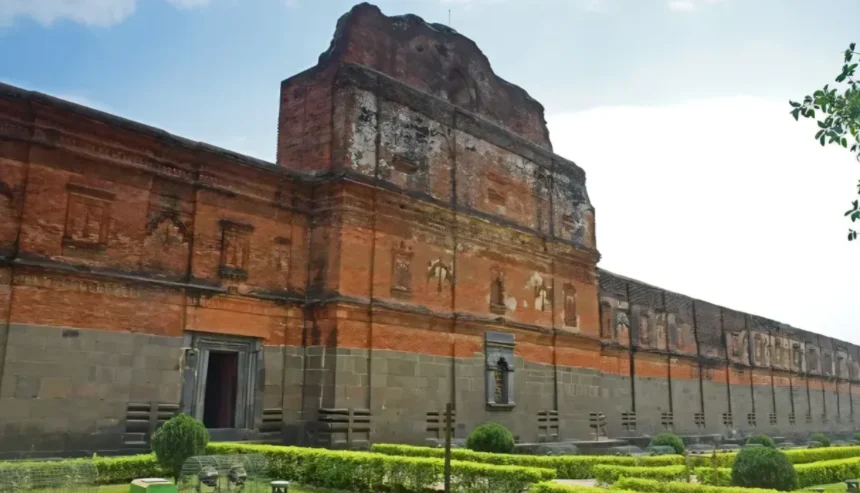

The recent announcement by a Hindutva organisation to install a Shiva Lingam outside the historic Adina Mosque in West Bengal stirs a debate about the targeting of Islamic heritage sites in India. The mosque, which dates back to 1373 CE, represents a significant chapter in India’s Islamic history, yet the ongoing efforts to claim its narrative by Hindutva groups have raised alarms about communal tensions and the disruption of social harmony.
Controversy Surrounding the Adina Mosque
The Adina Mosque, located in Malda district, is a monument of national importance, having been built by Sultan Sikandar Shah of the Bengal Sultanate. Recently, the organisation Adinath Puratan Shiv Mandir, led by BJP functionary Kajal Goswami, announced intentions to place a 3.6-foot Shiva Lingam outside the mosque, asserting that it stands on the site of a demolished Hindu temple. Goswami invites followers to partake in religious rituals at the site, dubbing the mosque the “old Adinath Temple.”
Although the organisation claims that sculptures found within the mosque substantiate its narrative, the Archaeological Survey of India (ASI) maintains the mosque’s significance as a protected heritage site. Claims regarding the mosque’s origin as a temple remain unfounded by any official archaeological research. This controversy marks a continuation of Hindutva organisations’ efforts to reinterpret and assert control over historical narratives related to Islamic sites in India.
Historical Context and Political Implications
The Adina Mosque is not the first religious site targeted by Hindutva narratives. Over the years, similar claims have arisen regarding other Muslim monuments across India. In recent years, BJP leaders have publicly echoed the assertion that the mosque was constructed using materials from pre-existing Hindu and Buddhist structures, with prominent figures like Samik Bhattacharya likening the controversy to the Babri Masjid-Ram Janmabhoomi movement. This brings forward a pattern wherein the narrative surrounding a historical monument becomes a tool for political mobilization.
Local and national politicians have shown varying responses to the potential installation of the Shiva Lingam. While BJP leaders emphasize the need to “restore” the supposed historical temple, critics, including CPI(M) state secretary Md Salim, have noted that such strategies are a recurrent tactic for fostering communal divisions. The ASI and Malda Police have recognized the mosque’s protected status under the Ancient Monuments and Archaeological Sites and Remains Act (AMASR), forbidding unauthorized religious activities on the site.
Growing Tensions and Community Response
The call for rituals outside the Adina Mosque has heightened community tensions, particularly among local Muslims. This latest initiative has drawn stark reactions, with Muslims perceiving it as part of a broader effort to undermine their religious identity and historical presence in the region. Protests have erupted in response to unauthorized rituals conducted within the mosque, illustrating the passionate connection local communities have to their heritage.
With the recent rise in such controversies, many fear that similar strategies aimed at altering historical narratives could lead to communal fracture. This controversy illustrates how the intersection of politics and religion can sow discord and heighten social exclusion within the broader Indian society. The potential marginalization of Muslims, who represent about 14% of India’s population, remains a pressing concern as public campaigns often gain traction under the banner of Hindutva politics.
Why It Matters
This ongoing controversy around the Adina Mosque symbolizes a troubling tendency in the current political climate of India, where historical and cultural narratives are being reshaped to serve political agendas. The implications extend beyond religious sentiments; they raise questions about the integrity of India’s diverse heritage and the protection of minority rights. As the groundwork for social cohesion weakens, it becomes crucial for governing bodies and society to address the resulting divisions responsibly.
Frequently Asked Questions
What is the significance of the Adina Mosque?
The Adina Mosque, built in 1373 CE, is an essential monument reflecting India’s Islamic heritage and is recognized as a protected heritage site by the Archaeological Survey of India.
What are the claims made by proponents of the Shiva Lingam installation?
Proponents claim that the Adina Mosque was built on the ruins of a Hindu temple and that archaeological evidence supports their assertion, though the ASI has not substantiated these claims.
What legal protections does the Adina Mosque have?
The Adina Mosque is protected under the Ancient Monuments and Archaeological Sites and Remains (AMASR) Act, 1958, which prohibits unauthorized religious activities on its premises.
How have local communities responded to the controversy?
Local Muslim communities view the push to install the Shiva Lingam as an attack on their religious identity and history, leading to protests and calls for the preservation of the mosque’s integrity.