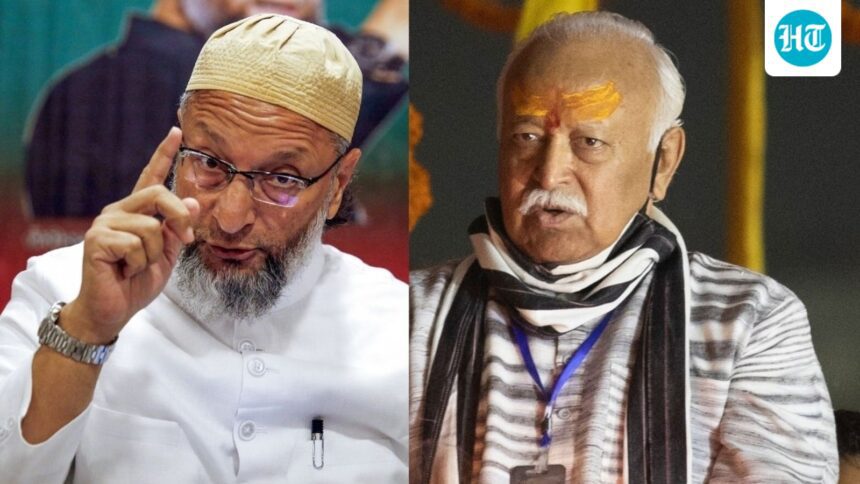

Recent comments by RSS chief Mohan Bhagwat regarding Hindu-Muslim unity have rekindled debates about inclusivity in Indian society. AIMIM leader Asaduddin Owaisi criticized Bhagwat’s remarks, framing them as part of a longstanding narrative that marginalizes religious minorities in India.
Owaisi’s Critique of the RSS
AIMIM’s Asaduddin Owaisi reacted strongly to Bhagwat’s assertion that a true Hindu must embrace Muslims as part of India’s fabric. Owaisi termed this perspective as the “oldest trick” in the RSS’s “playbook.” He emphasized that the RSS has historically opposed the inclusion of religious minorities, referencing statements from the organization’s founders and thinkers. Owaisi’s post on social media platform X suggested that the RSS’s origin is rooted in a resistance to the participation of diverse religious communities in the anti-colonial struggle. He further argued that the RSS has consistently advocated for authoritarian governance over democratic principles.
Bhagwat’s Remarks on Hindu-Muslim Relations
At a faith leaders’ conference in New York, Bhagwat addressed concerns regarding the presence of Muslims in a “Hindu Rashtra.” He assured his audience, stating that any Hindu who believes Muslims should be excluded from India does not truly embody Hindu values. Bhagwat claimed that true Hinduism recognizes the dignity of every human being and promotes the idea that all paths lead to a common destination. This reconciliatory message was part of his larger effort to present a softer image of the RSS to international audiences.
Owaisi’s Allegations of Suspicion Against Minorities
In his critique, Owaisi pointed out that the RSS and the ruling Bharatiya Janata Party (BJP) perceive Indian Muslims and Christians as “internal threats.” He claimed that foundational texts from RSS ideologues advocate treating Muslim citizens with “perpetual suspicion,” contributing to social and economic exclusion. Owaisi’s statements underscore a chilling atmosphere for minority communities in India, as they navigate a political landscape dominated by majoritarian sentiments. As of now, the RSS has not publicly responded to Owaisi’s allegations, leaving questions of accountability and discourse surrounding minority rights unaddressed.
Why It Matters
The tension between majority and minority communities in India highlights significant socio-political divides, which can have far-reaching implications for national unity and global perceptions of democracy in the country. This situation is particularly critical for the AI industry and developers, as social media platforms increasingly become battlegrounds for narratives that shape public perception. The dissemination of information about minority communities directly impacts user engagement and platform policies, making it essential for AI applications to address biases in these discussions. Understanding these dynamics is pivotal for developers aiming to build inclusive technologies that reflect diverse perspectives.
Frequently Asked Questions
What did Mohan Bhagwat say regarding Hindu-Muslim relations?
Bhagwat stated that any Hindu who believes there should be no Muslims in India is not a true Hindu, emphasizing the need for coexistence and the intrinsic dignity of all human beings.
How did Asaduddin Owaisi respond to Bhagwat’s comments?
Owaisi criticized Bhagwat’s remarks, suggesting they were part of a pattern where the RSS marginalizes religious minorities. He highlighted the organization’s historical opposition to their inclusion in the national narrative.
What are the implications of Owaisi’s allegations against the RSS?
Owaisi’s claims about the RSS viewing Muslims and Christians as “internal threats” point to systemic discrimination, which has implications for religious harmony, civil rights, and governance in India.
How can Bhagwat’s comments affect the perception of Hinduism globally?
By promoting a message of inclusivity, Bhagwat aims to reshape the global narrative around Hinduism. However, contrasting views from leaders like Owaisi highlight ongoing tensions, which may complicate this effort.