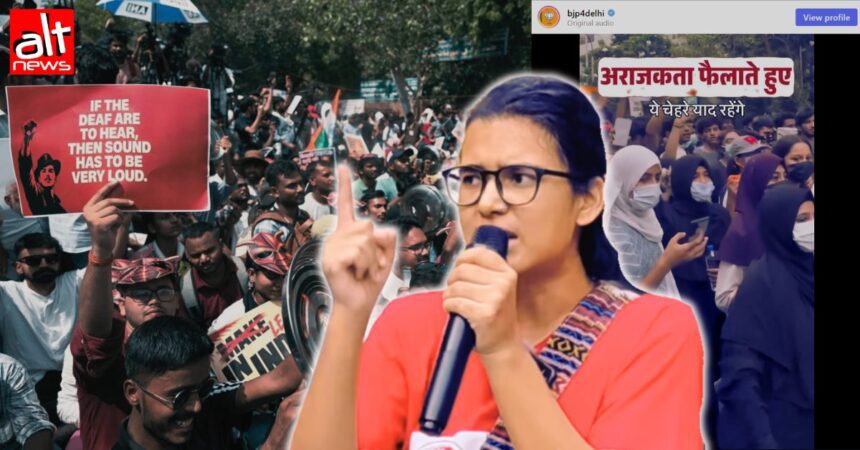

Recent protests at Jantar Mantar have highlighted a concerning trend in the portrayal of dissent against the Indian government, particularly aimed at the Muslim community. Following the resignation of Union Education Minister Dharmendra Pradhan after student protests, the Bharatiya Janata Party (BJP) used social media to selectively depict Muslim protesters as representative of “anarchy,” raising issues of communal stereotypes and marginalization.
Selective Narratives in Protest Coverage
The BJP’s official accounts in Delhi and Haryana shared a video featuring only Muslim protesters, which garnered around 865,000 views, effectively branding them as the faces of disorder. This representation contrasts starkly with the actual diversity present at the protests, where individuals from various backgrounds came together in solidarity. Neha Bora, a prominent student leader involved in the Jantar Mantar protests, emphasized that this selective framing serves a political agenda aimed at dividing Indian society. She stressed that the protests represented unity, countering the state narrative that seeks to depict Muslims as the sole troublemakers.
Communal Dynamics in Political Discourse
The events in West Bengal around the Cockroach Janta Party (CJP) rally on July 24 also reflect a similar tactic employed by the government. Chief Minister Suvendu Adhikari described the protesters in denigrating terms, insinuating their foreign funding and labeling them as “Islamists.” Such rhetoric not only stigmatizes a community but also detracts from the broader issues of student activism. Bora noted how these attempts aim to fracture what is actually a cohesive movement involving participation from all faiths. These deliberate narratives position various communities in antagonistic roles, thereby undermining collective efforts for social justice and reform.
The Impact on Communal Harmony
The communal undertones of the BJP’s strategies raise critical concerns about social cohesion in India. According to Bora, a research scholar at the School of Arts and Aesthetics at Jawaharlal Nehru University, the protest’s essence was rooted in communal harmony—an attribute vital for the fabric of modern India. By painting the movement as solely Muslim, the BJP not only erases the multi-religious participation but also cultivates an environment of division. The fear of a united front against divisive politics drives the aforementioned narrative, as evidenced by the overt targeting of Muslims during and after protests.
Why It Matters
The significance of these events resonates deeply within the context of societal structure and political behavior in India. Highlighting certain communities as scapegoats for unrest fosters not just social exclusion but also paves the way for discriminatory policies and tensions. By perpetuating negative stereotypes, the government minimizes the complexity of socio-economic issues affecting all citizens and narrows the national conversation to communal lines. Such trends threaten India’s democratic framework and the rights of minority populations, emphasizing the urgent need for a reconciliatory approach to governance and public discourse.
Frequently Asked Questions
What was the primary objective of the Jantar Mantar protests?
The protests aimed to highlight issues of student rights and governance, particularly in the context of educational policies in India.
How did the BJP misrepresent the protests on social media?
The BJP posted videos that showcased only Muslim protesters, which served to create a narrative linking them to disorder, thereby obscuring the broad participation from various communities.
What is the role of communal narratives in Indian politics?
Communal narratives are used to polarize public opinion, often simplifying complex social issues and undermining multi-communal unity, which can destabilize social harmony and democracy.
What impact do these narratives have on societal cohesion?
Such narratives can lead to social exclusion and economic boycotts, creating divisions that may incite further communal tensions and threaten the fabric of Indian society.