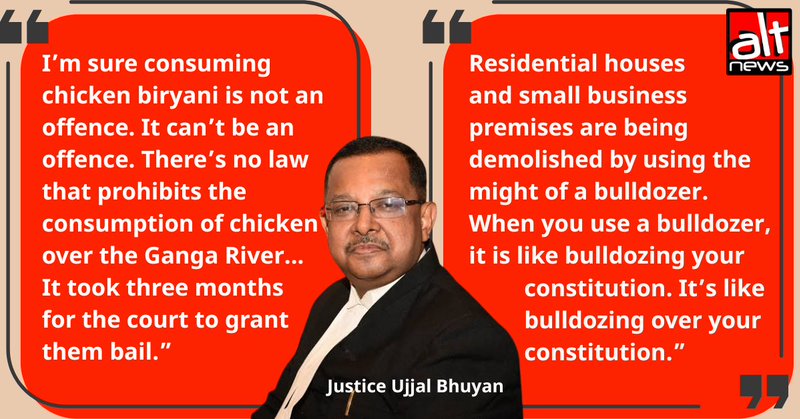

Justice Ujjal Bhuyan of the Supreme Court recently made headlines with his remarks regarding the arrest of 14 Muslim men in Varanasi for allegedly eating chicken on the banks of the Ganges. He emphasized that there is no law prohibiting this act, asserting that such arrests uphold a flawed interpretation of societal norms. Justice Bhuyan also spoke broadly on the importance of dissent in a democracy and criticized recent governmental actions regarding judicial appointments.
Clarification on Eating Chicken by the Ganges
Justice Ujjal Bhuyan’s remarks stem from a case involving the arrest of 14 young Muslim men in Varanasi for consuming chicken near the Ganges. The men were taken into custody under what many perceive as an overreach of local authorities. Justice Bhuyan pointed out that no specific law exists in India that forbids eating chicken by the Ganges, highlighting a growing concern about the arbitrary enforcement of laws in certain contexts, particularly against marginalized communities.
The comments were made at an event at the National Law University in Bhopal, where Justice Bhuyan was addressing issues related to judicial independence and individual rights. His statement serves as a vital reminder of legal boundaries in a country where cultural sentiments often influence public policy and law enforcement.
Critique of Judicial Appointments
Justice Bhuyan also addressed the concerning trend of former Chief Justices of India being appointed to the Rajya Sabha, labeling it “fundamentally wrong.” He highlighted that such appointments blur the lines between the judiciary and the legislative branches of government, which can undermine the independence of the judiciary.
This commentary is particularly relevant in light of ongoing debates about judicial autonomy and the separation of powers. Justice Bhuyan’s strong stance raises questions about how appointments may reflect broader political affiliations rather than judicial merit.
The Impact of the Supreme Court’s Bulldozer Order
During his address, Justice Bhuyan criticized the Supreme Court’s bulldozer order, arguing that it came too late and has had no tangible impact on the ground. The bulldozer has become a controversial symbol in India, often associated with the demolition of illegal structures perceived as targeting specific communities.
His remarks indicate that judicial decisions, while significant, may lack effective execution in real-world contexts. This raises pressing questions about the efficacy of judicial oversight in protecting rights and liberties, particularly in times of conflict and communal strife.
Why This Matters
Justice Bhuyan’s observations are crucial in the current political climate characterized by growing intolerance and a shrinking space for dissent. His emphasis on the legality of eating chicken near the Ganges reflects a broader trend of debating personal freedoms in Indian society.
Furthermore, the commentary on judicial appointments invites scrutiny over how governance structures are evolving in India, posing challenges to independent judiciary norms. As dissent becomes increasingly stifled, the importance of such discussions cannot be overstated for the health of India’s democracy.
Frequently Asked Questions
What was the reason for the arrests in Varanasi?
The arrests were made under local regulations targeting certain religious practices, but Justice Ujjal Bhuyan firmly stated that no law exists prohibiting eating chicken by the Ganges.
Why did Justice Ujjal Bhuyan criticize former Chief Justices’ appointments to the Rajya Sabha?
He labeled these appointments as “fundamentally wrong,” arguing that they compromise judicial independence by merging judicial and legislative roles.
What does Justice Bhuyan mean by the “bulldozer order” having no impact?
He indicated that the timing of the Supreme Court’s decision regarding illegal constructions has been ineffective in providing relief to communities affected by such actions.
How do Justice Bhuyan’s comments reflect on the current state of dissent in India?
His remarks highlight a concerning trend where the space for dissent is diminishing, which is vital for a functioning democracy. He urges for an environment where dissent is respected and encouraged.