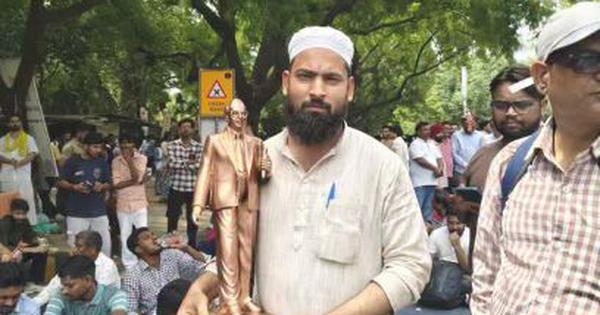

The ongoing protests at Jantar Mantar, Delhi, have turned into a focal point for highlighting the systemic discrimination against Indian Muslims. Muhammad Junaid, a volunteer providing food and water to demonstrators, has reported a disturbing pattern of police intimidation and harassment targeting his family as authorities seek to undermine his participation in the protest.
Allegations of Police Intimidation
Muhammad Junaid has alleged that his family became the target of the Uttar Pradesh Police in a bid to locate him. He stated that police officers visited his home in Ghaziabad, taking his father into custody initially on Thursday night and then again the following morning. Junaid’s claims extend to the detention of his relatives, including his sister’s father-in-law and brother-in-law, who were reportedly taken to the Masoori Police Station in Ghaziabad district.
Junaid emphasized that the police confiscated crucial personal documents, including bank passbooks and Aadhaar cards belonging to family members. He further alleged that officers informed his family that their release would be contingent upon Junaid presenting himself at the police station, raising concerns about collective punishment and unwarranted harassment.
The Role of Activism and Community Support
Since the protests began on June 6, Junaid has witnessed first-hand the struggles of demonstrators, particularly concerning access to basic necessities like drinking water amid sweltering heat. What started as a simple effort to distribute water evolved into a broader initiative that included providing food and other essentials to support the protestors. This grassroots activism showcases how common citizens can step in where governmental support fails, particularly for marginalized communities.
The Cockroach Janta Party, an active participant in the protests, has publicly criticized the actions of the Uttar Pradesh Police. They described the police’s targeting of Junaid as a misuse of resources, suggesting that the authorities should focus on genuine criminality rather than silencing volunteers who provide humanitarian assistance. This sentiment is echoed by various human rights advocates who have voiced concerns over the intimidation tactics employed against those involved in social justice movements.
Government Response and Denial of Allegations
On the other hand, the Meerut Police have categorically denied Junaid’s claims of detaining his family members. Senior police officials, including Senior Superintendent of Police Avinash Pandey, stated that “no such matter has come to my notice,” indicating a lack of accountability within the police department. Superintendent of Police Vinayak Gopal Bhonsle added that claims had been verified with all police station heads, concluding that no members of Junaid’s family had been detained in Meerut.
This disconnect raises further questions about the role of law enforcement in India, particularly with respect to minority communities. The refusal to acknowledge reported abuses signals a troubling trend of state-sanctioned repression rather than addressing the root causes of public dissent.
Why It Matters
This situation is indicative of larger, systemic issues facing Muslims in India, especially under the current governance led by the Bharatiya Janata Party (BJP). The targeting of Junaid for his humanitarian efforts reflects the broader trend of social exclusion and discrimination that is increasingly becoming normalized. It raises concerns about civil liberties and human rights, particularly for marginalized groups, and highlights the urgent need for accountability within law enforcement agencies.
Such actions can contribute to a cycle of fear and repression, undermining democratic values and the right to protest. The implications extend beyond immediate community impacts, influencing the social fabric and political landscape of the country and the conditions under which marginalized groups can express dissent or seek justice.
Frequently Asked Questions
What prompted the protests at Jantar Mantar?
The protests began on June 6 to demand the resignation of the education minister, which was further fueled by subsequent police actions against activists.
How has the Cockroach Janta Party responded to police actions?
The Cockroach Janta Party has condemned the police’s intimidation tactics, offering their support to Junaid and promising legal action against unlawful police actions.
What were the initial goals of Junaid’s activism at the protests?
Junaid started by distributing water to protesters facing difficulties in accessing basic needs and gradually expanded the efforts to include food and essentials.
What has been the response from law enforcement regarding Junaid’s allegations?
The Meerut Police have denied any allegations of detaining Junaid’s family, stating that investigations confirmed no such actions occurred in their jurisdiction.