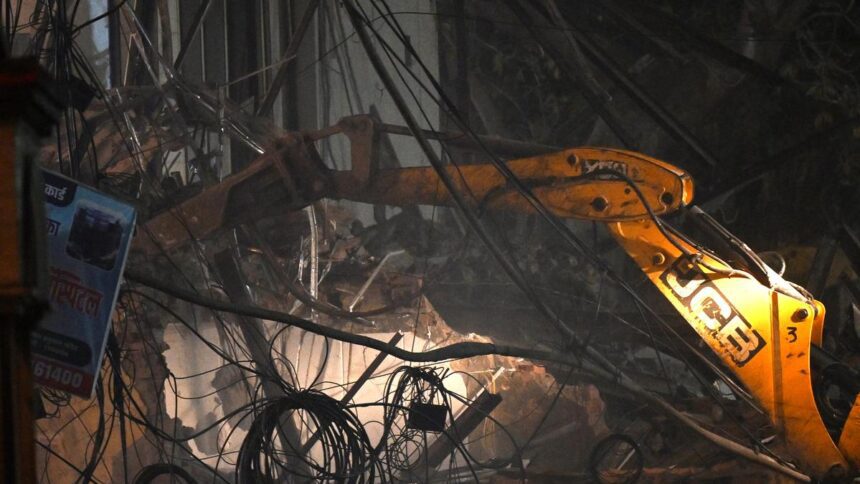

A recent demolition drive in Delhi’s Turkman Gate area has unearthed deep-rooted tensions around issues of legality, civic rights, and community identity, particularly concerning the local Muslim population. The operation, which targeted a mosque and other structures, led to protests and demonstrated a climate of fear and social exclusion prevalent in many urban localities.
Demolition Sparks Tensions in Turkman Gate
An uneasy calm descended on the Ramlila Maidan area following the early morning demolition of the Faiz-e-Ilahi mosque carried out by the Municipal Corporation of Delhi (MCD) and police. As security was tightened and barricades restricted local movement, an immediate sense of apprehension gripped residents, many of whom feared for their safety.
Shops in the area remained closed as locals attempted to navigate this heightened state of alert. One resident, Azim Ansari, a local shopkeeper, expressed his concerns by saying, “I couldn’t open my shop today as I decided to stay with my family in case the situation escalates.” This sentiment underscores a broader atmosphere of uncertainty faced by many in the community.
Fear, Confusion, and Community Response
Reports of panic were fueled by instances such as a burqa-clad woman who was seen distraught near a barricade, searching for her missing children. The swift action of locals and police, who ultimately located the children, only momentarily alleviated the tension. “If there was court intervention and the next date has been given in April, what was the hurry?” asked Mohammad Sadiq, a concerned resident, expressing the collective bewilderment at the demolition’s timing.
The local community is reeling from the impact of these events. The leaders of the area’s Aman (peace) committee have actively disavowed violence and stone-pelting accusations. Shehzad Khan, a committee member, emphasized the mosque’s long-standing presence and the community’s intent to seek legal redress rather than engage in conflict. “We will work to ensure peace while the government does its job,” he stated, reflecting a desire for coexistence amid adversity.
Legal Battles and Persistent Marginalization
The demolition carries larger implications for the Muslim populace in India, a group that has historically been subjected to various forms of discrimination and marginalization. This incident demonstrates ongoing challenges related to legal frameworks that frequently come into play against minority religious structures. The question of legality versus community rights surfaces repeatedly in residential areas with mixed demographics, leading to heightened tensions.
The rapid decision-making around demolition only compounds fears of economic and social exclusion of the local Muslim community. “This is our identity,” argues a local elder, further indicating the deep connection between the community’s historical presence and their socio-economic conditions. As people gather outside their homes discussing the unfolding events, voices of concern surface, underlining a collective anxiety regarding future civic rights.
Why It Matters
The recent demolition operation not only spotlights systemic discrimination faced by Indian Muslims but also highlights the broader socio-political climate in which such actions take place. Understanding these dynamics is crucial for policymakers and civil society, as they seek to foster equitable resolutions that respect community rights while maintaining public order. The episode illustrates the fragility of social cohesion in increasingly polarized societies and serves as a case study for observers interested in community resilience amidst rupture.
Frequently Asked Questions
What triggered the demolition in Turkman Gate?
The demolition was initiated by the Municipal Corporation of Delhi alongside police following claims regarding the illegal status of certain structures, including the Faiz-e-Ilahi mosque.
What has been the response from the local community?
Residents have expressed fear and confusion, citing a tense atmosphere. Many businesses temporarily closed in response to escalating concerns about safety and community identity.
How have community leaders reacted to the accusations of violence?
Local leaders, particularly from the Aman committee, have categorically denied involvement in violence, emphasizing their commitment to peaceful resolution through legal means rather than conflict.
What larger issues does this incident illustrate regarding minority rights in India?
This incident reflects ongoing patterns of social exclusion and marginalization faced by Muslims in India, raising questions about legal rights versus religious and community identities in urban planning contexts.