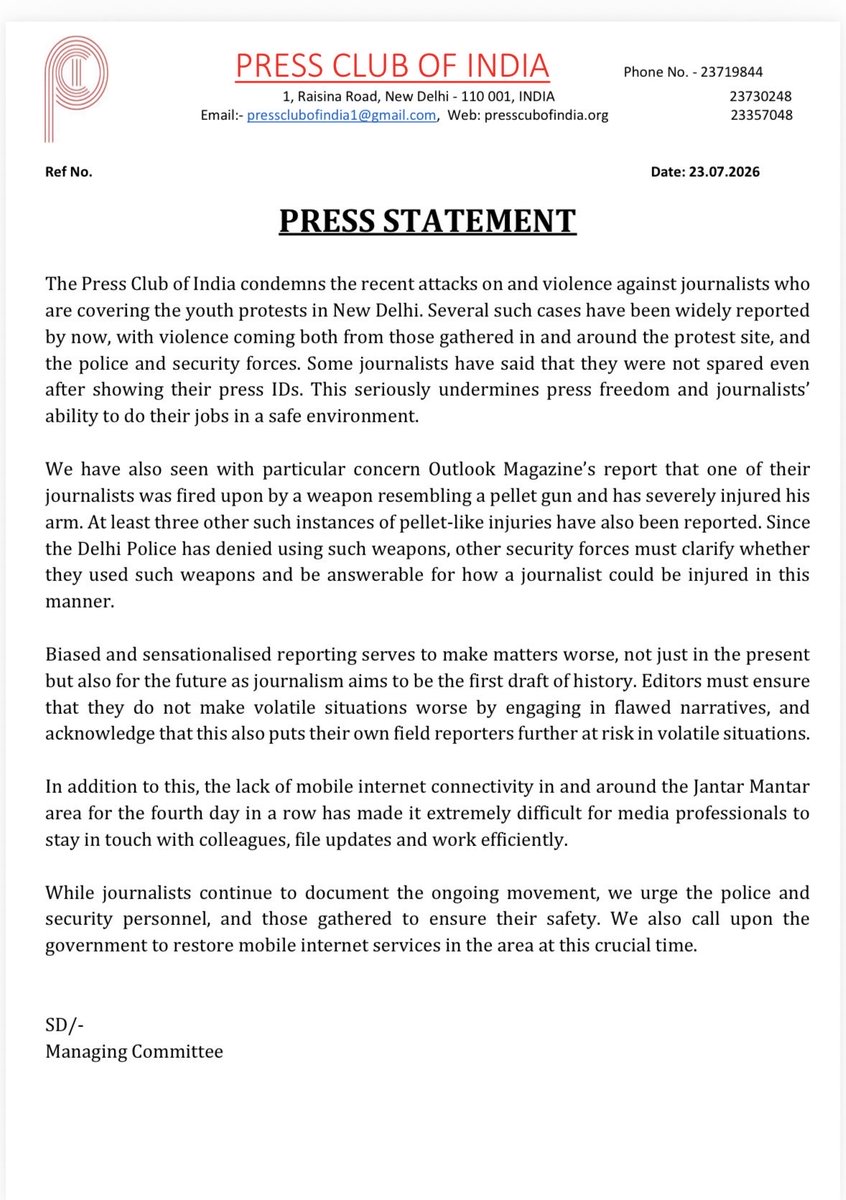

The Press Club of India has condemned the recent violent attacks on journalists covering youth protests in New Delhi, with specific focus on a journalist from @Outlookindia who suffered serious injuries from a pellet-like weapon. The organization has called for urgent action to ensure the safety of reporters and restore mobile internet services in affected areas during this critical time.
Escalation of Violence Against Journalists
In recent days, New Delhi has witnessed significant unrest as youth protests gain momentum. This surge in activism has unfortunately drawn violence not only from the authorities but also from unpermitted groups targeting journalists. The incident involving the @Outlookindia journalist has highlighted the dangers associated with covering these protests, as he was reportedly shot with a weapon resembling a pellet gun, leading to serious injuries. This incident is not isolated; at least three other instances of similar pellet-like injuries have been documented, reflecting a broader trend of hostility against media personnel.
The Role of Law Enforcement
The involvement of law enforcement in these violent episodes raises questions about the protection of journalists. The Press Club of India has urged police and security personnel to take immediate measures to safeguard reporters who are putting themselves at risk to cover the ongoing protests. The expectation is clear: law enforcement is obligated to protect all citizens, including journalists who serve a critical function in democracy by bringing transparency to significant social issues.
The Demand for Mobile Internet Restoration
Another pressing issue raised by the Press Club of India is the shutdown of mobile internet services in the impacted regions. This disruption not only hampers the dissemination of information but also restricts the ability of journalists and activists to communicate and report effectively. In an era where digital communication is vital, the government’s actions to suspend mobile internet services have prompted concerns regarding censorship and the right to information. The call for restoration reflects a broader demand for maintaining open lines of communication amidst civil unrest.
Why This Matters
The current situation surrounding these youth protests and the associated violence against journalists is significant for Indian politics for several reasons. First, it highlights the fragile state of press freedom in the country, raising alarms over the safety of journalists who serve as the watchdogs of democracy. Second, the crackdown on communication tools such as mobile internet poses a threat to the fundamental rights of citizens to access information and to communicate freely. Finally, the government’s response to these protests, through both violence and censorship, may have lasting consequences for its relationship with the youth and civil society at large, potentially impacting future elections and policy discussions.
Frequently Asked Questions
What sparked the youth protests in New Delhi?
The youth protests were ignited by various social and political issues concerning the rights and future of young people in India. Concerns around unemployment, education policies, and the government’s handling of dissent have fueled public discontent.
What is the significance of the Press Club of India’s condemnation?
The Press Club of India’s condemnation represents a collective concern regarding the safety of journalists and the need for accountability from law enforcement. It amplifies the call for protecting press freedom and highlights the critical role of media in informing the public during tumultuous times.
How has the government responded to the protests and violence against journalists?
The government’s response has included violent crackdowns on protests and the suspension of mobile internet services, which they argue is necessary for maintaining order. However, critics view these actions as a means to suppress dissent and limit freedom of expression.
What can be expected in the future regarding protest movements in India?
Given the ongoing tensions, it is likely that protests may continue as various social groups rally for their rights. The government’s approach to handling dissent will play a crucial role in determining whether these movements gain more traction or face further suppression.