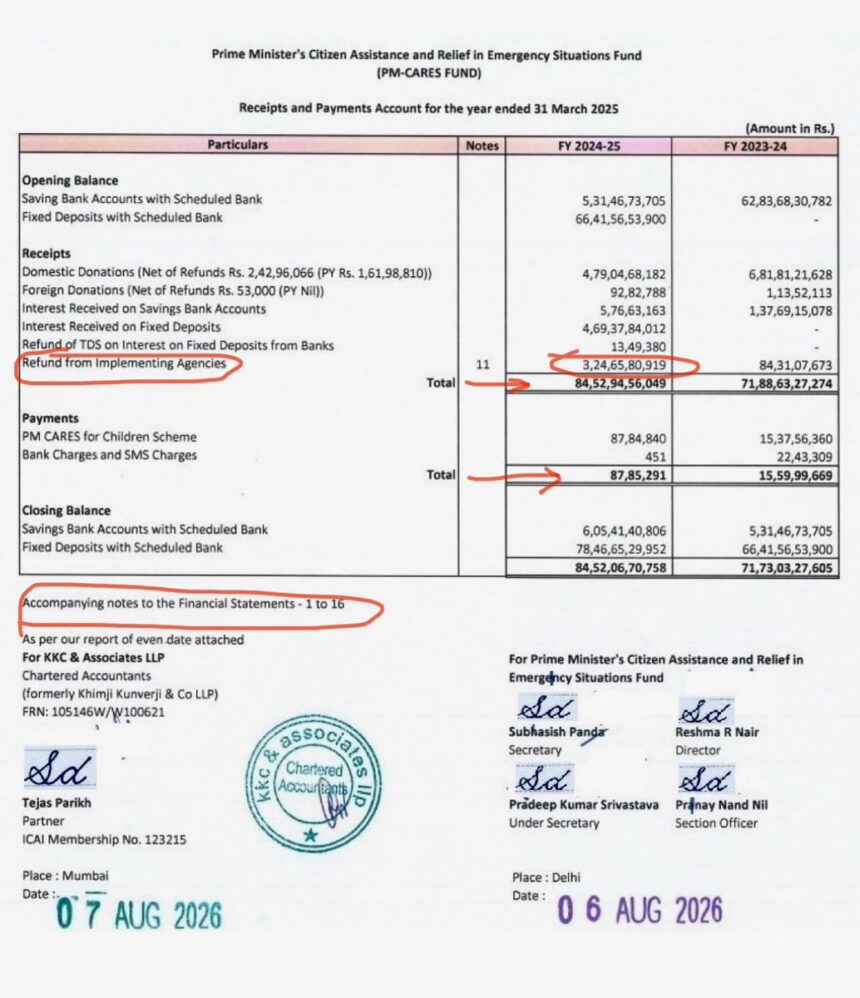

The recently released audit statement of the PMCARES Fund for the fiscal year 2024-25 has raised several critical concerns about its management and transparency. The report reveals that only a mere 0.01% of the available ₹8,452 crore has been utilized, sparking questions about the fund’s significant idle resources aimed at aiding citizens during crises.
Utilization and Unexplained Refunds
The PMCARES Fund, established to facilitate assistance during various disasters, shows an alarming trend in its financial management. With ₹8,452 crore at its disposal, the utilization rate stands at a dismal 0.01%. Critics wonder why such substantial allocations remain unspent, especially when the nation faces ongoing emergencies that require funding and support.
Further complicating the narrative is the reported ₹324 crore that was refunded by implementing agencies. The audit does not provide clarity on the reasons behind these refunds. Questions arise as to whether these refunds are linked to improper expenditures, possibly to circumvent scrutiny over faulty equipment or inadequate services delivered under the fund’s purview. The absence of specific details regarding which agencies issued the refunds only amplifies concerns about accountability.
Lack of Transparency
The lack of accompanying notes to the audit report is both puzzling and troubling. Typically, these notes provide crucial context and further explanation regarding financial activities, allocation decisions, and management strategies. By withholding such information, the PMCARES Fund perpetuates an environment of opacity, making it challenging for the public to hold it accountable.
Despite having attracted substantial contributions from both domestic and foreign sources, the fund’s revenue sources remain largely undisclosed. The refusal to submit itself to the Right to Information (RTI) Act further entrenches this secrecy, limiting public access to essential information regarding fund management and allocations.
Public Sentiment and Trust
This lack of transparency and accountability not only raises eyebrows among political commentators and economists but also fuels public skepticism. Since its inception, the PMCARES Fund has faced scrutiny regarding its operational protocols and governance structure. As citizens witness ongoing humanitarian crises, they are increasingly questioning the effectiveness of a fund meant to safeguard their interests yet operates shrouded in secrecy.
In the context of a democracy, citizens have the right to inquire about state actions and to ensure that funds allocated for their well-being are utilized effectively. The persistent lack of clarity can erode trust in governmental institutions, making it crucial for the PMCARES Fund to adopt more rigorous transparency measures.
Why This Matters
The political implications of the PMCARES Fund’s audit findings are profound. As the fund continues to gather large sums while failing to provide meaningful support during crises, it poses questions about governance and accountability in India. This situation may further provoke public sentiment against the current administration, portraying a stark contrast between intended welfare outcomes and actual organizational efficacy. The refusal to comply with transparency laws like the RTI Act can incite greater demands for accountability, possibly influencing electoral dynamics and public trust in state institutions. As the populace demands a thorough investigation into the fund’s operations, the political ramifications could affect upcoming elections and ultimately challenge the ruling party’s legitimacy.
Frequently Asked Questions
What is the PMCARES Fund?
The PMCARES Fund is a public charitable trust established in March 2020 to provide relief and support during disasters, including the COVID-19 pandemic.
Why is only 0.01% of the fund utilized?
The audit indicates a lack of effective spending. Reasons for the minimal utilization rate haven’t been clearly articulated, which raises concerns about fund management.
What details are missing regarding the refunded ₹324 crore?
The audit report does not specify which agencies made the refunds or the reasons behind them, leading to questions about accountability and the nature of the expenditures involved.
Why isn’t the PMCARES Fund subject to the RTI Act?
The fund operates as a public charitable trust but has thus far opted not to submit itself under the RTI Act, limiting public access to information about its operations and finances.