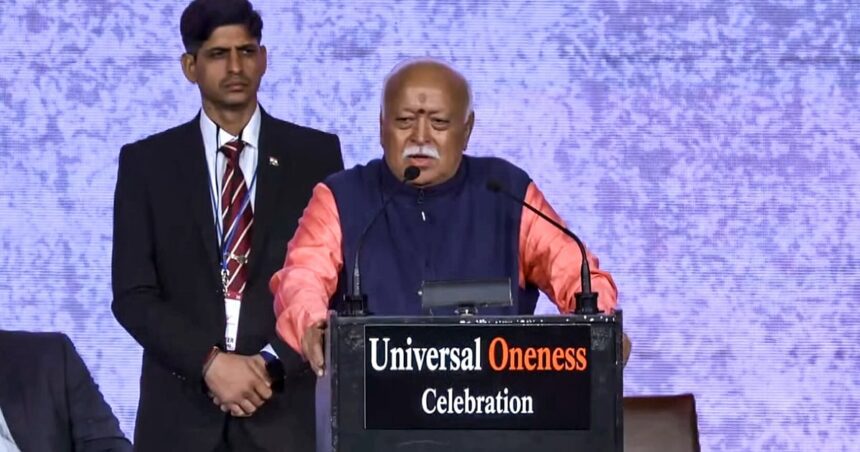

The controversy surrounding RSS chief Mohan Bhagwat’s recent remarks during his visit to the United States has reignited debates on the treatment of Muslims in India, highlighting the stark contrast between his statements abroad and the ongoing discrimination faced by minority communities at home.
Political Reactions to Bhagwat’s Remarks
During his address to the Indian-American community in New York, Bhagwat underscored the importance of unity in diversity, asserting that any Hindu who advocates for the exclusion of Muslims from India “will not remain a Hindu.” Despite these sentiments, the Opposition, including leaders from Congress, Trinamool Congress, AAP, and others, accused him of “doublespeak,” questioning why he refrains from expressing similar views within India.
Rajya Sabha MP Kapil Sibal remarked on the disparity between Bhagwat’s acceptance of diversity abroad and the alleged intolerance promoted by the RSS and its associated organizations within India. Congress spokesperson Shama Mohamed echoed this sentiment, alleging that the RSS perpetuates a narrative steeped in hatred and communalism.
Allegations of Discrimination Against Muslims
Opposition leaders have criticized the BJP for its role in fostering an environment where Muslims face systemic discrimination. AAP’s Saurabh Bharadwaj suggested that Bhagwat should communicate his advocacy for diversity to influential BJP leaders, many of whom have been accused of inciting communal tensions.
Leaders like AIMIM’s Asaduddin Owaisi have expressed skepticism, suggesting that the RSS maintains a bifurcated narrative—one for international audiences and another for its domestic base. This inconsistency in messaging raises questions about the organization’s commitment to inclusivity and how it regulates the actions of its affiliate groups, which are often implicated in acts of violence against Muslims.
The BJP’s Response and Defense
In contrast, BJP leaders defended Bhagwat’s remarks. Maharashtra Chief Minister Devendra Fadnavis emphasized that the essence of Hindutva lies in tolerance, stating that India’s civilization has historically accommodated diverse communities. Several BJP members praised Bhagwat for countering negative perceptions of Hinduism and promoting a narrative of inclusivity on a global platform.
However, critics argue that the sentiments expressed abroad must translate into concrete actions at home. Instances of violence and discrimination against Muslims, including the demolition of homes and attacks during religious celebrations, undermine claims of tolerance purported by BJP leaders. Such actions are cited as evidence of systemic exclusion faced by Indian Muslims, drawing attention to the urgent need for accountability.
Why It Matters
This ongoing debate about the treatment of Muslims in India is significant not only for the country’s social fabric but also for its global image as a democracy. The dichotomy between the rhetoric of unity abroad and the realities of discrimination at home places India at a crossroads regarding its commitment to human rights and social justice. In an interconnected world, the treatment of minorities impacts international perceptions of India, potentially affecting diplomatic relations and economic partnerships.
Frequently Asked Questions
What did Mohan Bhagwat say in New York?
Mohan Bhagwat stated that diversity must be celebrated, and any Hindu believing that Muslims should not reside in India is not truly adhering to Hindu principles.
How did the Opposition respond to Bhagwat’s remarks?
Opposition leaders criticized Bhagwat, claiming he engages in “doublespeak” by promoting tolerance abroad while enabling a culture of discrimination at home.
What actions are being alleged against the BJP and RSS regarding Muslims in India?
The BJP and RSS have been accused of fostering an environment in which violence against Muslims is tolerated, including communal riots and systemic discrimination practices.
What is the impact of Bhagwat’s comments on India’s international standing?
Bhagwat’s remarks contribute to the ongoing debate about India’s stance on human rights, particularly the treatment of minorities, which is crucial for maintaining equitable international relations.