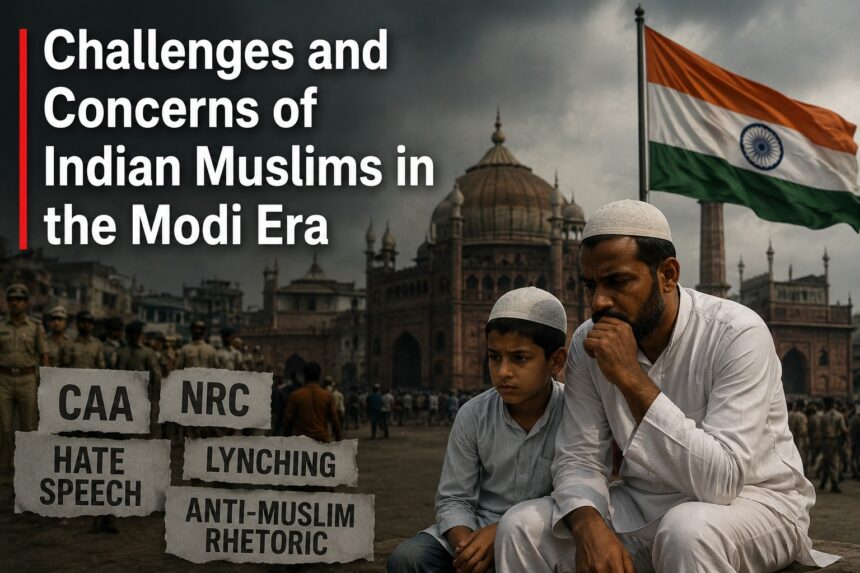

Recent actions by the BJP government in India against the Muslim community have resulted in significant social, economic, and political marginalization. This growing sense of insecurity raises concerns about constitutional rights, religious freedoms, and equal citizen status for Muslims, prompting a call for collective action among community leaders.
Historical Context of Discrimination
Since India gained independence in 1947, Muslims have faced various forms of discrimination, but the challenges have escalated notably in recent years, particularly after the BJP assumed control in 2014. The community has frequently been the target of communal riots, with historical precedents set in the 1960s during large-scale anti-Muslim violence in states like Madhya Pradesh and Bihar. The Congress party’s initial promises of equality and protection under India’s secular Constitution have increasingly been overshadowed by growing anti-Muslim sentiments and actions. This historical context sets the stage for understanding the contemporary issues at hand.
Current Climate of Exclusion and Marginalization
Under the leadership of Prime Minister Narendra Modi and the BJP, Muslims have faced increased marginalization through legislative and administrative actions. Instances of mosque demolitions have surged, with estimates indicating hundreds of mosques facing destruction under the pretext of illegal construction. Educational institutions—often run by Muslim organizations—are also under scrutiny, with reports of arrests and government interventions that disproportionately target Muslim-run establishments. Such systematic actions reflect an ideological framework that seeks to delineate boundaries for Muslim participation in India, akin to the theory of Hindutva proposed by figures like V.D. Savarkar.
Rise of Hostile Narratives
The narrative surrounding Muslims in India has shifted towards one of hostility, driven in part by inflammatory rhetoric from BJP leaders and the normalization of hate speech in political discourse. The emergence of mob lynching as a new form of violence has been particularly alarming, corroborated by reports of multiple killings linked to accusations of beef selling or cow smuggling. This wave of violence has instilled fear amongst Muslims, compelling many to confront a deteriorating societal landscape where they are often viewed as second-class citizens. The government’s failure to acknowledge these injustices further exacerbates feelings of vulnerability among the Muslim community.
Why It Matters
The sociopolitical dynamics affecting Indian Muslims extend beyond national borders and impact international relationships, particularly with Muslim-majority nations. Furthermore, the erosion of constitutional rights for any community challenges the foundational values of democracy, justice, and equality that India espouses. As digital platforms facilitate discussions of these issues globally, clarity on these developments is essential for audiences interested in social justice, governance, and human rights.
Frequently Asked Questions
What systemic issues do Indian Muslims face under BJP rule?
Indian Muslims encounter issues including mosque demolitions, restrictions on educational institutions, and increasing instances of mob violence, which contribute to a fear of disenfranchisement.
How has the BJP government’s approach changed since 2014?
The BJP has adopted a more aggressive stance towards Muslims, implementing policies and engaging in rhetoric that marginalizes this community, contrasting with previous governments that maintained a facade of neutrality.
What is the significance of the All India Muslim Majlis Mushawarat (AIMMM)?
AIMMM emerged in the 1960s as a response to communal violence, serving as a platform for Muslim leaders to unite and advocate for the community’s rights during crises, which is now more critical than ever in light of the ongoing challenges faced by Muslims under the current government.
How are community leaders responding to the situation?
Muslim leaders recently convened in Delhi to address the systemic discrimination and strategize ways forward, highlighting a collective effort to defend their constitutional rights and assert their place in Indian society.