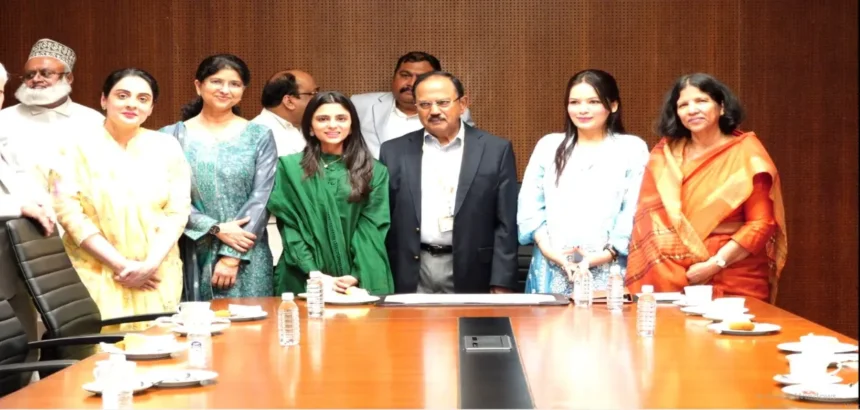

In a recent meeting, National Security Advisor Ajit Doval engaged with Indian Muslim community leaders to emphasize inclusion and opportunities for Muslim individuals, particularly in the armed forces. His comments underline both progress and persistent challenges related to discrimination, social exclusion, and marginalization faced by Muslims in India under the current government.
Engaging with the Community
Ajit Doval’s interaction with members of the Muslim community included prominent figures such as Naima Khatoon, Vice Chancellor of Aligarh Muslim University, and various educationists, social workers, and industrialists. During the meeting, Doval mentioned that a significant number of Muslim youths have been enlisted in the Army and paramilitary forces in the last twelve years, asserting that this reflects an absence of bias in government job recruitment.
While acknowledging the rights of the Muslim community to critique governmental policies, Doval cautioned against doubting the government’s intentions. He noted that challenges in securing government employment might stem from broader socioeconomic issues rather than systemic discrimination. This perception raises critical questions about the balance between acknowledging community grievances and framing them as part of larger economic factors.
Identity and Inclusion
Doval urged members of the Muslim community to embrace multiple facets of their identity and to refrain from experiencing their identity through a singular, religious prism. He posited that such a perspective may lead to a misguided sense of victimhood, limiting broader social engagement. This call for nuanced identities tackles the ongoing narrative of alienation many minority communities face in contemporary India.
Within this context, Doval proposed the idea of fostering dialogue and engagement across communities, particularly in periods of mistrust. He emphasized that an exclusive focus on a singular identity can hinder societal integration and economic opportunities for the community as a whole. The overarching narrative appears aimed at curtailing the feelings of exclusion while inviting Muslim leaders to actively participate in a national dialogue.
Challenges Persisting Under Current Policies
Despite Doval’s remarks on inclusivity, significant concerns about systemic discrimination against Muslims remain. Issues such as housing shortages, especially in regions governed by the Disturbed Areas Act, continue to pressure Muslim communities. Zafar Sareshwala, an educationist who attended the meeting, acknowledged how this legislation restricts property transactions across religious lines, thereby exacerbating economic difficulties.
Furthermore, Dr. Zahir I. Kazi, a Padma awardee and leader of Anjuman-I-Islam, highlighted constraints imposed by the Foreign Contribution Regulation Act (FCRA), which hampers institutional access to educational grants from Gulf countries. Both Sareshwala and Kazi’s observations spotlight the stark contrast between governmental rhetoric around empowerment and the practical, systemic barriers that hinder Muslim socio-economic advancement.
Why It Matters
This dialogue reflects broader trends of political engagement and identity struggles in India’s multi-religious society. The Government’s initiatives aimed at integrating Muslim communities into national frameworks can have varying effects on the community’s perception of governance. While it promotes inclusion at a rhetorical level, ongoing socio-political issues continue to impact daily lives. Acknowledging these factors is pivotal, as they can inform future political strategies, foster community dialogues, and enhance social cohesion.
Frequently Asked Questions
What actions has the Indian government taken to recruit more Muslim youth in the armed forces?
The Indian government has implemented policies aimed at increasing recruitment from diverse backgrounds in the armed forces, reporting significant enlistment of Muslim youth in recent years.
What are the main barriers to employment for Muslims in India?
Main barriers include economic challenges, social mobility issues, and restrictive laws like the Foreign Contribution Regulation Act (FCRA), which affects access to educational grants and economic opportunities.
How has the Disturbed Areas Act affected the Muslim community in Gujarat?
The Disturbed Areas Act limits inter-community property transactions, leading to housing shortages and reinforcing socioeconomic inequalities within Muslim-majority areas in Gujarat.
What role do conversations about identity play in these discussions?
Conversations around identity are crucial as they highlight the struggles of Muslim communities, advocating for a multifaceted identity that promotes integration rather than isolation.