
Summary of the Controversy
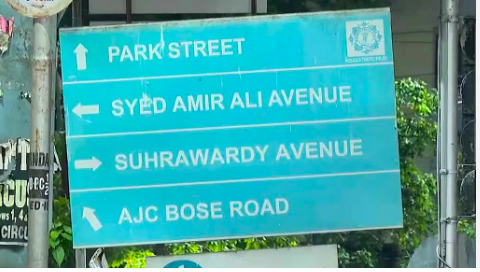
The renaming of a prominent street in Kolkata from Suhrawardy Avenue to Gopal Mukherjee Road has ignited a significant debate over historical representation and the erasure of Muslim figures from Indian public memory. Defended by the BJP-led government as a correction of a supposed historical wrong, the change is criticized by historians and political leaders who assert that it is a misunderstanding of historical facts.
The Name Change and Its Justification
The Kolkata Municipal Corporation, under the leadership of the BJP, announced the renaming of Suhrawardy Avenue to Gopal Mukherjee Road. Chief Minister Suvendu Adhikari defended the decision by claiming the avenue was named after Huseyn Shaheed Suhrawardy, the final Prime Minister of undivided Bengal, thus suggesting the renaming rectifies a “historical wrong.” This justification reflects a broader narrative often used by the BJP to question and redefine historical events and figures.
Historical Clarification and Opposition Response
Historians and political opposition, including Congress leader Pawan Khera and representatives from the CPI(M), quickly refuted Adhikari’s claims. They clarified that the avenue was actually named after Hassan Shahid Suhrawardy, an esteemed educationist and art historian, not his relative who later became a figure in Pakistan. Critics argue that this conflation exemplifies a troubling trend in contemporary Indian politics where historical ignorance is leveraged to shape public sentiment and policy.
Controversial Figure: Gopal Mukherjee
The decision to rename the road after Gopal Mukherjee has rekindled discussions about his legacy. Described historically as a prominent Hindu leader during the deadly communal violence in Bengal in 1946, Mukherjee played a pivotal role in rallying armed groups for retaliatory measures against Muslims. His legacy is contentious, eliciting mixed reactions based on the violent and divisive context of his actions, contrasting sharply with the more inclusive legacies associated with the figures being erased from public discourse.
Why It Matters
This incident reflects a growing trend of historical reinterpretation and the politics of naming in India, with implications for the country’s broader socio-political landscape. The erasure of Muslim historical figures, often justified under nationalism, poses a risk to communal harmony and societal cohesiveness. Such actions spark debates that resonate beyond state boundaries, drawing international attention to issues of discrimination, marginalization, and the ongoing struggle for representation among Indian Muslims. This scenario underscores the importance of accurate historical narratives in shaping cultural identity and fostering inclusive public spaces.
Frequently Asked Questions
What prompted the renaming of Suhrawardy Avenue?
The Kolkata Municipal Corporation renamed the street in an effort to correct what the BJP-led government described as a “historical wrong.” However, this claim has been contested by historians and opposition leaders.
Who was Hassan Shahid Suhrawardy?
Hassan Shahid Suhrawardy was a celebrated educationist, art historian, and former Vice-Chancellor of the University of Calcutta, distinct from Huseyn Shaheed Suhrawardy, who was involved in the politics of undivided Bengal and later Pakistan.
What is Gopal Mukherjee’s role in Bengal’s history?
Gopal Mukherjee was a controversial figure known for leading armed Hindu groups during the 1946 communal violence in Bengal, advocating for retaliatory attacks against Muslims, which has resulted in mixed assessments of his legacy.
Why is this renaming significant for Indian Muslims?
This renaming reflects a broader trend of erasing Muslim contributions from public spaces, symbolizing systemic marginalization and igniting discussions about historical accuracy and representation in contemporary India.