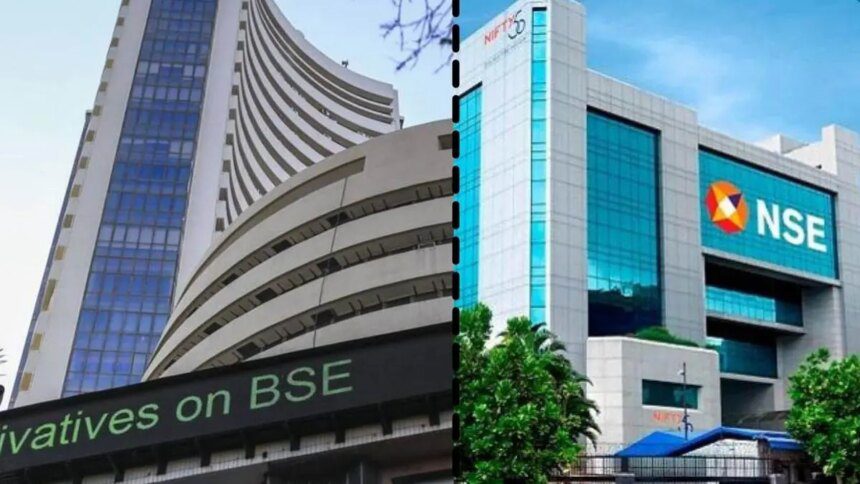

Broader markets drew significant attention on Tuesday, despite benchmark indices facing setbacks. The Nifty Midcap 100 reached a record high of 62,365.25, even as Taiwan surpassed India in market capitalization, shifting India to the sixth spot.
The Sensex concluded down 479 points, or 0.63 percent, at 76,009.70, while the Nifty dropped 118 points, or 0.49 percent, settling at 23,913.70, slipping below the 24,000 mark it had regained just a session prior. The index peaked at an intraday high of 24,089.80 before sellers took control, dragging it to a low of 23,885.45 before a slight recovery occurred.
According to Bloomberg data, Taiwan, boasting a market capitalization of $4.95 trillion, edged out India at $4.92 trillion for the fifth position, following the US, China, Japan, and Hong Kong. The rally for Taiwan was driven largely by semiconductor giant Taiwan Semiconductor Manufacturing Co.
Contract expirations contributed to market volatility on the NSE and BSE, with May contracts on the NSE expiring on Tuesday and those on the BSE set to expire on Wednesday.
The Nifty Midcap 100 index finished 0.54 percent higher at 62,299, while the Smallcap 100 increased by 0.4 percent. Ajit Mishra, Senior Vice President of Research at Religare Broking, noted that renewed US military engagement in the Middle East dampened market sentiment, pushing Brent crude prices back toward the $98 per barrel level.
Despite the turbulence in the main indices, the Nifty Midcap 100 hit an all-time high, buoyed by growth-oriented stocks such as Adani Total Gas, Exide Industries, Naukri, KPIT, and JSW Energy. Siddhartha Khemka, Head of Research at Motilal Oswal Financial Services, observed that resilience in broader markets amid global uncertainties reflects ongoing domestic liquidity participation.
Sudeep Shah, Head of Technical and Derivatives Research at SBI Securities, emphasized that the ratio charts for Midcap and Smallcap indices relative to the Nifty are trending higher, indicating structural outperformance. The Midcap 100’s price-to-earnings ratio currently stands at 29.94 with a price-to-book ratio of 4.88. The index has appreciated by 9.17 percent over the last year and 143.68 percent over five years.
The Indian rupee also faced downward pressure, falling approximately 45 paise to close at 95.68 against the dollar after a three-day winning streak. The movement of USD/INR back above the ₹95.5 mark raised concerns about India’s import bill and inflation trajectory. In the bullion market, MCX Gold declined by around ₹900 to approximately ₹1,58,150, influenced by geopolitical uncertainty and a stronger dollar, after repeatedly failing to break the ₹1,61,000 resistance level.
In sector performance, metal stocks led the session’s gains, supported by rising global commodity prices in aluminium, copper, and zinc, with the Nifty Metal index rising over 1.2 percent. Stocks like Hindalco, Vedanta, and Lloyds Metals attracted institutional interest. The Nifty Energy sector also closed positively, while banking stocks, particularly private lenders such as Axis Bank and Kotak Mahindra Bank, faced pressure from expiry-related selling and liquidity concerns. Consumer durables and the realty sector also ended lower.
Elevated crude prices over the past fortnight have influenced increases in petrol, diesel, and CNG prices, with petrol and diesel rising cumulatively by ₹8-10 per litre in several cities, and CNG in Delhi now priced at around ₹83 per kg. Fuel-dependent sectors, including aviation, logistics, paints, and cement, face ongoing cost pressures, while oil marketing companies risk margin compression should crude prices remain high.
Khemka suggested that a gradual upward trend in domestic markets might continue if crude oil prices soften. However, mixed signals from US-Iran negotiations and developments in the Strait of Hormuz are maintaining heightened sensitivity in energy markets amidst geopolitical developments.
Looking ahead, upcoming US Core PCE inflation and GDP data are expected to influence Federal Reserve rate expectations, which in turn could affect the direction of the dollar, along with gold and risk appetite in emerging markets.
Published on May 26, 2026.