
Discontent Among Muslim Women Over Madhya Pradesh’s Uniform Civil Code
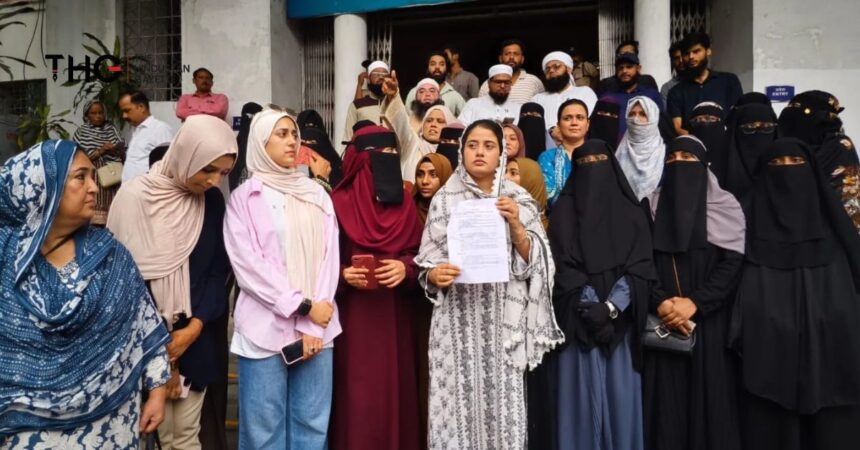
In a significant statewide mobilization, Muslim women in Madhya Pradesh protested against the recently passed Uniform Civil Code (UCC) Bill, submitting memorandums in 50 districts addressed to President Droupadi Murmu. This collective action, organized by Congress MLA Arif Masood and the All India Muslim Personal Law Board (AIMPLB), emphasizes the community’s deep concerns regarding the implications of the UCC on their religious freedoms and personal laws.
Protests and Community Concerns
The demonstrations came in response to a narrative suggesting that Muslim women supported the UCC, a claim that has been strongly contested. Anas Ali, part of Masood’s team, stated the purpose of the protests was to contradict that narrative, arguing instead that Muslim women are deeply concerned about the implications of this bill on their rights. “Masood had called for women to hold strong protests because it was being suggested that Muslim women were happy with the bill,” Ali explained, highlighting the community’s dissatisfaction.
The UCC Bill, which has passed through the assembly and is awaiting the governor’s assent, aims to standardize laws governing marriage, divorce, and inheritance across all communities, sparking fears among Muslim women that their personal laws would be jeopardized. The demonstrators, in their memorandums, underscored that the Constitution of India guarantees the protection of religious freedoms, emphasizing Articles 14, 21, 25, 26, 29, and 30.
Legal and Cultural Implications of the UCC
The memorandums submitted to the President articulated concerns that changes to Muslim Personal Law could infringe upon the community’s right to religious freedom. These laws historically govern critical family matters, and any alterations could undermine the cultural and familial integrity of the Muslim community. The protesters also invoked Article 44 of the Constitution, which deals with the UCC as part of the Directive Principles of State Policy, noting that its implementation is not directly enforceable.
Drawing upon the 21st Law Commission’s 2018 report, which suggests a more nuanced approach to reforming personal laws instead of enforcing a uniform code, the women demanded that the UCC not apply to Muslim personal laws, similar to the exemptions enjoyed by Scheduled Tribes and other special groups. This call for exemption underscores a broader quest for preserving cultural and religious identities in India’s multi-religious tapestry.
Future of the Movement Against UCC
Addressing the media, Masood reported strong participation from women across various districts, marking the protests as just the initial phase of a sustained movement against the UCC. He stressed that the Muslim community would continue to advocate for rights protected under their personal laws. “The struggle to protect these constitutional rights will continue,” Masood affirmed, indicating that a series of demonstrations and organized protests are planned as part of a broader campaign to challenge the UCC.
The Madhya Pradesh Legislative Assembly’s decision to pass the UCC Bill, despite dissent from opposition parties, signifies a growing trend under the current BJP-led government towards standardizing personal laws, which critics argue disproportionately affects marginalized communities like Muslims. The implications of such legal changes could further entrench social exclusion and discrimination against Muslim communities in India.
Why It Matters
The unfolding situation in Madhya Pradesh illustrates a pivotal moment in India’s socio-political landscape, particularly regarding religious freedoms and minority rights. The UCC, while presented as a measure for equality, raises critical questions about cultural identity and the rights of diverse communities within a pluralistic society. For developers and businesses, understanding these dynamics is crucial, as social stability influences market conditions, consumer behavior, and workforce demographics. The pushback against the UCC also highlights the importance of inclusive policy-making that respects the multifaceted identities of Indian citizens.
Frequently Asked Questions
What is the Uniform Civil Code (UCC)?
The UCC aims to replace personal laws based on the scriptures and customs of each major religious community in India with a common set governing every citizen, addressing legal matters such as marriage, divorce, and inheritance.
Why are Muslim women opposing the UCC in Madhya Pradesh?
Muslim women oppose the UCC because they fear that it threatens their personal laws governing essential family matters and infringe upon their religious freedoms, which are protected by the Constitution of India.
What are the constitutional articles mentioned in the protests against the UCC?
The protesters referenced Articles 14, 21, 25, 26, 29, and 30 of the Indian Constitution, which collectively emphasize the protection of personal rights, cultural identity, and religious freedom.
What future actions are planned against the UCC?
Congress MLA Arif Masood has indicated that the protests are only the first phase of a broader movement, with future demonstrations and organized actions planned to continue opposing the UCC.