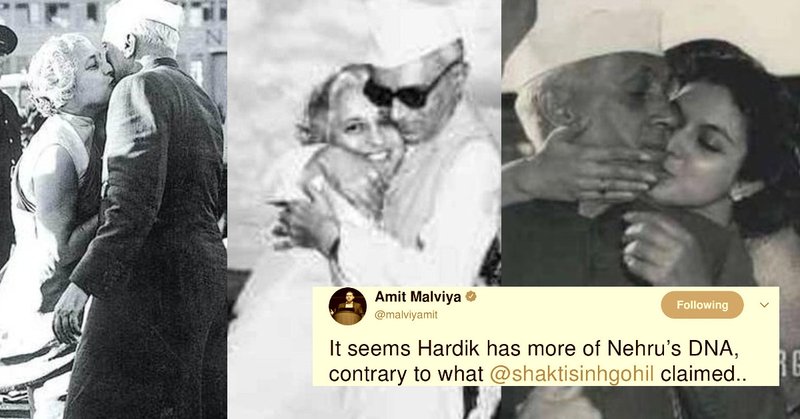

Recent discussions have resurfaced around affectionate photographs of Jawaharlal Nehru, showcasing him with his sister Vijaylakshmi Pandit and his niece Nayantara Sehgal. Despite the evident familial context, these images have been used misleadingly by certain political factions to draw connections between Nehru and contemporary political figures, notably Hardik Patel.
Contextualizing the Photos
The two images in question depict Nehru receiving affectionate gestures from family members. One image features his sister Vijaylakshmi Pandit giving him a peck on the cheek, while the other shows his niece Nayantara Sehgal kissing him upon his arrival at London airport in 1955. The presence of Pandit, who was serving as the High Commissioner to the UK at that time, highlights the familial nature of these interactions.
However, in a politically charged environment, such pictures have been misappropriated by some commentators to suggest deeper connections between family lineage and political heritage. For instance, BJP’s IT cell head Amit Malviya recently shared these photos with claims tying Hardik Patel’s lineage to Nehru. This raises questions about the selective interpretation of history being used in present-day political discourse.
The Role of Political Commentary
The political landscape in India is fraught with shifts and tensions that often see historical figures and their legacies invoked to justify modern political claims. In this scenario, Malviya’s comments seem aimed at echoing BJP’s narrative of lineage and legitimacy, suggesting that Hardik Patel, a prominent figure in contemporary politics, could be linked to Nehru’s legacy based on mere familial resemblance or affection depicted in these images.
This tactic has been recognized as a long-standing approach used by various factions within the BJP and RSS, with the goal of reshaping public perception regarding political families and their histories. Despite the enduring nature of these claims, they often overlook the comprehensive historical and familial contexts, focusing instead on image curation to serve modern political narratives.
The Historical Legacy of Nehru
Jawaharlal Nehru remains one of India’s most significant historical figures, serving as the nation’s first Prime Minister post-independence. His tenure was marked by efforts to forge a secular, democratic state and to promote educational and technological advancements in a newly independent India. The personal connections showcased in the photos do not only reflect affection but also symbolize a collective family legacy intertwined with India’s political evolution.
Thus, while the images of Nehru with his family members might appear innocuous at first glance, utilizing them for political gain presents a simplified and often skewed interpretation of history. Indian voters and citizens must critically examine how images and narratives are used in political rhetoric to shape contemporary identity and allegiance.
Why This Matters
The manipulation of historical images for political rhetoric has significant implications. It not only affects the understanding of past legacies but can also polarize public opinion based on misleading associations. For Indian readers, recognizing the strategic use of such imagery can lead to a more informed and discerning view of current political narratives. It emphasizes the importance of historical context in political discussions and debates, especially as India approaches further electoral milestones.
Frequently Asked Questions
Who is Nayantara Sehgal?
Nayantara Sehgal is the niece of Jawaharlal Nehru and an accomplished author, noted for her works that often reflect the socio-political fabric of India.
What role did Vijaylakshmi Pandit play in India’s history?
Vijaylakshmi Pandit was a prominent politician and diplomat, serving as India’s first female High Commissioner to the UK. She was also influential in India’s independence movement.
Why are these images controversial in today’s political discourse?
These images are controversial because they are being used by some political factions to draw unwarranted connections between Nehru’s legacy and current political profiles, thereby oversimplifying complex familial and historical contexts.
What is the BJP’s stance on Nehru’s legacy?
The BJP often critiques Nehru’s policies and legacy, which has led to attempts to reshape public perception by linking modern politicians to Nehru’s lineage selectively when it’s convenient for their narrative.