
Summary of Recent Developments in Kerala’s Waqf Board Controversy
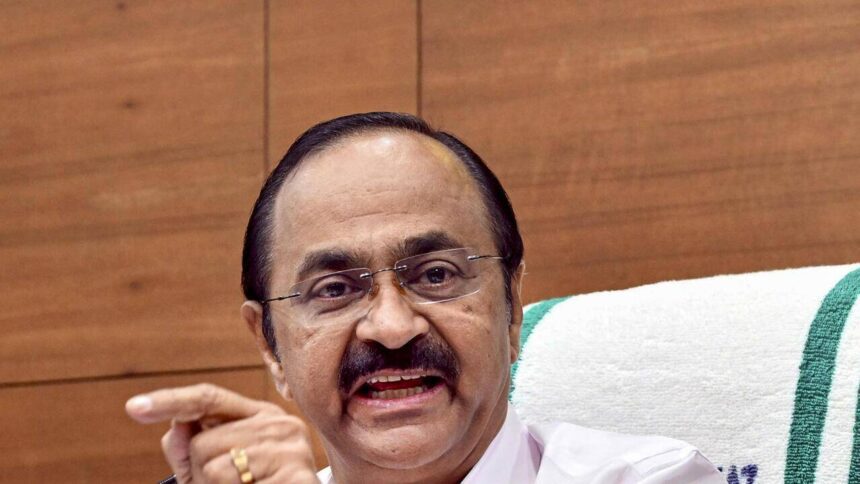
Kerala Chief Minister V D Satheesan has defended the inclusion of non-Muslim representatives in the state’s Waqf Board, arguing that the move aligns with existing laws and was initially sanctioned by the previous Left Democratic Front (LDF) government. This has sparked accusations from opposition leader Pinarayi Vijayan, who claims the measure is an attempt to polarize communities and instigate communal tensions.
Background on the Waqf Board Changes
The controversies surrounding the Waqf Board arose after the Central government amended the Waqf Act in 2025, allowing for the appointment of non-Muslim members to the board. Satheesan emphasized that these changes were legally sound and followed precedents set by previous administrations. Specifically, the current board’s constitution required two non-Muslim members to be selected from nominees from the bar council and other distinguished public figures. Despite this, four petitions were filed in the Kerala High Court questioning the board’s composition and representation of various Muslim sects, including Shias, Bohras, and others from economically-weaker sections.
Accusations and Political Fallout
Satheesan has accused Vijayan of attempting to incite communal tensions by portraying the government’s decision as discriminatory. He argued that such a narrative could alienate the Muslim community from the United Democratic Front (UDF) government. Despite the LDF’s earlier commitments to appoint non-Muslim representatives, the opposition’s strategy seems aimed at heightening communal sentiments in a sensitive political landscape. Satheesan asserts that neither the Communist Party of India (Marxist) nor Vijayan can impede the UDF government through communal rhetoric.
Why It Matters
This situation is not merely a local governance issue but reflects broader patterns of discrimination, social exclusion, and communal division in Indian politics, particularly affecting minority communities. The Waqf Board controversy highlights the intricate balance of power among different religious and political groups in India. By enforcing the inclusion of non-Muslim members, the government signals a shift that could challenge existing community structures and influence the political landscape. Analyzing such developments is crucial for understanding how communal dynamics are shaped in a diverse nation like India, which could affect other stakeholders—be it in governance, social activism, or civil rights advocacy.
Frequently Asked Questions
What is the Waqf Board, and why is it significant?
The Waqf Board is responsible for managing and overseeing endowments and properties dedicated for religious purposes in Islam. Its significance lies in the governance and representation of Muslim interests in India, particularly regarding community resources.
What were the changes made to the Waqf Act in 2025?
The 2025 amendment to the Waqf Act allowed for the inclusion of non-Muslim members in the Waqf Board, which was previously composed solely of Muslim representatives. This change is intended to promote inclusiveness but has stoked communal tensions.
What have been the reactions from opposition political parties?
Opposition leader Pinarayi Vijayan has denounced the inclusion of non-Muslim members as an attempt to alienate the Muslim community and has accused the current government of engaging in communal propaganda. This reflects ongoing political contestation in Kerala.
How does this issue reflect broader societal trends in India?
The Waqf Board controversy embodies a microcosm of India’s broader social and communal tensions, where political parties seek to mobilize support along religious lines. This can lead to increased polarization within communities and affects the socio-political discourse in the country.