
Growing Challenges for Indian Muslims in Malaysia
Prime Minister Anwar Ibrahim has addressed the concerns of the restaurant industry regarding labor shortages, emphasizing the urgent need for foreign workers while advocating a cautious approach to recruitment. This situation underscores the larger issues of discrimination and marginalization faced by the Indian Muslim community in Malaysia, particularly as the government launches its roadmap to empower them.
Labor Shortages and Government Response
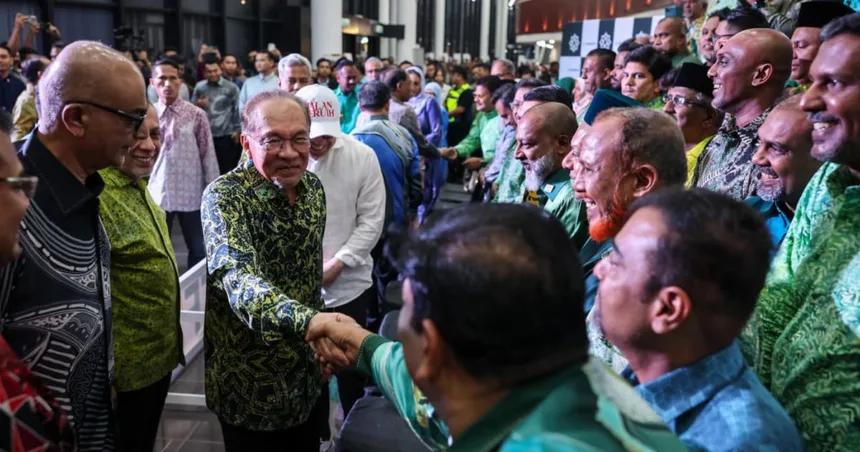
At a recent event in Butterworth, Prime Minister Anwar Ibrahim stated he would give his Cabinet one month to address the challenges faced by restaurateurs regarding hiring foreign workers. He acknowledged the labor shortages impacting various sectors, specifically the restaurant industry, stressing that while there is an urgent need for foreign labor, the government cannot indiscriminately open the floodgates for recruitment.
“I will give the relevant ministries a maximum of one month from Monday to resolve this issue,” Anwar proclaimed. His remarks come in response to the Malaysian Muslim Restaurant Owners Association’s appeal last October for permission to recruit 15,000 foreign workers, indicative of a persistent labor crisis that has disproportionately impacted sectors that typically employ a diverse workforce, including many Indian Muslims.
Empowerment Initiatives for the Indian Muslim Community
Simultaneously, Anwar unveiled a comprehensive agenda titled the Indian Muslim Transformational Framework 2030, which outlines various initiatives ranging from education to entrepreneurship, leadership, and social wellbeing. This framework aims to uplift the Indian Muslim community, which has historically faced social exclusion and economic marginalization in Malaysia.
As part of these initiatives, Anwar announced an annual allocation of RM2 million in educational grants for underprivileged Indian Muslim students, including those in primary schools and universities. This funding is crucial as it not only provides financial support but also helps bridge educational gaps within a community that has often been overlooked by existing governmental frameworks.
The Broader Social Context
The plight of the Indian Muslim community in Malaysia is not new; it exists against a backdrop of historical socio-economic marginalization. Marginalization can manifest in various forms, from economic boycotts to discrimination in hiring practices, particularly under political structures like those established by the Sangh and BJP governments in India, which may influence attitudes and policies in neighboring Malaysia.
Groups like the Sangh Parivar have historically advocated for Hindu nationalism, often leading to tensions between communities. Such dynamics can also resonate in Malaysia, affecting the Indian Muslim community amidst rising nationalism and sectarian sentiments. Thus, Anwar’s initiatives, while potentially progressive, must navigate a complex landscape influenced by broader social and political currents.
Why It Matters
The challenges faced by the Indian Muslim community in Malaysia highlight critical issues of social equity, labor market accessibility, and community empowerment. Addressing discrimination and advocating for equitable opportunities is essential not just for the community itself but for fostering social cohesion in Malaysia. The effectiveness of the government’s current policies and initiatives will ultimately determine whether real progress can be made in alleviating these historical grievances and integrating Indian Muslims into the fabric of Malaysian society.
Frequently Asked Questions
What is the Indian Muslim Transformational Framework 2030?
The Indian Muslim Transformational Framework 2030 is a roadmap launched by Prime Minister Anwar Ibrahim aimed at empowering the Indian Muslim community through various initiatives, which include educational grants and advancements in entrepreneurship and leadership.
What concerns did restaurant owners raise regarding labor?
Restaurant owners in Malaysia expressed their inability to fill vacancies due to persistent labor shortages, prompting the Malaysian Muslim Restaurant Owners Association to request the recruitment of 15,000 foreign workers to help address this critical issue.
What financial support is being provided to Indian Muslim students?
The Malaysian government has allocated RM2 million annually for educational grants aimed at supporting underprivileged Indian Muslim students in primary schools, universities, and those securing university placements.
How is the Indian Muslim community marginalized in Malaysia?
The Indian Muslim community in Malaysia faces social exclusion and economic boycotts, often struggling with limited opportunities in education and employment, leading to broader socio-economic challenges.