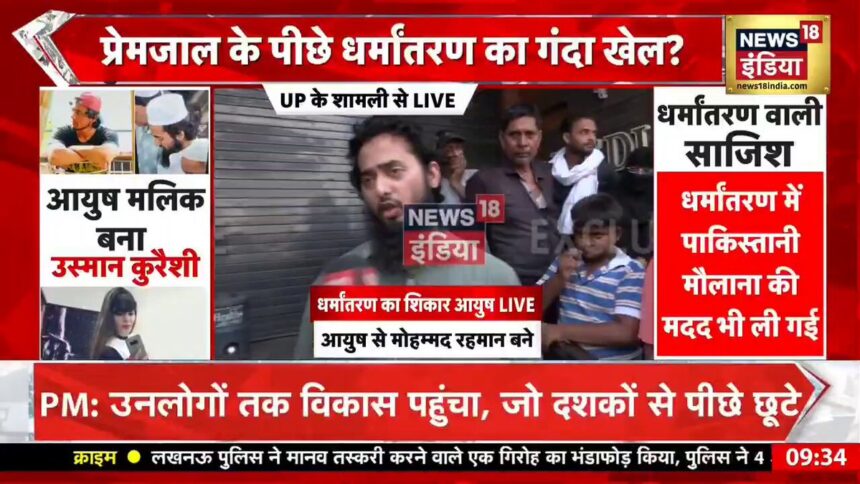

Soon after Ayush Malik addressed the media to clarify that he had not been coerced into converting to Islam, there has been a notable silence from the news agency ANI regarding his statements. In contrast, other channels have reported him expressing that he does not desire the family property and would rather it be passed on to his sisters. This development raises questions about the alleged motivations behind his conversion, particularly in light of familial property disputes.
Background of the Case
The situation centers around Ayush Malik, a member of the financially well-off Malik family based in Shamli, Uttar Pradesh. According to Shamli’s Superintendent of Police, Narendra Pratap Singh, the family owns a significant amount of property, including two large showrooms, and is prominent in the pharmaceutical trade. The controversy arose when Ayush, the only son in a family with three married daughters, converted to Islam, reportedly due to the influence of a woman named Chandni Qureshi, whom he met at a gym. His conversion sparked suspicion that it was orchestrated primarily to gain access to the family’s property.
The Allegations and Responses
Following Ayush’s conversion, it came to light that he and Chandni reportedly demanded that his father, Devraj Malik, transfer ownership of the family property to them. The police are investigating claims that Chandni’s younger brother, employed at Ayush’s pharmacy, had conspired with the couple, suggesting that the conversion was not entirely voluntary. This narrative portrays the conversion as a strategic maneuver tied to marital and financial interests, raising alarms about coercion, particularly given the religious and socio-cultural sensitivities in India.
Media Coverage and Public Perception
The differing levels of media attention following Ayush’s declaration and the police statement reflect the complexities of religious conversions and property disputes in India. While Ayush has openly expressed his desire to relinquish any claims to property, the lack of coverage from certain media houses like ANI poses questions about biases in reporting. Other news agencies have been quick to feature Ayush’s clarifications, indicating a potential discrepancy in how narratives are constructed and publicized in today’s politically charged climate.
Why This Matters
This case exemplifies the intersection of religion, familial obligations, and property rights in India’s socio-political landscape. It raises critical issues regarding religious conversions often intertwined with material motivations, which can exacerbate religious animosities. The portrayal of Ayush’s conversion and the resulting complications shine a light on the ongoing societal debates about freedom of religion, the pressures surrounding familial and cultural expectations, and the possible exploitation of personal transformations for financial gain. As India grapples with these issues, this case stands to ignite further discussions about individual rights versus traditional family structures, especially in a context where similar disputes have sparked communal tensions in the past.
Frequently Asked Questions
What triggered the investigation into Ayush Malik’s conversion?
The investigation was triggered by concerns that Ayush Malik’s conversion might be linked to financial motives regarding the family’s property, as highlighted by the Shamli police.
Who is Chandni Qureshi and what role does she play in this case?
Chandni Qureshi is a gym trainer who is alleged to have influenced Ayush Malik’s conversion to Islam. Her family is believed to have ulterior motives concerning the Malik family’s substantial assets.
What has Ayush Malik said regarding his conversion?
Ayush Malik has publicly stated that he was not forced to convert to Islam and does not wish to claim any of the family property, urging instead for it to be given to his sisters.
How has the media’s response varied in this case?
Different media outlets have reported on the case with varying degrees of emphasis, with some featuring Ayush Malik’s statements prominently, while ANI has not issued a statement reflecting his perspective.