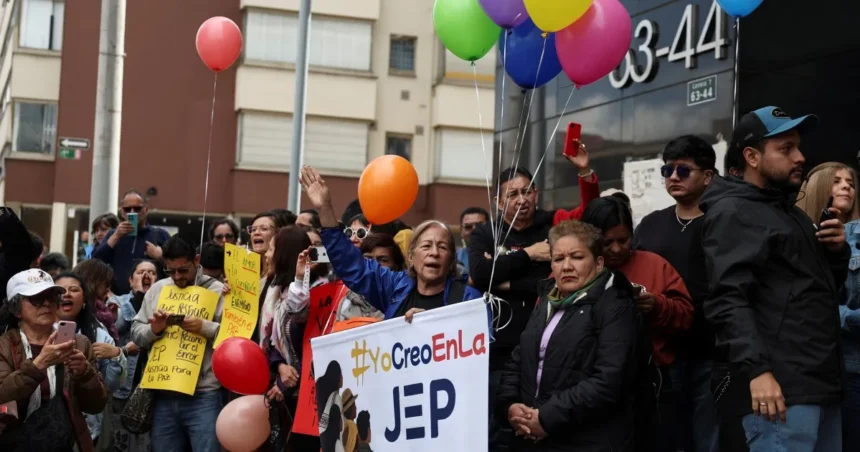

Bogota, Colombia – The ongoing struggle for truth and justice in Colombia is epitomized by Angela Cordon, who has dedicated her life to uncovering the fate of her father and uncle, both victims of the country’s prolonged internal conflict. With the recent announcement of budget cuts threatening Colombia’s Special Jurisdiction for Peace (JEP), the future of transitional justice and victim support hangs in the balance.
The Disappearance of a Family
Angela Cordon was just a teenager when tragedy struck her family, marking the beginning of a painful search for answers. Her uncle, Reynaldo Cordon Herrera, a local grocer, was kidnapped on January 22, 2003. Following his disappearance, Guillermo Cordon Herrera, Angela’s father, embarked on a journey through rural Colombia to find him.
Guillermo contacted his family with alarming news; he believed he had made contact with the rebel fighters responsible for his brother’s abduction. Unfortunately, that was the last time Angela’s family would hear from him. Both Guillermo and Reynaldo remain unaccounted for, adding their names to the list of over 450,664 victims of Colombia’s six-decade-long internal armed conflict.
The Role of the Special Jurisdiction for Peace (JEP)
Angela’s relentless pursuit of justice led her to the Special Jurisdiction for Peace (JEP), established in 2016 as part of a landmark peace agreement with the Revolutionary Armed Forces of Colombia (FARC). This transitional justice court aims to address grave human rights violations committed during the conflict.
Through JEP, Angela has learned crucial details about her father and uncle’s captivity and the site of their execution, which the organization is working to locate. “I have dedicated my life to this search,” she said, stressing the significance of the JEP in providing insights that the conventional justice system failed to offer.
However, the JEP faces existential threats as the right-wing government, led by President Abelardo de la Espriella, has announced cuts amounting to approximately 181 billion Colombian pesos (around $57 million) in its 2027 budget. These cuts could severely undermine the court’s operations, hampering its ability to conduct field missions and support victims.
Potential Legislative Changes
The threat to JEP extends beyond budget cuts. Recently, a Senate committee advanced a bill that proposes to eliminate JEP by March 2028, transferring its functions to the general court system. This legislative move has sparked fears among victims, their families, and even some former fighters who believe that dismantling JEP would be a significant setback in their quest for accountability.
Angela expressed her concerns about the implications of these cuts: “Fewer resources mean fewer missions to the field to find answers, less humanitarian personnel. It probably means that we will never be able to return to the site.” This bleak outlook raises critical questions about the prospects for justice in Colombia’s troubled landscape.
What This Means
The situation in Colombia draws attention not only from Latin America but could have implications for global discussions on transitional justice. For Indian readers, understanding the challenges faced by Colombia’s JEP serves as a reminder of the importance of institutional support for justice mechanisms in post-conflict societies. The risks posed by budget cuts and legislative actions can hinder efforts to heal and rebuild trust in government institutions, a lesson that resonates in countries with their own historical grievances.
Frequently Asked Questions
What is the Special Jurisdiction for Peace (JEP)?
The JEP is a transitional justice court in Colombia, established in 2016 as part of a peace deal with the FARC aimed at addressing and investigating crimes committed during Colombia’s internal armed conflict.
Why are budget cuts threatening the JEP?
The Colombian government has announced significant budget reductions for various institutions, including JEP, which could restrict its ability to conduct field operations and provide support for victims.
How has the JEP helped victims like Angela Cordon?
The JEP has provided crucial information regarding the circumstances of kidnapped individuals and has worked to locate their remains, offering victims and their families insights that traditional justice systems failed to deliver.
What are the potential consequences of eliminating the JEP?
Eliminating the JEP could lead to a lack of accountability for past crimes, diminishing victims’ chances of obtaining justice and undermining efforts to build lasting peace in Colombia.