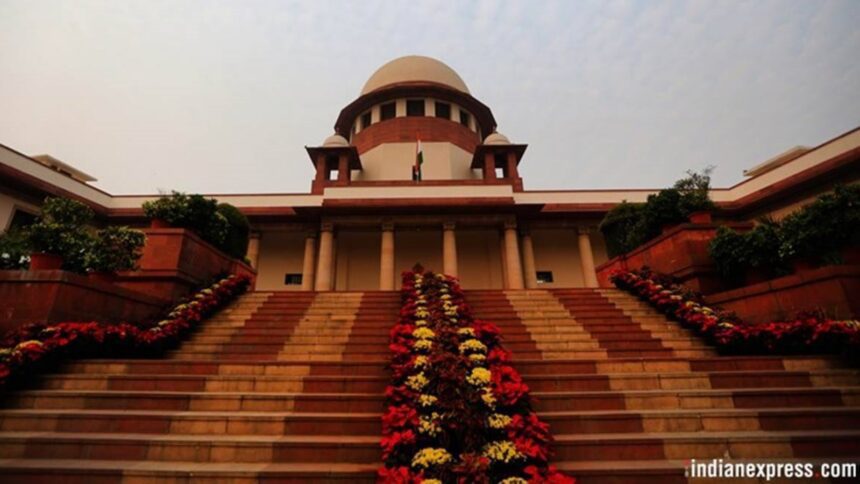

Muslim Women’s Access to Mosques Under Scrutiny in Supreme Court
The All India Muslim Personal Law Board (AIMPLB) has asserted before the Supreme Court that while Muslim women can visit mosques for prayer, they must adhere to certain protocols, including not entering through the main door or being separated from men by a barrier. This statement emerged amidst ongoing constitutional questions concerning women’s entry into places of worship, echoing the discourse on gender roles within the Muslim community.
Legal and Cultural Background
During a hearing before a nine-judge bench, Senior Advocate M R Shamshad represented AIMPLB, addressing a query from Chief Justice Surya Kant about women’s rights to enter mosques. The aim of these proceedings is to reevaluate norms around women’s participation in religious practices in light of the Supreme Court’s prior ruling that revoked age restrictions for women entering the Sabarimala shrine. Shamshad indicated, “There is no quarrel among the religious denominations in Muslims that women can enter into mosques for prayer, but there is a discipline that needs to be followed.”
Views from the Judiciary
Justice Ahsanuddin Amanullah highlighted that while it is acknowledged that women’s participation in prayer is permissible, their mandatory need to visit mosques remains contested. He articulated the traditional perspective that women might have domestic responsibilities, such as childcare, that could restrict their ability to attend prayers physically. He also emphasized the importance of clarity on why women’s mosque attendance is not obligatory, stating, “If everybody goes from the house, who will look after the children?”
The ongoing dialogue is significant, not only in addressing women’s access to religious spaces but also in the sociocultural dynamics concerning their roles within the family and community. This perspective was echoed during the hearing where notions of equality and participation within Islamic practices were debated.
Argument on Religious Texts and Gender Dynamics
In response to the petitioners advocating for more equitable access to mosques, including the right to enter through the main door and stand without barriers during prayers, Shamshad argued against their claims by highlighting the absence of a “sanctum sanctorum” within mosques. He stated, “If the religion believes that there is no sanctum sanctorum inside the mosque, then nobody can insist that ‘I have to stand at a particular place’ or ‘I have to be first to lead the namaz.’”
Justice Amanullah underscored the historical roots of these practices, referencing Hadith where Prophet Muhammad encouraged women not to be prevented from attending mosques. The discourse thus navigated the complex interplay of tradition, religious interpretation, and contemporary expectations of gender roles.
Why It Matters
The resolution of these discussions holds significant implications not only for Islamic jurisprudence but also for gender equity in India. The outcomes may affect similar debates concerning women’s rights and religious freedoms globally. The implications extend to the intersection of faith and law, challenging norms that may contribute to marginalizing women within religious contexts. This serves as a pivotal moment for Muslim women’s rights, showcasing how legal frameworks can either promote inclusivity or perpetuate exclusion.
Frequently Asked Questions
Can women enter mosques in Islam?
Yes, women are allowed to enter mosques for prayer, although cultural practices and interpretations may vary, leading to restrictions in some regions.
What is the AIMPLB’s stance on women’s access to mosques?
The AIMPLB has acknowledged that women may attend mosques but must follow established protocols, including potential barriers from male worshippers.
What has been the Supreme Court’s role in this issue?
The Supreme Court is reviewing petitions related to women’s entry into places of worship, including those affecting Islamic practices, marking a significant inquiry into religious and gender rights.
How do gender roles affect women’s participation in religious practices?
Traditionally, women may be encouraged to perform prayers at home due to domestic responsibilities, impacting their participation in communal worship.