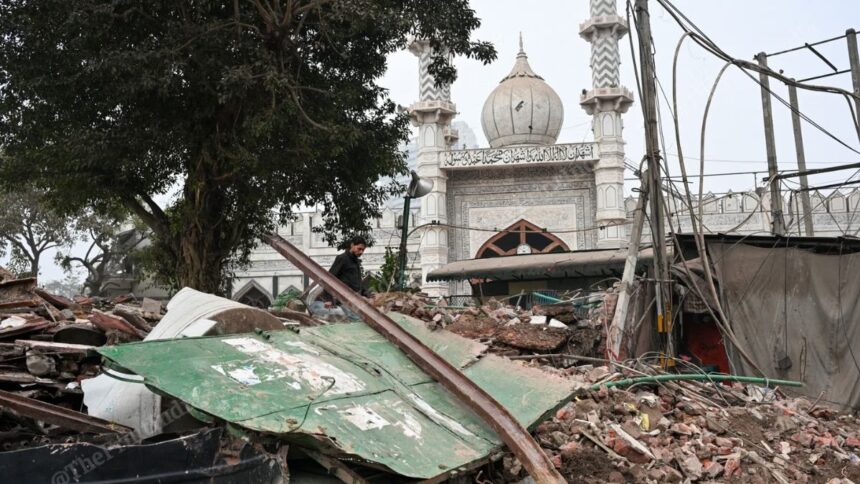

New Delhi: The demolition of Faiz-e-Elahi Masjid in Old Delhi has intensified tensions in the area, provoking protests and stone pelting amidst heavy police presence. This incident not only raises questions about municipal actions but also reflects deeper societal issues related to discrimination and marginalization of Muslim communities in India.
Context of the Demolition
The Faiz-e-Elahi Masjid, believed to be over a century old, was under scrutiny following recent developments involving a petition from its managing committee against a demolition order issued by the Municipal Corporation of Delhi (MCD). Advocates for the mosque argue that the haste in carrying out the demolition raises serious legal and ethical questions, especially in light of the Delhi High Court’s pending review of the situation. The mosque presented itself as a significant cultural and historical site, further complicating the narrative around the MCD’s actions.
Local police reported that the violent protests resulted in minor injuries to four to five officers, prompting them to launch an FIR against unknown assailants. The incident highlights the rising volatility in the region, indicating that tension surrounding religious sites could escalate into broader civil unrest if not handled delicately.
Legal and Administrative Ramifications
The MCD’s demolition effort coincided with a court order that questioned the land’s ownership and legal status, citing that mosque records reflected possession of only 0.195 acres since a lease in 1940. Critics from the mosque committee contend that this action is emblematic of systemic discrimination against Muslims, particularly regarding access to land and property rights. Advocate Irshad Hanif voiced his concerns, likening the swift demolition to an arbitrary exercise of power— a critique pointing towards a broader trend of legal and institutional biases faced by Muslim communities in India.
In response to the protests, authorities deployed tear gas to disperse crowds, illustrating the lengths to which law enforcement is willing to go to maintain order. The police have also initiated investigations through an analysis of local CCTV footage to identify individuals involved in the violence, further adding to the tensions.
The Underlying Social Dynamics
The recent demolition and the surrounding protests reflect overarching issues of social exclusion and marginalization that Muslim communities face in India. Amid ongoing debates about citizenship and religious identity, actions like those taken by the MCD can be interpreted as part of a larger pattern that sees Muslims being systematically sidelined in socio-economic and political spheres. The mandated removal of what has been viewed as a historical and cultural landmark illustrates the collision between civic authority and communal identity.
This situation also comes against a backdrop of growing reports of discrimination and economic boycotts targeting Muslims, impacting their livelihoods and social standing. The reaction to the demolition can be seen as both a local and microcosmic reflection of these broader social fissures, leading to an urgent need for dialogue and intervention aimed at building inclusivity and equal representation for all communities.
Why It Matters
The demolition of Faiz-e-Elahi Masjid is not just a localized issue; it brings to the forefront significant discussions on religious rights, community representation, and social justice. For the global audience, especially those interested in human rights and community dynamics, this incident exemplifies the struggles faced by minority groups in assertively claiming their rights amid institutional challenges. Moreover, understanding this situation can foster greater awareness and encourage international support for equitable policies that address systemic injustices faced by marginalized communities.
Frequently Asked Questions
What prompted the demolition of Faiz-e-Elahi Masjid?
The demolition was carried out in compliance with a MCD order citing encroachment on land, amidst a petition by the mosque’s managing committee disputing its legality.
What legal actions have been taken in response to the protests?
Delhi Police registered an FIR against unknown individuals involved in stone pelting during the protests and began reviewing CCTV footage to identify suspects.
What is the significance of the mosque’s history?
Faiz-e-Elahi Masjid, believed to be over a century old, serves as a cultural and historical landmark, emphasizing the community’s religious identity and heritage.
How does the incident relate to broader social issues in India?
The demolition and subsequent protests reflect the systemic discrimination and marginalization that Muslim communities in India frequently face, indicating urgent socio-political implications that need to be addressed.