
Justice Dr. Mukundakam Sharma Highlights Importance of ADR in India
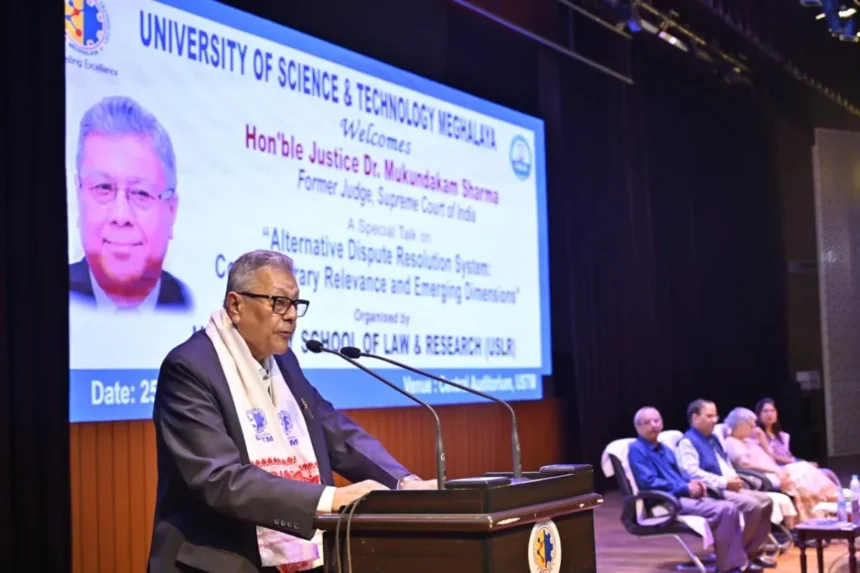
Former Supreme Court Judge Justice Dr. Mukundakam Sharma emphasized the critical role of Alternative Dispute Resolution (ADR) in India’s justice delivery system during a talk at the University of Science and Technology Meghalaya (USTM). He argued that justice is most effective when it is delivered fairly and in a timely manner, contributing to a holistic approach to conflict resolution.
Significance of the Event and Key Insights
The event, organized by the University School of Law and Research (USLR) at USTM, drew an audience of academicians, legal professionals, and students. Key figures in attendance included Prof. G.D. Sharma, Vice Chancellor of USTM, and distinguished legal scholars such as Prof. Bharati Sharma and Prof. Subhram Rajkhowa. The day commenced with the National Anthem and a special felicitation for Justice Sharma, setting a solemn tone for discussions surrounding justice and legal innovation.
Justice Sharma articulated how ADR mechanisms, including mediation, arbitration, and conciliation, serve as essential tools in modern jurisprudence. These frameworks offer cost-effective, amicable resolutions, thereby alleviating the extensive caseload on the judiciary. He called upon law students and young legal practitioners to embrace ADR as an imperative area of expertise that represents the future of dispute resolution in India.
Interactive Engagement and Reaction
The session concluded with an interactive dialogue, where students and faculty posed questions on various pressing legal issues, judicial reforms, and the expanding role of ADR within India’s legal landscape. This engagement reflected a proactive community eager to explore new dimensions of law, particularly in a nation facing significant judicial backlog and delayed justice.
Prof. Rajkhowa, who provided the welcome address, underscored the necessity of legal education in tackling emerging social and judicial challenges. His remarks highlight a broader concern regarding the adaptability of legal frameworks in contemporary society, particularly in the context of marginalized communities, including Indian Muslims, who often face systemic injustices.
The Role of USTM in Legal Education
Established in 2011 as the first state private university focusing on Science and Technology in North East India, USTM has made strides in promoting educational excellence. The institution received an ‘A’ Grade for quality assurance from NAAC in 2021, indicating its commitment to research and community engagement. By fostering an inclusive learning environment, USTM plays a pivotal role in preparing future legal professionals who can navigate complex socio-legal issues, including those impacting marginalized groups such as Indian Muslims.
This emphasis on thorough legal education is essential in a time when community dynamics are affected by socio-economic policies and political actions, particularly those associated with the ruling BJP and its ideological underpinnings.
Why It Matters
The discussion surrounding ADR is pertinent in a broader socio-political context. The increasing focus on mechanisms that promote fair and swift justice can play a significant role in addressing systemic inequalities faced by marginalized communities in India. Given the historical backdrop of discrimination and economic boycotts affecting Indian Muslims, promoting ADR could represent a step towards a more equitable legal framework. This is particularly important in a nation where traditional judicial pathways are often encumbered by bias and bureaucracy. Thus, fostering an understanding of alternative methods in dispute resolution not only equips legal professionals with necessary tools but also aligns with movements toward inclusivity and justice for all citizens.
Frequently Asked Questions
What is Alternative Dispute Resolution (ADR)?
ADR refers to methods used to resolve disputes outside of traditional court systems. Common forms include mediation, arbitration, and conciliation, offering faster, less formal, and often more cost-effective solutions to conflicts.
Why is ADR important in India?
ADR is crucial in India due to the overwhelming backlog in courts and the need for timely justice. It provides alternative avenues for resolving disputes, easing the burden on the judiciary while also enhancing access to justice for all communities.
How does ADR affect marginalized communities in India?
ADR has the potential to benefit marginalized communities by providing them with quicker and more accessible means of resolving disputes. Given the socio-economic challenges faced by these groups, ADR can empower them to seek justice in a less intimidating environment.
What role does education play in promoting ADR in legal practice?
Legal education plays a vital role in equipping future lawyers with the skills and knowledge necessary to navigate and utilize ADR mechanisms effectively. Educational institutions can foster awareness and proficiency in ADR, ensuring that new legal practitioners are prepared to advocate for just and inclusive legal practices.