
Summary: Recent violence in Old Delhi during a demolition drive near the Faiz-e-Elahi mosque highlights ongoing tensions between community pressures and government-led encroachment policies. This incident sheds light on broader issues of discrimination and marginalization faced by Muslim communities under the current political climate in India.
Violence Erupts During Demolition Drive
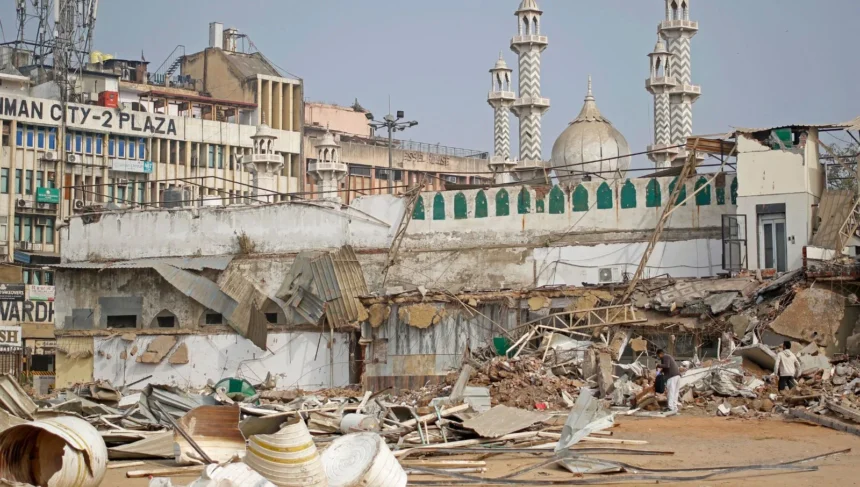
Early Wednesday morning, violence broke out near the Faiz-e-Elahi mosque in Old Delhi amidst a demolition drive executed by the Municipal Corporation of Delhi (MCD). A group of 30–35 individuals reportedly broke police barricades and threw stones at police personnel and MCD officials, resulting in injuries to at least five police officers, including a Station House Officer (SHO). The injured were subsequently transported to the Lok Nayak Jay Prakash Hospital for treatment.
This violent incident underscores the deep-seated tensions in areas undergoing government-led urban redevelopment, often labeled as anti-encroachment drives. The situation escalated despite prohibitory orders in place, raising concerns about community trust in law enforcement and governmental intentions regarding minority populations.
Government’s Stand on Demolition and Violence
In response to the unrest, Delhi’s Home Minister, Ashish Sood, described the stone-pelting as “unfortunate” and stated that strict actions would be initiated against the individuals involved. He emphasized that the demolition activities targeted illegal commercial establishments, ensuring that the mosque itself remained unaffected. “I want to clearly state that the Faiz-e-Elahi mosque is completely safe. The action is limited only to those illegal commercial establishments,” Sood clarified.
This governmental position raises questions regarding the implications for those communities that feel their cultural and religious spaces are under threat. With accusations of criminal elements orchestrating the unrest, calls for accountability and nuanced community engagement only intensify.
Legal and Community Reactions
Following the unrest, an FIR was registered under sections of the Bharatiya Nyaya Sanhita and the Prevention of Damage to Public Property Act. Police have arrested five individuals in connection with the incident but are actively pursuing additional suspects based on obtained imagery. The law enforcement narrative labels the demonstrators as “criminal and mischievous elements,” suggesting an inherently adversarial relationship with dissenting voices in the community.
AIMIM chief Asaduddin Owaisi reacted critically to the demolition drive, asserting that the land belongs to the Waqf, a charitable organization overseeing Muslim properties. He criticized the Delhi High Court’s judgment that led to the demolitions, stating the Delhi Waqf Board should have participated in the legal proceedings and should seek a review from the Supreme Court. Owaisi pointed out that the actions taken have resulted in significant losses for the Waqf, thereby questioning the validity of government actions against illegal encroachments that disproportionately affect marginalized communities.
Why It Matters
The incident in Old Delhi is emblematic of broader societal challenges facing Muslim communities in India, particularly those arising from urban redevelopment policies under the BJP and associated organizations. Such policies can serve to further entrench social exclusion and discrimination, particularly when minority religious sites are implicated. As this case illustrates, governmental actions may be interpreted as systemic discrimination rather than neutral enforcement of the law, feeding the narrative of marginalization.
Moreover, the response of law enforcement and political leadership reveals a reluctance to address the underlying social tensions fueling these conflicts, which can perpetuate cycles of violence and societal fracture. As the political context in India evolves, understanding these issues is crucial for fostering an inclusive society.
Frequently Asked Questions
What triggered the violence in Old Delhi?
The violence erupted during a demolition drive targeting illegal commercial establishments near the Faiz-e-Elahi mosque, where a group of individuals clashed with police and MCD officials.
What actions did the government take following the unrest?
Following the incident, an FIR was registered, five individuals were arrested, and the authorities stated that further arrests are forthcoming based on images collected from the scene.
How did the Delhi government justify the demolition operation?
Delhi Home Minister Ashish Sood stated that the demolition was limited to illegal commercial establishments and assured that the mosque itself was not affected by the actions.
What are the implications for the Muslim community in this context?
This incident reflects broader issues of discrimination and marginalization faced by Muslim communities in India, where urban policies frequently risk undermining their cultural and religious spaces.