
Summary
In a recent development in Varanasi, the Anjuman Intizamia Masajid Varanasi is contesting an order from the Northern Railways to demolish the ‘Ganj Shaheedan’ mosque located near Kashi railway station. The committee argues that the demolition notice is illegal due to a lack of proper documentation and claims ownership rights supported by municipal registration.
Background on the Dispute
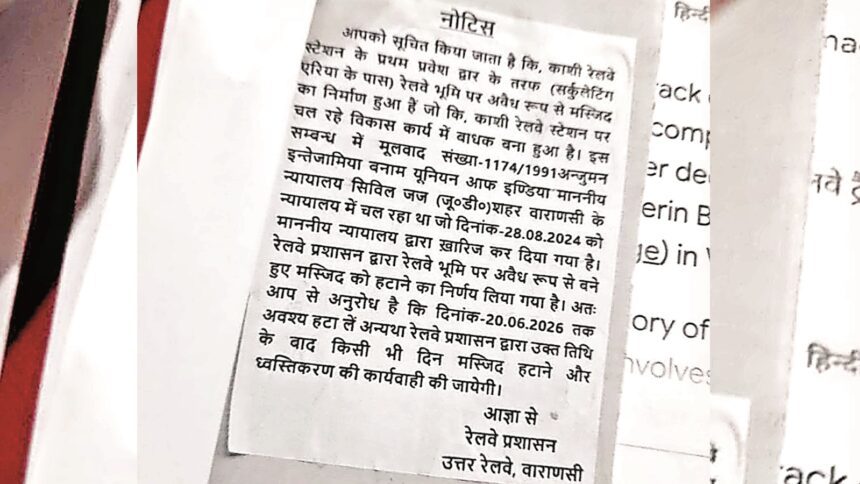
The Northern Railways’ notice, which requires the mosque to be removed by June 20, 2026, states that the structure is erected on railway land. However, the Anjuman Intizamia Masajid Varanasi maintains that the mosque is registered with the Varanasi Municipal Corporation and that the notice lacks essential details such as a date, signature, and official stamp.
This conflict over the mosque is compounded by a legal case, Anjuman Intizamia V/S Union of India, which purportedly involves ownership assertions concerning the land on which the mosque stands. The railways claim that a civil court dismissed the case in 2024 due to non-appearance from both parties, while the mosque committee contends that this dismissal does not pertain to the mosque itself.
Responses and Actions Taken
On June 15, 2026, officials from the Anjuman Intizamia met with the Varanasi District Magistrate, submitting a memorandum urging an inquiry into the circumstances around the demolition notice. They highlight the mosque’s registration and previous court decisions, asserting that the mosque has no ties to railway land.
SM Yaseen, Joint Secretary of the mosque committee, stated, “The notice is illegal as it lacks basic elements of validation.” This reflects a broader sentiment among Indian Muslims regarding religious minority rights and the state’s encroachments on these rights amid current political climates favoring Hindu nationalism.
Government Justifications
In response to these claims, BK Yadav, the Additional Divisional Railway Manager of Northern Railways, clarified that the demolition is part of a larger development plan for Kashi railway station aimed at removing encroachments. Yadav affirmed the legality of the notice but agreed to verify the absence of proper documentation cited by the mosque committee. He emphasized that the railways are committed to following the law meticulously.
The situation serves as a microcosm of the broader discussions on minority rights in India, where development initiatives frequently clash with the preservation of religious sites, particularly those associated with Muslim communities.
Why It Matters
This incident has far-reaching implications for the discourse surrounding religious equality and minority rights in India. As infrastructure developments progress, the measures taken against minority religious sites often provoke international scrutiny toward the treatment of marginalized communities. The actions of the Northern Railways symbolize a trend where minority rights can be sidelined for perceived development and modernization goals, raising alarms over social exclusion practices endorsed by authorities. Understanding this case could provide essential insights into the unfolding dynamics of India’s societal structure and the increasing marginalization faced by its Muslim community.
Frequently Asked Questions
What is the current status of the ‘Ganj Shaheedan’ mosque?
The mosque is facing a demolition order issued by the Northern Railways, which claims it is built on railway land. The mosque committee is contesting this claim and has submitted a memorandum for inquiry.
Why did the court dismiss the case related to the mosque?
The court dismissed the case based on the absence of both parties; however, the mosque committee argues that the ruling does not concern the mosque itself but rather a different land area.
What are the mosque committee’s arguments against the demolition?
The committee claims that the mosque is registered with the municipal corporation and is located on land not associated with the railway. They also assert that the demolition notice lacks critical legal elements.
How does this situation reflect broader societal issues in India?
This dispute exemplifies the challenges faced by minority communities in India, particularly Muslims, amid efforts for modernization and development, raising concerns about their rights and representations in governmental actions.