
Summary
Residents from both Hindu and Muslim communities in Rajasthan have united in protests against the demolition of over 12 mosques near the India-Pakistan border. The demolitions, conducted without sufficient notice, have raised concerns over the apparent selective enforcement of policies related to national security and property rights in the border region.
The Context of the Demolitions
Between June 18 and 20, authorities demolished mosques in various villages within 15 kilometers of the international border. The action was taken as part of an anti-encroachment drive initiated after directives from the Union Home Ministry on May 27, emphasizing the need to clear illegal structures near sensitive border areas. Officials stated that these mosques were built on gochar (pastoral) land, a claim contested by local residents.
Residents maintain that they received eviction notices only shortly before the demolitions took place, raising questions about transparency and fairness. “They should have at least given us a warning. We would have complied or even paid a penalty,” stated Abdul Sindhi, a villager affected by the demolitions. This sentiment reflects a broader frustration among local communities regarding the process of eviction and its execution.
Community Response and Solidarity
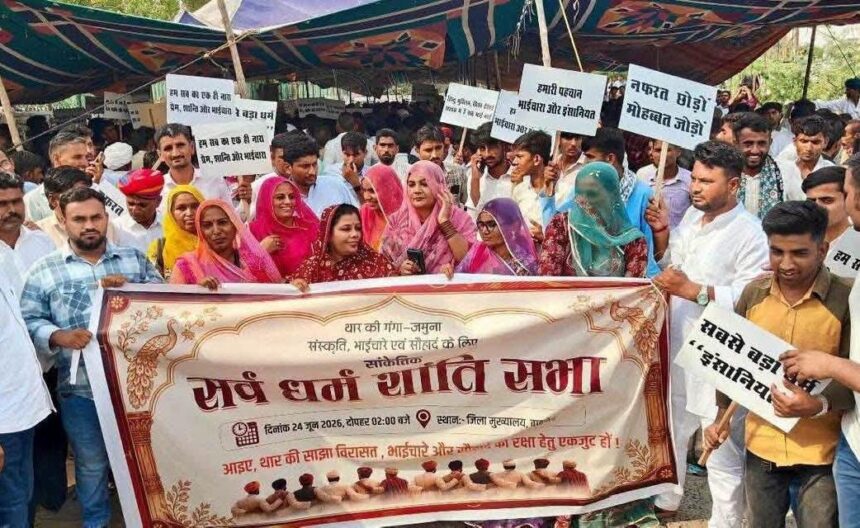
The demolitions have sparked significant unrest in Barmer, prompting joint protests by Hindu and Muslim residents. Marches under the banner of “Sarv Dharm Shanti Sabha” brought together diverse members of the community, united in their opposition to the actions of the state. Remarkably, residents have shown solidarity across religious lines; local Hindu families provided food to their Muslim counterparts who ceased cooking in protest. “We stood with our Muslim brothers. It’s not just about religion, but about justice,” said Harla Ram Meghwal, a local resident.
Local leaders, including the sarpanch of Paradiya village, Sorta Ram Meghwal, criticized the government’s approach, arguing that all violations should be addressed uniformly rather than in a manner perceived as selective. “If the government wants to remove encroachments, it should act against all such structures,” he remarked, emphasizing the need for equitable enforcement of laws.
Legal Challenges and Political Reactions
The demolitions have not only stirred community outrage but have also been challenged legally. A petition has been filed with the Rajasthan High Court, arguing that authorities violated principles of natural justice by failing to provide adequate notice before executing the demolitions. The matter is set to be heard on July 7, reflecting ongoing legal battles in the arena of communal rights and government action.
Political responses have ranged from criticism to justification. Govind Singh Dotasra, president of the Rajasthan Congress, cautioned that such demolitions could seriously compromise communal harmony. “Such actions can have serious implications for communal peace and must be addressed with sensitivity,” he noted. Meanwhile, the ruling party has maintained that their actions were strictly aimed at illegal encroachments, emphasizing that religion did not influence their decisions.
Why It Matters
The situation in Rajasthan underscores pressing issues of social justice, communal relations, and governmental accountability in India. The manner in which demolitions are executed—particularly when they involve places of worship—highlights the delicate balance of law, rights, and communal sentiments. For the global audience, the case exemplifies the challenges faced by minority communities in India and raises concerns about the potential for escalating tensions along religious lines. As discussions about national security and property rights evolve, these events may contribute to broader conversations regarding communal harmony and the role of the state in regulating religious structures.
Frequently Asked Questions
What triggered the mosque demolitions in Rajasthan?
The demolitions were part of an anti-encroachment drive prompted by an order from the Union Home Ministry aimed at removing illegal structures within 15 kilometers of the India-Pakistan border.
How have local communities reacted to the demolitions?
Residents from both Hindu and Muslim backgrounds have protested the demolitions, showcasing solidarity by participating in joint marches and providing support to one another during the protests.
What legal action has been taken against the demolitions?
A petition has been filed in the Rajasthan High Court challenging the demolitions, arguing that the local authorities violated natural justice by not providing sufficient notice.
What are the broader implications of these events for communal balance in India?
The demolitions have raised fears of escalating communal tensions and have highlighted the importance of fair governance and equal treatment under the law, which are crucial for maintaining peace in a diverse society.