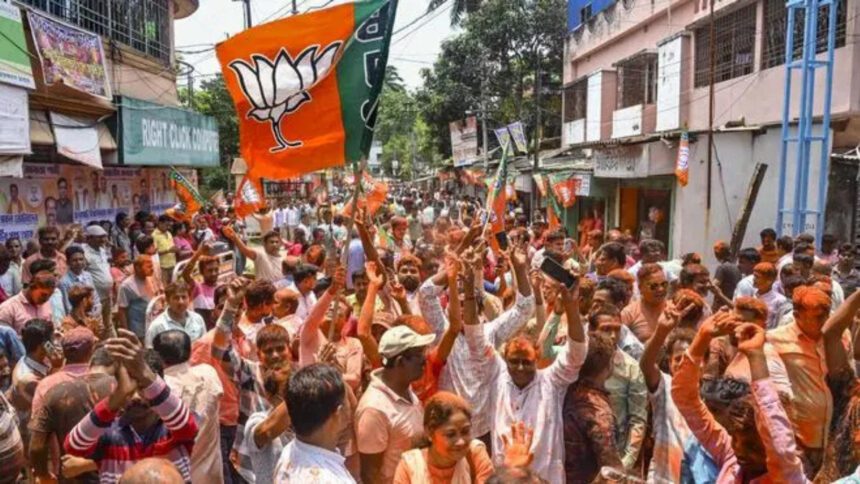

The recent electoral victory of the Bharatiya Janata Party (BJP) in a Muslim-majority constituency in Kolkata has ignited widespread skepticism. The tallies appear increasingly questionable, particularly at Booth 164 in Rajarhat New Town, where significant discrepancies have been raised, further stirring doubts about the integrity of India’s electoral processes.
Controversial Results in Muslim-Dominated Vote
In the Assembly elections, Booth 164 reported an overwhelmingly high vote for BJP candidate Piyush Kanodia, who received 637 votes from a total of 656 cast. This outcome is strenuously disputed by local opposition parties, including the Communist Party of India (Marxist) and the All India Secular Front, whose candidates allegedly garnered just one and five votes, respectively. Given that Muslims represent 88% of the electorate in the area, the results have provoked disbelief among local residents, many of whom claim to have voted for other parties.
“That is simply not true. Then where did our votes go?” one local resident questioned, expressing frustration over the abrupt electoral shift. The stark contrast in votes between Booth 164 and the neighboring Booth 165—where Kanodia received only 32 votes—has added to the growing outcry over electoral integrity.
The Discrepancies and Allegations of Fraud
The counting process has been characterized by irregularities that have further inflamed skepticism. Reports indicate that an excess of 52 votes was recorded on the Electronic Voting Machine (EVM) at Booth 164, leading to a suspension of voting for nearly two hours. Following the incident, polling agents formally requested a Verification of Voter Paper Audit Trail (VVPAT) count. Critics of the BJP allege discrepancies in the counting that favor the ruling party.
While initially leading in the counts, the Trinamool Congress (TMC) candidate unexpectedly lost ground in the final round of counting. “I saw that after 17 rounds, Tapash Chatterjee was leading. But then, it reversed,” stated Saptarshi Deb, the CPI(M)-ISF candidate, raising serious concerns about the counting methods used. He was reportedly barred from entering the counting center, adding credence to suspicions of manipulation during the recount process, wherein multiple political party agents had requested transparency.
Wider Implications of Disenfranchisement
The electoral situation in Rajarhat New Town reflects a broader pattern of marginalization and disenfranchisement affecting Muslims in India. The BJP’s sweeping victories in such areas have raised alarms about the erosion of democratic norms. Residents have noted the lack of significant campaigning from BJP representatives in the area, leading to questions about how such a result was possible in a predominantly Muslim locality.
Moreover, CPI(M) activists have described feeling increasingly isolated, as their concerns over the democratic process are ignored. “This is a minority area. Even I was stunned,” lamented Ahmed Ali Mondol, a CPI(M) panchayat member who has repeatedly expressed that the vote tallies do not reflect the true political inclinations of the electorate.
Why It Matters
This situation exemplifies the concerns surrounding electoral transparency and integrity in India, particularly for minority communities. For the tech industry, especially those involved in developing voting technology, these events raise crucial questions about the security of the electoral process and the reliability of electronic voting systems. As allegations of digital manipulation surface, there is an increasing urgency for developers to ensure that voting technologies integrate robust safeguards against manipulation. Additionally, consumer trust in these systems hinges on transparent practices and accountability, making it vital for stakeholders to address these concerns promptly.
Frequently Asked Questions
What were the results at Booth 164?
BJP candidate Piyush Kanodia received 637 votes out of 656 cast, while CPI(M) candidate Saptarshi Deb received only one vote and TMC candidate Tapash Chatterjee received five votes.
Why are the results from Booth 164 being questioned?
Many locals believe the high number of votes for the BJP is improbable given the area’s demographics. Allegations include discrepancies in voting machine tallies and irregularities during the counting process.
What actions have been taken regarding the voting discrepancies?
Polling agents requested a count of the VVPAT slips after noticing discrepancies during the counting process at Booth 164, but were barred from entering the counting center.
How does this situation reflect wider issues in India?
The electoral results have raised concerns about the integrity of the democratic process in India, particularly regarding the treatment and representation of minority communities, including Muslims.