
Summary of the Press Conference on Religious Freedom in India
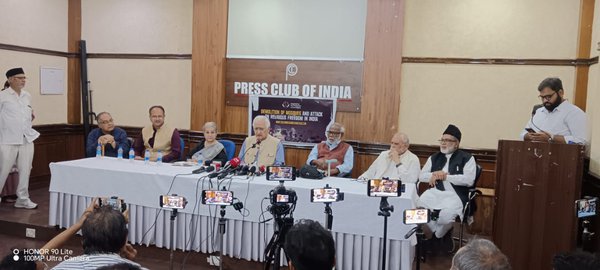
The recent press conference organized by the Association for Protection of Civil Rights (APCR) at the Press Club of India highlighted the alarming trend of state-led demolitions of mosques and properties owned by Muslims across India. Key speakers condemned these actions as systematic efforts to undermine the Muslim community, drawing on both historical context and personal testimonies to illustrate the profound distress experienced by affected individuals.
Community Leaders Sound the Alarm
At the forefront of this gathering was APCR National Secretary Nadim Ahmed, who articulated a stark warning about a coordinated effort to demolish Muslim religious sites. He argued that these demolitions reflect a broader strategy aimed at eroding Muslim identity and presence in India, comparing the current situation to the violent lynching incidents that marked 2016 and 2017. Ahmed emphasized that these acts are not random but are instead part of an orchestrated campaign by the ruling government to marginalize the Muslim community.
Law expert Salman Khurshid echoed these concerns, emphasizing the necessity for affected communities to maintain meticulous legal records and documents. He called for a united legal defense against such actions, ensuring that efforts are made to fight against what he deemed unjust demolitions. The call to legal preparedness was a recurring theme, showcasing a dual strategy of resistance through community action and the judicial system.
Personal Testimonies Illustrating a National Crisis
The press conference also featured poignant personal stories from community leaders detailing their experiences of persecution and loss. Reyasat Ali, an advocate from Meerut, shared the distressing details surrounding the Thane Wali Masjid, where authorities demanded the submission of ownership documents under threat of demolition. His narrative highlighted the fears shared by many Muslims as they grapple with increasing state hostility.
Further testimonies from figures like Sadat Hussain from Rajasthan and Adil Khan from Varanasi underscored a troubling nationwide pattern of demolitions framed as development efforts that often disproportionately affect Muslim neighborhoods. These accounts testified to a rising tide of fear and uncertainty within Muslim communities, a subject that Vice President of Jamaat-e-Islami Hind, Malik Motasim Khan, characterized as a “tsunami of hatred.”
Challenges Facing Minority Communities
Adding broader context, senior journalist John Dayal pointed out that the current climate of hostility is not limited to Muslims but extends to Christians and other minority communities in India. This trend of communal polarization poses significant risks to the fabric of Indian society, prompting urgent calls for unity among all marginalized groups.
Dr. Zafarul-Islam Khan, a veteran journalist and former Chairman of the Delhi Minorities Commission, offered historical perspective, arguing that the ongoing violence is a continuation of a long-term agenda aimed at cultural domination by the ruling party. He concluded with a call for documentation of human rights violations and international advocacy, urging community members to remain vigilant and engaged in democratic processes, even in the face of overwhelming challenges.
Why It Matters
The events detailed at the APCR press conference are crucial for understanding the current socio-political landscape in India, particularly regarding minority rights. The systematic demolition of religious sites not only threatens the cultural heritage of communities but also raises alarm about the erosion of democratic freedoms. As international observers look to India, the struggle for justice and human rights within the country serves as a litmus test for democracy itself.
Frequently Asked Questions
What is the current situation regarding mosque demolitions in India?
There has been a notable surge in state-led demolitions of mosques and properties belonging to the Muslim community, raising concerns over systemic discrimination and marginalization.
What are community leaders calling for to address these issues?
Leaders are advocating for heightened legal preparedness, meticulous documentation of rights violations, and robust community mobilization to resist such actions effectively.
How does this affect the broader social fabric of India?
The targeting of religious minorities could further polarize communities, thereby threatening India’s democratic values and social cohesion.
What role can the global community play in this situation?
International entities and human rights organizations can provide support by raising awareness, documenting violations, and applying pressure for accountability regarding the treatment of minority communities in India.