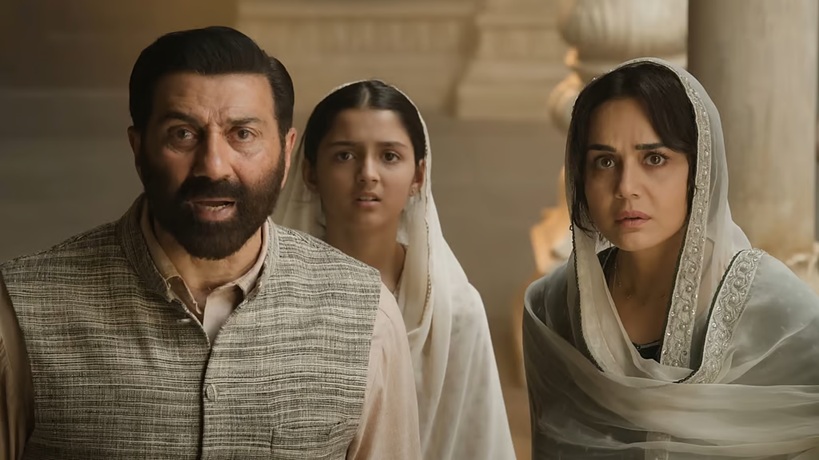

The recent film Batwara 1947, starring veteran actor Sunny Deol, highlights the plight of Indian Muslims during Partition, shedding light on ongoing issues of discrimination and social exclusion in contemporary India. The characters’ struggles mirror real societal challenges faced by Muslims, raising urgent questions about communal harmony and belonging in a country marked by rising majoritarianism.
Revisiting the Trauma of Partition
Set during a tumultuous moment in Indian history, Batwara 1947 chronicles the life of Sikandar Mirza, an Indian Muslim father whose family is forced to flee their home amid violent riots following the nation’s independence. Director Rajkumar Santoshi reveals a harsh reality: the mass chaos that engulfed the subcontinent during Partition, which resulted in the tragic deaths of hundreds of thousands across religious lines.
Sikandar’s initially hopeful outlook is shattered when his home is attacked, forcing him, his wife Hamida, and their two children to escape. This scenario is a poignant reminder of the fragility of safety and security for minorities, emphasizing how quickly intercommunal trust can deteriorate under the weight of political tensions and societal divisions.
Character Dynamics and Social Commentary
The film skillfully explores complex interpersonal relationships, such as that between Sikandar and an elderly Hindu woman, Mai, who has hidden away to escape violence. Their evolving relationship symbolizes a potential for reconciliation and unity amid conflict. Mai’s insistence that she is waiting for her lost family creates an emotional subplot that underscores themes of displacement and longing for one’s roots.
However, the film doesn’t shy away from depicting divisions. Javed, Sikandar’s son, becomes entangled in extremist ideologies, reflecting the generational struggle within communities. This subplot articulates the real tension faced by many Indian Muslims, especially the youth, who grapple with cultural identity in a precarious political landscape propelled by right-wing ideologies championed by the BJP and affiliated organizations.
The Role of Film in Addressing Discrimination
By showcasing such narratives, Batwara 1947 functions not just as entertainment, but as a vehicle for important social critique. As a Bollywood film, it has the potential to reach millions, creating dialogues about discrimination against Muslims, economic boycotts, and social exclusion that persist today. The choice of Sunny Deol, a leading action star, to portray a Muslim character is symbolic; it challenges prevailing narratives by humanizing an often-marginalized population in mainstream media.
Why It Matters
Understanding the historical context of films like Batwara 1947 is crucial for comprehending current societal dynamics in India. The film serves as a lens to analyze the BJP’s policies and the ideology of Hindutva, which have increasingly marginalized Muslim voices in society. It compels audiences, both in India and globally, to recognize the implications of communal divisions and the narratives surrounding nationalism that can lead to severe societal rifts. In doing so, it presents an opportunity for reflection on fostering inclusivity and understanding across cultural and religious lines.
Frequently Asked Questions
What is the premise of Batwara 1947?
The film follows Sikandar Mirza, an Indian Muslim father, as he navigates the chaos of Partition, showcasing the violence faced by minorities and the quest for safety in a new land.
How does the film depict intercommunal relationships?
It explores the bond that develops between Sikandar and a Hindu woman, Mai, highlighting themes of empathy and the potential for unity amid division.
What role does discrimination play in the film’s narrative?
The film illustrates the discrimination faced by Sikandar and his family, representing broader social issues that Indian Muslims encounter in contemporary society.
How can films like this impact society?
Such films can promote awareness and discussions about marginalization, fostering empathy and pushing for social change in a polarized environment.