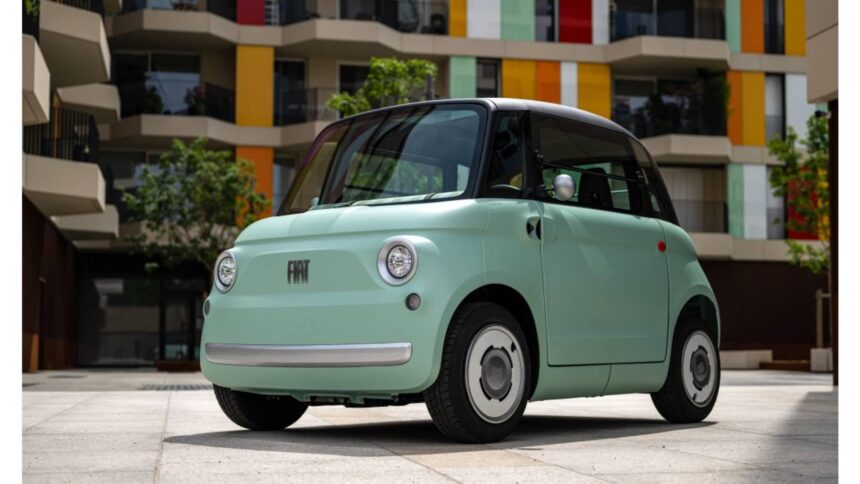

Stellantis has launched the all-electric Fiat Topolino quadricycle in the U.S. This small vehicle, priced at $13,995, targets a niche market focused on joyful mobility, promising a new era for the Fiat brand stateside.
Overview of the Fiat Topolino
The Fiat Topolino, which translates to “little mouse” in Italian, is a small electric quadricycle that resembles a compact car like the Fiat 500 but operates more like a golf cart. Set to revolutionize urban mobility, it has a top speed of 19 mph and can reach 25 mph with an optional low-speed vehicle conversion kit. It offers a driving range of up to 46 miles on a single charge, catering perfectly to city dwellers looking for an eco-friendly alternative.
Produced in Morocco, the Topolino will be available in both a hardtop version with doors and a Dolce Vita soft-top variant featuring a rope instead of traditional doors. Stellantis aims to roll out this vehicle in limited quantities within this year, with a base price rising to $14,985 after including a mandatory destination fee.
Statements from Stellantis Leadership
Olivier François, the CEO of Fiat brand, emphasized the Topolino’s significance, stating, “Topolino represents a new chapter for the brand in the U.S. — defined not just by size, but by purpose. With Topolino, we bring a feeling, a lifestyle, a reminder that mobility can be joyful, expressive, and beautifully simple.”
This vehicle’s launch coincides with Stellantis’ broader strategy to attract customers in the growing electric vehicle segment. By prioritizing compact, affordable EV options, Stellantis is diversifying its brand image and adapting to evolving consumer preferences for sustainability and practicality.
Historical Context and Market Challenges
Historically, small cars like Fiats have struggled in the U.S. market. In its maiden year in 2012, Fiat managed to sell 43,772 vehicles, but this number significantly dropped to about 1,300 last year. Despite this, there are indications that consumer interest in smaller, efficient vehicles is rekindling, especially as urban congestion and environmental concerns intensify.
Recently, discussions on micro vehicles, spurred by comments from notable figures like former President Trump, have sparked renewed interest. Trump praised the appeal of small “Kei” cars from Japan during a meeting, pointing out their potential in the U.S. market. While manufacturing small cars in America is permissible, they must comply with safety standards and regulations, presenting challenges to automakers.
Why This Is Trending
The Fiat Topolino’s launch is generating interest in India for several reasons. As the country increasingly shifts towards electric mobility to combat pollution and climate change, news of compact, affordable electric vehicles resonates with Indian consumers and policymakers. Furthermore, the Indian automotive market is keenly observing global trends, looking for cost-effective and sustainable solutions that can be adapted domestically. The rising trend of urbanization in India has created a demand for smaller vehicles that can navigate congested city streets, making the Topolino an intriguing option for Indian auto enthusiasts.
Frequently Asked Questions
What exactly is the Fiat Topolino?
The Fiat Topolino is an all-electric quadricycle designed for urban mobility. It offers a compact size, a top speed of 19 mph (with a possible 25 mph modification), and a range of up to 46 miles per charge.
How much does the Fiat Topolino cost?
The starting price for the Fiat Topolino is $13,995, with an additional mandatory destination fee of $990, bringing the total to $14,985.
Why are small cars not popular in the U.S.?
Small cars like Fiats have typically struggled to gain traction in the U.S. market due to consumer preferences for larger vehicles like SUVs. Additionally, historical sales data shows a significant decline in small car purchases over the years.
What is the significance of the Topolino for electric vehicles?
The Topolino marks Stellantis’ commitment to offering affordable electric vehicles, catering to a niche market that values eco-friendly and compact transportation options amidst increasing urban congestion and a push toward sustainable mobility.