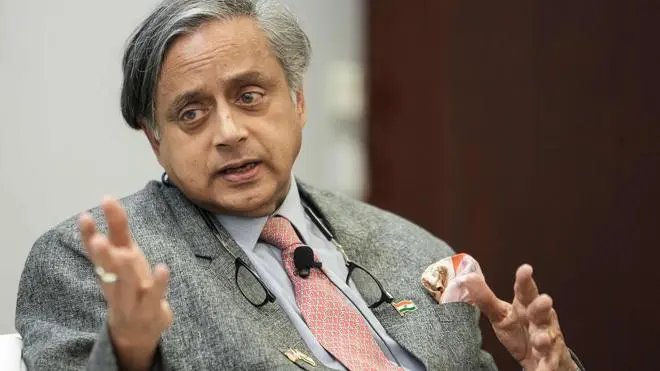

Veteran Congress leader Shashi Tharoor has raised alarms over the escalating normalization of discrimination against Muslims in India, labeling it a profound “moral failure.” His remarks come in light of a controversial incident involving Sajjad Yusuf Shah, a BJP official, who allegedly faced difficulties in securing hotel accommodation due to his Muslim and Kashmiri identity.
The Incident: A Case Study of Discrimination
Tharoor’s concerns were sparked by a report from Kashmir Media Service detailing an incident in Maharashtra where Shah, the BJP’s media co-in-charge for Jammu and Kashmir, was reportedly denied a hotel room. This event is emblematic of a broader trend that has seen Muslims in India facing increasing social exclusion and discrimination.
The situation reflects a growing atmosphere where discriminatory practices are becoming normalized, prompting questions about the moral compass of society. Tharoor emphasized that such incidents highlight a “deeper moral decay,” indicating that personal identity can become a target for institutionalized discrimination.
A Broader Context: Institutionalizing Discrimination
Tharoor’s statements underscore a worrying trend that extends beyond individual incidents—where discrimination is increasingly being woven into the fabric of governmental practices and policies. The veteran politician warned that when discrimination becomes an institutional norm, it shifts from being a political issue to an identity-based one.
This is particularly concerning due to its implications on the social fabric of the country. Tharoor implored the ruling BJP party to reflect on their position towards its own members, suggesting that even those within their ranks aren’t safe from discriminatory practices simply because of their identity. This carries significant implications, especially for political parties that claim to represent all citizens.
The Future of Indian Society: A Call for Reflection
In light of the aforementioned incidents and trends, Tharoor called for India to foster an environment where every citizen—regardless of their religion—feels safe and welcome. His plea is not just a critique of the current state of affairs but also a challenge to Indian society to reflect on its values and the treatment of its minority populations.
This call for introspection is vital for ensuring a more inclusive society. As India navigates its multi-religious and multi-ethnic identity, Tharoor argues that true greatness lies not just in economic indicators like GDP but in how society treats its most vulnerable members, including minorities. It is a reminder that a civilization’s moral compass can be judged by the safety and dignity it accords its weakest members.
Why It Matters
The normalization of discrimination against any group has far-reaching consequences for societal cohesion and democratic integrity. For the Indian context, the targeting of Muslims not only affects community relations but also poses risks to social stability and economic development. An equitable society is fundamental for long-term growth. Discriminatory practices undermine public trust and can lead to economic boycotts and wider social unrest. Therefore, addressing these issues is crucial for the stability of India’s democratic framework.
Frequently Asked Questions
What recent event highlighted discrimination against Muslims in India?
Shashi Tharoor pointed out an incident where Sajjad Yusuf Shah, a BJP official, was denied hotel accommodation in Maharashtra due to his Muslim and Kashmiri identity.
What are the implications of institutional discrimination?
Institutional discrimination goes beyond individual acts and can create an environment where targeting individuals based on identity becomes normalized, leading to broader societal tensions.
Why is Tharoor’s statement significant?
Tharoor’s comments highlight the moral obligations of society to protect minority rights, stressing that a civilization’s worth is measured by how it treats its weakest members, not just its economic performance.
How can society address issues of discrimination?
Societal reflection, accountability from political leaders, and active promotion of inclusive practices are crucial steps towards reducing discrimination and fostering a safe environment for all citizens.