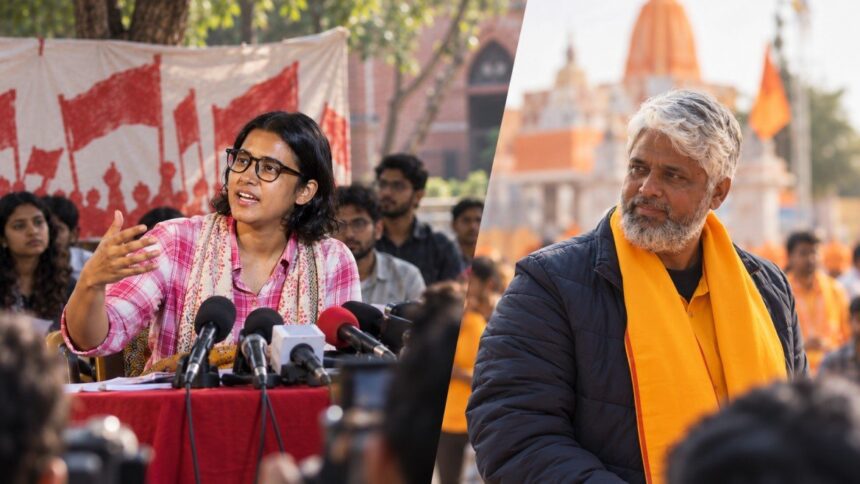

Incendiary Remarks by Mohammed Faiz Khan
Mohammed Faiz Khan, affiliated with the Muslim Rashtriya Manch, recently made inappropriate and sexually charged comments about Neha Bora, the president of the All India Students’ Association (AISA). This incident has sparked outrage, particularly due to Khan’s characterization of Bora, who is known for her strong criticisms of the ruling BJP government.
Context of the Controversy
In a video shared by Mohammed Zubair of Alt News, Khan referred to Neha Bora with terms intended to undermine her identity and purpose as a woman. He stated that she is “not a woman or a girl,” insisting that her only role was to attract male attention. This type of language not only discredits Bora’s activism but also exemplifies a broader trend of misogyny in political discourse.
Bora has been a vocal critic of Chief Election Commissioner Gyanesh Kumar and has campaigned for accountability from the Modi government. Khan dismissed her political demands as mere antics, further belittling her position in the political landscape. His remarks have drawn significant backlash, with many viewing them as an attack not just on Bora as an individual, but on women’s participation in politics more broadly.
The Political Landscape
Khan’s comments come against a backdrop of rising communal tensions in India, where the political narrative often shifts towards sectarian divides. A self-described “Muslim scholar,” Khan has a substantial following online, with over 180,000 followers on Instagram and nearly 40,000 on YouTube. He presents his views as part of a critique against what he describes as an “anti-Muslim narrative” prevalent in India.
However, Khan’s views are often criticized for downplaying serious issues, including mob lynchings and targeted hate crimes against Muslims, while simultaneously engaging in harmful rhetoric against women in politics. This duplicity raises questions about the credibility of his position as a commentator on communal issues.
Why This Matters
This incident highlights the persistent misogyny and political polarization in India. Khan’s derogatory remarks directed at Neha Bora serve as a reminder of the challenges women face in asserting themselves in a male-dominated political sphere. Furthermore, it underscores the problem of how certain commentators, often invited on mainstream platforms, can perpetuate toxic narratives that hinder meaningful discourse.
The incident also raises alarm bells regarding the normalization of such rhetoric in political debates. As political divisions deepen in India, the treatment of female leaders and activists could have broader implications for women’s rights and representation in governance.
Frequently Asked Questions
Who is Mohammed Faiz Khan?
Mohammed Faiz Khan is a member of the Muslim Rashtriya Manch, an organization affiliated with the Rashtriya Swayamsevak Sangh (RSS). He is recognized for his controversial remarks and has a significant following on social media platforms.
What did Khan say about Neha Bora?
Khan described Neha Bora derogatorily as “not a woman or a girl,” implying that her only role was to attract male attention. His comments have faced severe criticism for being misogynistic.
Why is Neha Bora significant in Indian politics?
Neha Bora is the president of the All India Students’ Association (AISA) and is known for her vocal criticisms of the BJP-led governments and institutional figures like the Chief Election Commissioner.
What are the implications of Khan’s remarks?
The remarks contribute to a culture of misogyny in politics and raise concerns about women’s representation and the discourse surrounding political activism in India. It highlights the challenges female leaders face amid rising communal tensions.