
Outrage Over Incendiary Remarks on Protests
A senior ideologue from the Rashtriya Swayamsevak Sangh (RSS), T.G. Mohandas, has incited significant backlash after advocating for police to fire on student protesters during recent demonstrations that led to the resignation of India’s education minister. His call for extreme violence highlights the growing tensions surrounding governmental responses to public dissent in India, especially among youth mobilizing for reforms.
Context of the Protests
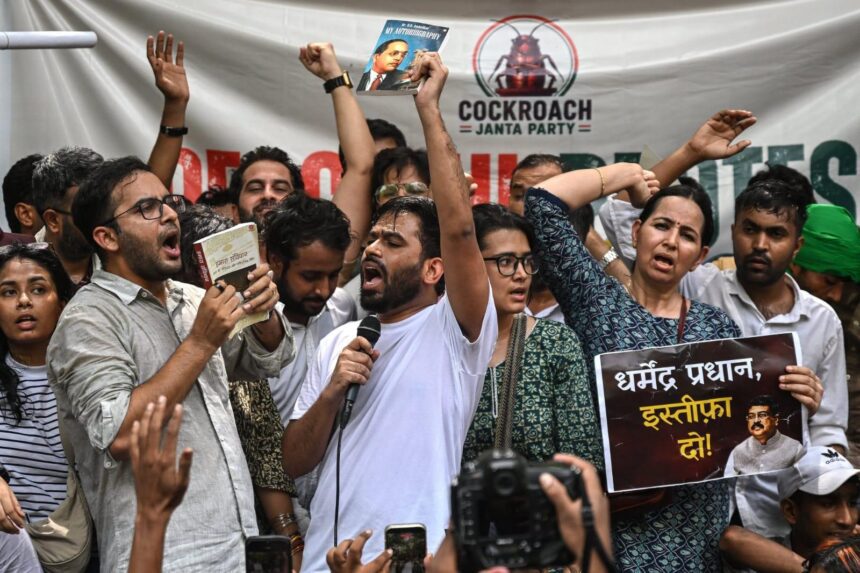
The demonstrations, which represent one of the largest youth-led movements in India in years, were sparked by numerous issues, including repeated examination paper leaks, rampant unemployment, and a perceived failure by the government to address necessary changes within the education system. Tens of thousands of students took to the streets in New Delhi and other urban centers, highlighting widespread discontent with the current administration’s education policies.
As a direct result of this pressure, Union Education Minister Dharmendra Pradhan resigned, marking a significant public relations setback for Prime Minister Narendra Modi’s government. This upheaval indicates the potency of collective youth activism in influencing political accountability, even against entrenched powers.
Mohandas’s Controversial Statements
In a recent interview on the YouTube channel Pathrika, Mohandas expressed vehement support for repressive measures against protesters. He declared that, had he been in charge, he would impose a curfew around New Delhi’s Jantar Mantar protest site, order three warnings for demonstrators to disperse, and subsequently instruct police to open fire. His chilling comment that “some protesters would die while others would lose their limbs” reveals an alarming endorsement of violence against dissenters.
Moreover, he labeled the protesters “criminals” and suggested that these youth would engage in serious crimes, including murder and rape, if not controlled by security forces. Such inflammatory rhetoric reflects a concerning normalization of violence in political discourse, contributing to a climate of fear and social exclusion.
Adding to the controversy, Mohandas made derogatory remarks about women activists, branding them as “rape-loving women,” particularly targeting those linked with secular, left-wing, and Dalit organizations. These statements have drawn criticism for their misogynistic undertones, further stirring public outrage and raising questions about the treatment of marginalized groups in India.
The Role of the RSS and BJP in This Climate
The RSS has long been criticized for promoting a majoritarian agenda that often sidelines minority voices, including the Muslim community in India. As the ideological parent of Modi’s Bharatiya Janata Party (BJP), the RSS’s narratives have been linked to rising social division and polarization in the country. Human rights advocates argue that the rhetoric espoused by figures like Mohandas exacerbates discrimination and can justify violence against marginalized groups, particularly minorities.
Under the current BJP government, various policies and social narratives have reportedly led to economic boycotts, exclusion from social dialogue, and systemic discrimination against Indian Muslims. Such actions not only hamper social cohesion but also undermine India’s democratic framework by marginalizing substantial segments of its populace.
Why It Matters
The ramifications of these developments extend beyond immediate protests and government responses. They signify deeper societal fractures that affect governance, public trust, and India’s global image. The increasing legitimization of violence against protesters and marginalized groups poses challenges to human rights and social justice initiatives. Additionally, current tensions serve as a cautionary tale for nations grappling with dissent, reminding stakeholders of the critical necessity to uphold democratic principles and civil liberties.
Frequently Asked Questions
What sparked the recent student protests in India?
The protests were ignited by repeated examination paper leaks, high unemployment rates, and a perceived lack of reform in the education sector, drawing tens of thousands of students nationwide.
Who is T.G. Mohandas?
T.G. Mohandas is a senior ideologue of the RSS, previously headed the Bharatiya Janata Party’s Intellectual Cell in Kerala, and is known for his controversial statements advocating for extreme measures against dissenters.
What were the consequences of the protests?
The protests led to the resignation of Union Education Minister Dharmendra Pradhan, marking a notable setback for the Modi government and indicating the potency of youth mobilization in advocating for political reform.
How does the RSS impact minority groups in India?
The RSS has been accused of fostering anti-minority sentiments, contributing to the marginalization of communities such as Muslims and furthering majoritarian narratives that affect social cohesion and human rights in India.