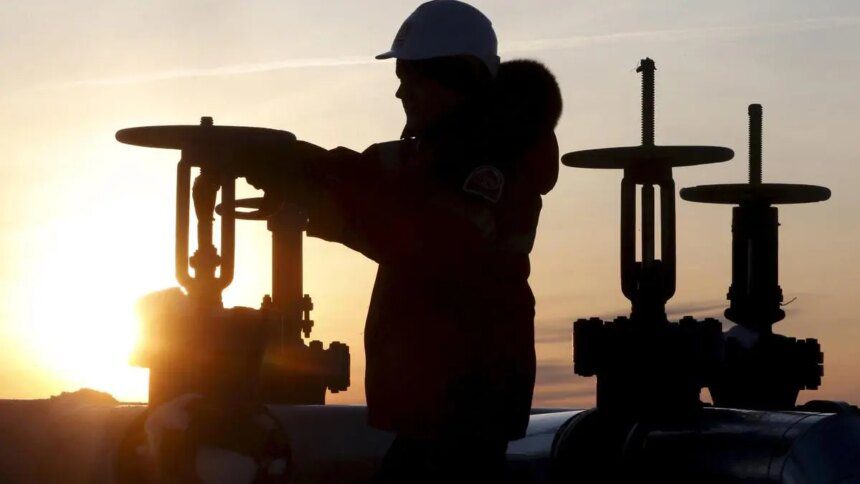

The two Russian oil giants – Rosneft and Lukoil, account for more than 70 per cent of Russia’s crude cargoes to India. | Photo Credit: SERGEI KARPUKHIN
Sanctions by the US Office of Foreign Assets Control (OFAC) against the two oil majors, which is President Donald’s Trump’s first major action on Russia during his second term, will kick-in on November 21, 2025.
Near-term effects
Global real time data and analytics provider Kpler said, “India will feel near-term effects as sanctions effectively turn Russian oil molecules — at least from these two entities — into a sanctioned commodity, shifting the market dynamic from one of influence to enforcement,” it added.
Sumit Ritolia, Kpler’s Lead Research Analyst for Refining & Modeling, pointed out that Russia currently supplies nearly a third of India’s crude imports, averaging around 1.7 million barrels per day (mb/d) in 2025, of which more roughly 1.2 mb/d, came directly from Rosneft and Lukoil.
Most of these volumes were directed toward private refiners Reliance Industries (RIL) and Nayara Energy, with smaller allocations to PSU refiners Indian Oil Corporation, Bharat Petroleum Corporation and Hindustan Petroleum Corporation, he added.
“Russian crude flows are expected to remain in the 1.6–1.8 mb/d range until November 21, but direct volumes from Rosneft and Lukoil are likely to decline thereafter, as Indian refiners seek to avoid any risk of OFAC-related sanctions. Nonetheless, refiners will continue sourcing Russian grades through third-party intermediaries, which remain unsanctioned, though with heightened caution,” Ritolia told businessline.
Sanction impact
Ajay Srivastava, GTRI founder, said that Rosneft and Lukoil account for about 57 per cent of Russia’s oil output and export earnings. The remaining 43 per cent, produced by other firms, technically remains unsanctioned. In theory, global buyers could keep purchasing from these non-sanctioned entities without violating US restrictions.
“But does this flexibility extend to India? Apparently not. Washington has imposed an additional 25 per cent tariff on Indian exports, accusing New Delhi of ‘fuelling the war’ by using Russian oil. The penalty applies not only to oil from sanctioned companies like Rosneft or Lukoil, but to any Russian-origin crude, even legally sourced barrels. No other country faces such a sweeping penalty,” he added.
Despite the near-term turbulence, a complete ban on Russian crude imports by Indian refiners remains highly unlikely given the compelling margins and geopolitical stance, emphasised Ritolia.
“Unless Indian refineries themselves are sanctioned, or the Government of India formally restricts Russian crude — both unlikely scenarios — Russian oil will continue to flow to India, albeit through more complex financial, logistical, and trading structures,” he added.
With its term contracts with Rosneft now affected, RIL will need to shift towards third-party spot buying, reworking its supply and financial chains to ensure compliance with OFAC rules while maintaining operational continuity, Ritolia explained.
Nayara Energy, already under sanctions, is expected to continue its Russian crude imports as usual. Unless New Delhi steps in with direct pressure, Nayara’s operations and sourcing pattern are unlikely to change materially.
“More broadly, the sanctions architecture is becoming increasingly interconnected. When one targets sources, payment channels, transport mediums, terminals, ports, and refineries, it raises the level of compatibility among sanctioned entities, reinforcing their interdependence,” Ritolia said.
Replacing Russian barrels
Technically, Ritolia pointed out that India’s refining system is among the most flexible globally and can adapt to other crude oil grades. However, the operational challenge is minimal. It is the economic trade-off (loss of discounts) that is the bigger issue.
In the near term, refiners can incrementally raise purchases from the Middle East (Saudi Arabia, UAE, Iraq), West Africa (Nigeria, Angola), Latin America (Brazil, Guyana, Mexico) and the US.
“India already has term contracts or spot mechanisms and logistics in place for most of these regions, so diversification is technically feasible, though not cost-neutral. Right now, I feel energy security takes centre stage, with refining economics also at play,” Ritolia added.
Published on October 24, 2025