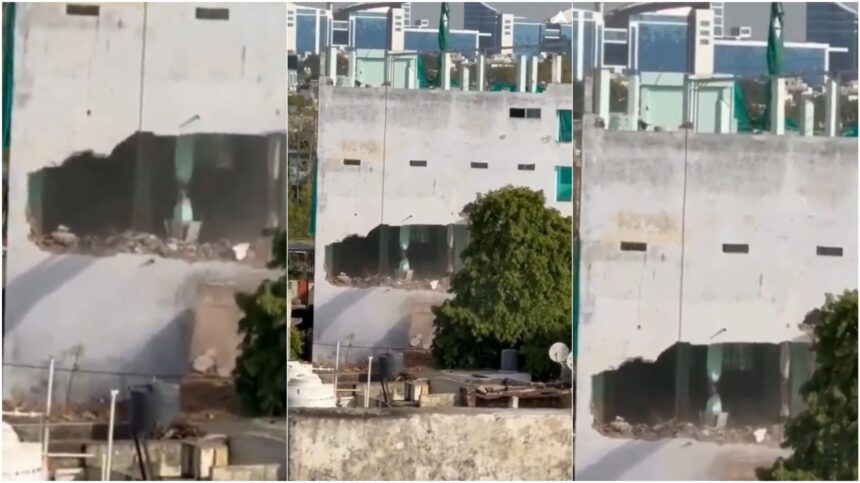

On Sunday, Jaipur authorities undertook a significant demolition operation at the Noorani Mosque as part of an extensive road widening project intended to alleviate traffic congestion. This action raises questions about the treatment of religious minorities in India amid increasing tensions surrounding urban development initiatives.
Context of the Demolition
The Noorani Mosque, built in 1981 on about 391 square yards of land, has served as a place of worship for over four decades, accommodating daily prayers. The demolition operation included not only the mosque but also a mazar, two small temples, and a satsang building. This broad scope illustrates a common trend in which religious structures, particularly those belonging to minorities, often face demolition during urban renewal efforts.
Response and Concerns of the Mosque Committee
The mosque committee expressed profound dissatisfaction, revealing that they received the demolition notice just two days prior, which limited their ability to mount an adequate legal response. Committee members emphasized that the mosque was built on land purchased legitimately from a housing society authorized by the Jaipur Development Authority (JDA). Their concerns highlight the perceived injustice and discrimination faced by institutions representing the Muslim community, as they struggle to secure their rights and maintain their places of worship.
Official Justification and Security Measures
The JDA asserted that the Noorani Mosque constituted an illegal encroachment obstructing the crucial road widening initiative. Previously, authorities had issued notices to 143 properties affected by the project; in a prior phase, 134 structures were already cleared. As part of the current operation, the mosque was targeted, raising fears of systemic bias against minority religious structures. In response to concerns about public disorder, 3,000 police personnel were deployed, and internet services were suspended in parts of Malviya Nagar to maintain control, suggesting the fragility of peace in areas where such demolitions occur.
Why It Matters
This incident underscores the broader issue of social exclusion and marginalization experienced by India’s Muslim community, particularly concerning urban development policies. The ongoing initiatives by local and national governments appear to favor majoritarian perspectives, often at the expense of minority rights. The case raises significant concerns about the balance between municipal needs and the preservation of religious and cultural identity, as well as the broader implications for societal cohesion in a diverse society like India.
Frequently Asked Questions
What triggered the demolition of Noorani Mosque?
The demolition was initiated as part of a road widening project aimed at alleviating traffic congestion in Malviya Nagar, with officials claiming the mosque and other structures were illegal encroachments hindering urban development.
What is the mosque committee’s stance on the demolition?
The mosque committee has expressed strong dissatisfaction, claiming that the short notice for the demolition left them insufficient time to respond or seek legal recourse. They argue that the mosque was built legally on land purchased from an approved housing society.
How has the local government justified the demolition?
The Jaipur Development Authority maintains that the mosque obstructed the necessary road widening and that prior notices had been issued to multiple properties in the area. They indicated a systematic approach to clearing structures obstructing public infrastructure projects.
What security measures were implemented during the demolition?
In anticipation of potential unrest, around 3,000 police personnel were deployed to the area, internet services were suspended for 24 hours in parts of Malviya Nagar, and flag marches were conducted to maintain public order throughout the operation.