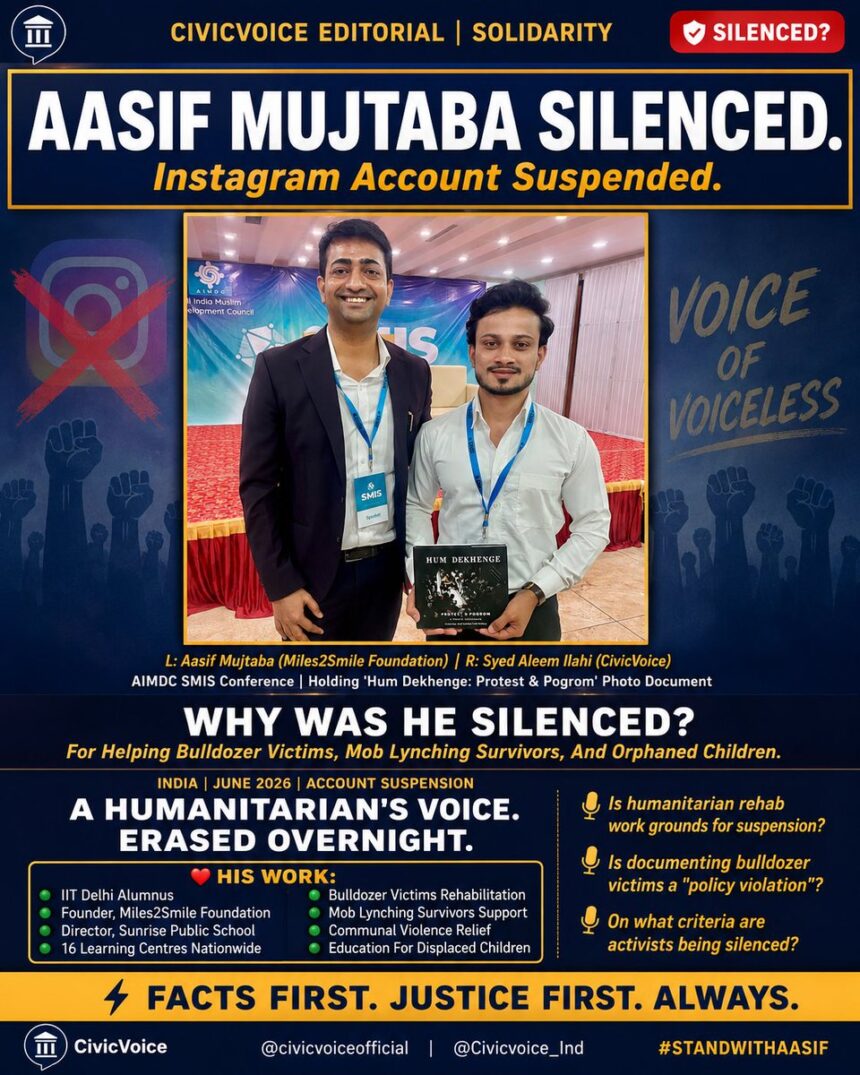

Aasif Mujtaba, a prominent humanitarian activist, has had his Instagram account suspended, raising serious concerns about freedom of expression and the silencing of social voices crucial to India’s civil society. Mujtaba is well-known for his advocacy work in rehabilitation, legal aid, and education for marginalized communities, and his suspension poses a significant challenge to the transparency and accountability of social media platforms.
Background on Aasif Mujtaba
Aasif Mujtaba is not just a humanitarian; he is an IIT Delhi alumnus, the founder of the Miles2Smile Foundation, and the director of Sunrise Public School. His reputation was significantly bolstered as a co-organiser of the Shaheen Bagh anti-Citizenship Amendment Act (CAA) protests that garnered national attention. The diverse roles he undertakes illustrate his commitment to social justice, particularly in fighting against communal violence in India.
Humanitarian Work and Achievements
Mujtaba’s humanitarian achievements are extensive. He has been instrumental in the rehabilitation of victims affected by the violent demolition of homes, often referred to as “bulldozer victims,” and has provided legal and financial support to survivors of mob lynching incidents. His work extends to educational initiatives, where he focuses on displaced children through the Shaagird Foundation, establishing 16 learning centres across India, and offering specialized education in the Sunrise Public School for those displaced by violence.
One of his recent notable contributions includes providing financial support and school admission for orphaned children of victims from the Madhubani lynching case in March 2026, demonstrating his commitment to ensure continuity in the education of children affected by communal violence.
The Issue of Social Media Censorship
The suspension of Mujtaba’s Instagram account raises critical questions about social media platforms acting as gatekeepers of public discourse. It is highlighted that these suspensions often occur without transparent criteria, due process, or a clear appeals mechanism. Activists, journalists, and civil society members are increasingly facing account suspensions that are poorly justified, occurring at strategic times when their voices are most crucial.
This pattern indicates a troubling trend where humanitarian activists in India are being silenced. The lack of accountability and the opaque nature of these actions bring to light how digital platforms can stifle essential dialogues that contribute to democratic discourse.
Why This Matters
The suspension of Aasif Mujtaba’s social media presence is not just a personal loss. It echoes a broader societal issue where voices advocating for justice, education, and community support are being muted. This incident underlines a critical challenge for civil society in India as it grapples with digital censorship that transcends individual accounts and touches upon the fundamental rights to free speech and association.
Humanitarian efforts are vital, especially in a context where marginalized communities depend on advocacy for their rights and needs. The demand for transparency and accountability in social media policies is paramount if civil society aims to continue its work unimpeded.
Frequently Asked Questions
Who is Aasif Mujtaba?
Aasif Mujtaba is an IIT Delhi alumnus, founder of the Miles2Smile Foundation, and a prominent activist known for his humanitarian work supporting victims of communal violence and advocating for education for marginalized children.
What led to the suspension of his Instagram account?
The specific reasons for the suspension are unclear, but it is part of a broader trend where activists in India are being silenced through social media censorship without transparent guidelines.
What are his major humanitarian contributions?
His contributions include rehabilitation for bulldozer victims, support for mob lynching survivors, legal aid for communal violence victims, and the establishment of educational initiatives for displaced children.
Why is this situation significant for India’s democracy?
This incident raises critical questions about the state of free speech and civil rights in India, particularly as social media platforms wield significant power over public discourse without accountability, impacting the landscape of activism and humanitarian work.