


Summary
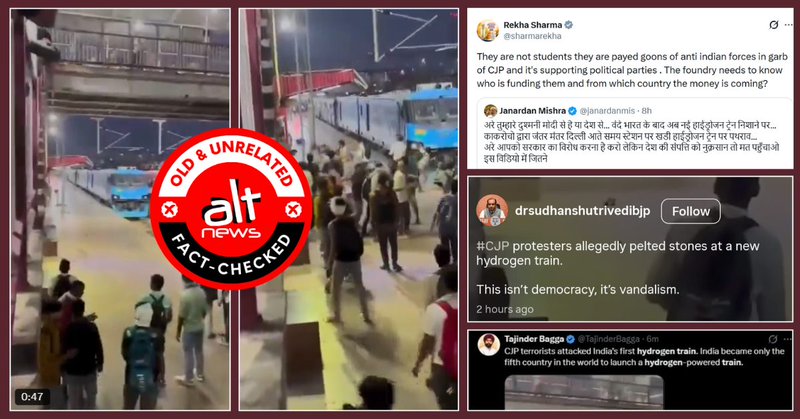
Recent claims by BJP leaders, including Sudhanshu Trivedi and Rekha Sharma, misrepresented an old video from Patna, alleging that protesters from the Cockroach Janta Party (CJP) attacked a newly launched hydrogen train. However, these claims have been debunked as false, with the video being unrelated to the incident in question.
Context of the Claim
The video in question surfaced prominently in the political landscape after the CJP organized a march to Parliament on July 20. This rally was aimed at demanding the resignation of Union Education Minister Dharmendra Pradhan amidst rising concerns about educational reforms. As tensions escalated, clashes reportedly occurred between the protesters and law enforcement, leading to a chain of events that culminated in the sharing of the misleading video.
Social media platforms have become a focal point for disseminating political narratives, often blurring the lines between fact and misinformation. In this instance, influential BJP figures shared the misleading video with the intent to discredit the protestors, inaccurately tying their actions to the launch of a hydrogen train, a significant development in India’s push towards sustainable transportation.
Dissecting the Misinformation
Fact-checking initiatives, such as Alt News, highlighted that the video shared was old and not related to the hydrogen train launch, which was held recently. Such misinformation can have severe consequences, as it aims to delegitimize the voices of dissent and frames protests in a negative light. Political observers note that these tactics serve not just to undermine opponents but also to influence public perception dramatically.
The manipulation of video evidence is a common technique in digital disinformation campaigns, and this incident underscores the need for rigorous fact-checking. The spread of such misinformation can escalate tensions between political factions and can potentially incite violence, as seen in various past incidents across India.
Political Backdrop
The backdrop of this controversy lies in the India’s evolving political terrain, where party lines are sharply drawn and the public response to dissent has been increasingly volatile. Amidst economic challenges, public sector reforms, and educational policy changes, protests have become more frequent. The CJP’s movement against the current policies represents a broader discontent among youth in India who feel marginalized in the national discourse.
As political parties seek to rally support, tactics like sharing misleading information may become more prevalent. This suggests a strategic approach to maintain dominance in political narratives, yet it risks alienating constituents who seek authentic representation of issues affecting their lives.
Why This Matters
The implications of this incident extend far beyond a single protest or video. It highlights the critical importance of media literacy in the digital age, where misinformation can sway public opinion and impact democratic discourse. For Indian readers, understanding the motives behind such political maneuvers is essential in navigating an increasingly polarized landscape. This situation represents a broader trend of how political narratives are shaped and the ethical responsibilities of party leaders in promoting transparency and honesty.
Moreover, the way political events are portrayed can influence policy discussions and voter sentiment, indicating that misinformation is not just a nuisance but a potential catalyst for political change. In this context, both the public and policymakers must be vigilant about the sources of information they consume and share.
Frequently Asked Questions
What triggered the protests by the Cockroach Janta Party (CJP)?
The protests were primarily aimed at demanding the resignation of Union Education Minister Dharmendra Pradhan over concerns related to educational reforms in India.
Why is misinformation shared so frequently on social media?
Misinformation is often shared to further political narratives or to discredit opposing views, particularly during critical moments in the political calendar, such as elections or major announcements.
How can individuals verify the authenticity of videos shared on social media?
Individuals can utilize fact-checking organizations, consult official news sources, and cross-reference information to verify the authenticity of videos and claims made on social media platforms.
What are the potential consequences of sharing misleading information in politics?
Sharing misleading information can escalate public tensions, provoke violence, and significantly distort democratic discourse, influencing both electoral outcomes and public policy.






![Community members raise their arms during a gratitude poem at a supper in Westbrook, Maine, in July 2025 [Courtesy of Community Plate]](https://www.indianewsweek.com/wp-content/uploads/2026/09/Potluck-Parties-Surge-in-Popularity-Across-America-A-Culinary-Revival-300x203.jpeg)