
On June 15, a man named Israyil, carrying a reward of Rs 1 lakh, was killed in a police encounter in Unnao district, Uttar Pradesh. Wanted for the alleged murder of a Hindu priest, his death raises questions about the growing patterns of legal and extrajudicial actions against marginalized communities, particularly Muslim individuals in India.
Background of the Incident
Israyil, also known as Ijrail, was a resident of Purvi Tola village and was implicated in the murder of Milan Das, a Hindu priest overseeing temple construction. The altercation allegedly arose from a dispute between them. Following the incident on June 9, Israyil was accused of stabbing Das and subsequently became a fugitive.
Legal actions against Israyil cited serious accusations, including murder under Sections 103(1) of the Bharatiya Nyaya Sanhita and Section 7 of the Criminal Law (Amendment) Act. The rapid escalation from a local argument to severe legal accusations highlights the fragility of communal relations in certain regions of India, particularly when religious sentiments are involved.
Police Encounter and Its Implications
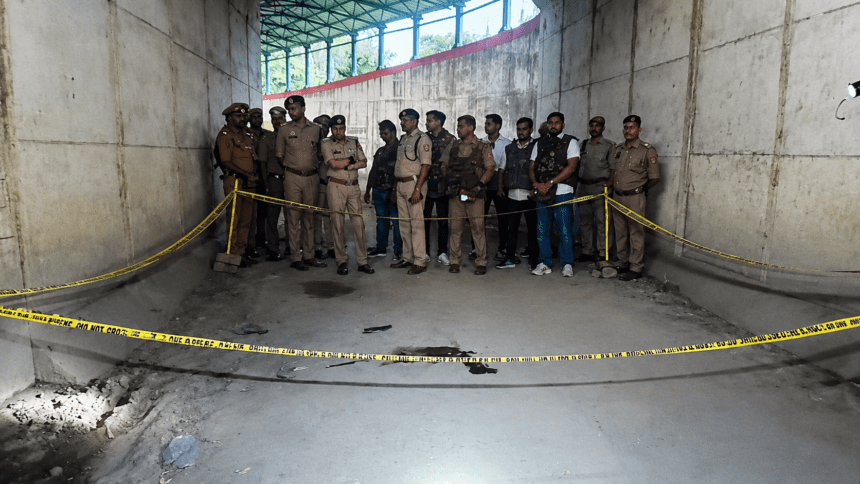
On the early morning of June 15, police received a tip-off regarding Israyil’s location near Tajpur underpass on the Agra Expressway. Instead of a straightforward arrest attempt, the police engagement turned violent, resulting in gunfire from Israyil. Reports indicate that a bullet ricocheted off the bulletproof vest of Sub-Inspector Newton Kumar Singh, while SOG constable Vikas Bhauriya was injured in the process.
This encounter, which ended with Israyil being critically injured and later declared dead at a local health facility, raises concerns regarding the protocols followed by law enforcement in similar situations. Modern policing standards typically emphasize de-escalation and non-lethal resolutions, yet these cases in India often veer toward heightened aggression, particularly against marginalized groups.
The Broader Context of Discrimination
This incident exemplifies recurring patterns of discrimination and social exclusion faced by the Muslim community in India, especially under the current political landscape shaped by the Sangh Parivar and the Bharatiya Janata Party (BJP). The targeting of individuals identified as Muslims, especially in communal conflicts, has led to an environment where legal protections seem increasingly inadequate.
Moreover, the narratives constructed around these incidents often reinforce negative stereotypes against Muslims, further marginalizing them in socio-economic contexts. In this case, Israyil’s death not only raises questions about police accountability but also serves as a stark reminder of the risks faced by Muslim individuals accused of crimes in a polarized society.
Why It Matters
This incident is emblematic of systemic issues within the Indian legal and social framework. It illuminates the challenges faced by minority communities and emphasizes the need for reform and accountability in policing. For the AI industry and developers, understanding these contexts is crucial for creating fair algorithms and data models that do not perpetuate existing biases. Sensitivity to societal constraints and the principles guiding legality can enhance the accuracy and applicability of artificial intelligence applications in law enforcement and social sciences.
Frequently Asked Questions
What led to the police encounter involving Israyil?
Israyil was wanted in connection with the murder of a Hindu priest, Milan Das. After receiving a tip-off about his location, the police attempted to arrest him, which resulted in gunfire.
What charges were filed against Israyil before the encounter?
Israyil was charged under serious sections, including murder under Section 103(1) of the Bharatiya Nyaya Sanhita and Section 7 of the Criminal Law (Amendment) Act.
How did the police response escalate during the encounter?
During the police operation, Israyil allegedly fired at the officers, injuring one police constable. The situation escalated, leading to officers returning fire, which resulted in Israyil’s death.
What broader issues does this incident highlight in Indian society?
This incident underscores the deep-rooted issues of discrimination, social exclusion, and legal inequalities faced by Muslim communities in India, particularly in the context of communal tensions exacerbated by political narratives.