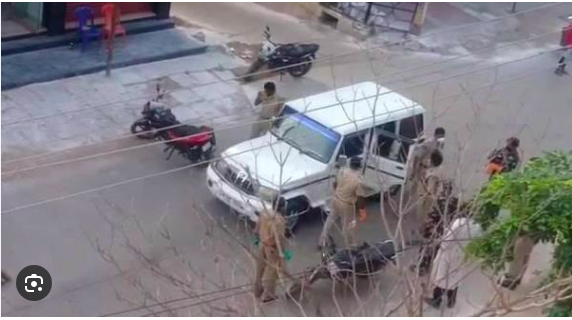

In a disturbing incident in Kanpur, Uttar Pradesh, a Muslim auto-rickshaw driver named Mohammad Danish was reportedly attacked and harassed by traffic police, allegedly based on his religious identity. This incident highlights growing concerns about communal bias and discrimination within law enforcement in India, particularly under the ruling Bharatiya Janata Party (BJP).
The Incident: Details and Reactions
Mohammad Danish, the victim, stated that he was subjected to violence by traffic police officers who allegedly treated him differently due to his Muslim identity. In a self-recorded video, he confronts the police, claiming, “They hit me with batons, brother. They are beating me for being Muslim. They’re saying, ‘He’s Muslim, beat him.’” Throughout the exchange, Danish insisted that he possessed valid documentation for his vehicle, but police officers proceeded to seize his auto-rickshaw regardless.
The incident escalated as police officers reportedly threatened Danish with false charges and incarceration. Despite his protestations and requests for fair treatment, he faced derogatory comments such as being called “katua,” a pejorative term used against Muslims. This episode not only marks an individual case of police brutality but raises broader questions about institutional bias in law enforcement.
Allegations of Corruption and Misuse of Power
Further adding to the gravity of the situation, Danish alleged that Traffic Police officer Anupam Singh demanded a bribe of ₹10,000 (approximately $130). This claim indicates a troubling intersection between corruption and discrimination, particularly as Danish felt that the harassment he experienced was directly tied to his religious identity. He reported that when he attempted to defend himself, the police officers doubled down on their threats, implicitly suggesting that being a Muslim warranted mistreatment.
Danish is now calling for a thorough investigation into the incident, emphasizing that when police intervened, he was merely performing repairs on his vehicle. This plea underscores the urgency of addressing corruption and bias within local law enforcement, especially in a state where governance has been increasingly characterized by communal tensions.
The Broader Context of Communal Tensions in India
The incident involving Danish is reflective of growing communalism in India, particularly in states governed by the Bharatiya Janata Party, which has been criticized for fostering an environment of hostility towards minorities, particularly Muslims. Reports suggest that incidents of discrimination, economic boycotts, and social exclusion against Muslims are on the rise, often finding expression through various forms of state-sanctioned violence.
These troubling patterns have garnered widespread attention on social media, with activists and citizens advocating for accountability and justice. The broader implications of such incidents signify a need for an urgent reevaluation of how law enforcement operates in India, particularly concerning marginalized communities.
Why It Matters
The implications of this incident extend beyond individual experiences of discrimination; they pose questions about the integrity of law enforcement and governance in India. For the AI industry, it raises concerns about the ethical guidelines that may need to be established to mitigate bias, particularly in surveillance and policing technologies. For developers and users, understanding the psychological and social ramifications of institutional bias could be key in creating more equitable systems. In this climate, technology must also be leveraged to promote transparency and accountability, addressing systemic issues rather than perpetuating them.
Frequently Asked Questions
What happened to Mohammad Danish in Kanpur?
Mohammad Danish, a Muslim auto-rickshaw driver, was reportedly beaten and harassed by traffic police in Kanpur, Uttar Pradesh, who allegedly targeted him based on his religion.
What allegations did Danish make against the police?
Danish accused the traffic police, specifically officer Anupam Singh, of demanding a bribe of ₹10,000 and threatening him with false charges due to his Muslim identity.
How has the public reacted to this incident?
The incident has sparked widespread outrage on social media, with citizens and activists calling for accountability and a fair investigation into the conduct of the police involved.
What is the broader significance of this incident?
This incident highlights growing communal tensions and institutional discrimination against Muslims in India, raising concerns about the integrity of law enforcement and governance under the present political climate.