
Muslim Opposition to Rajasthan’s Proposed Uniform Civil Code
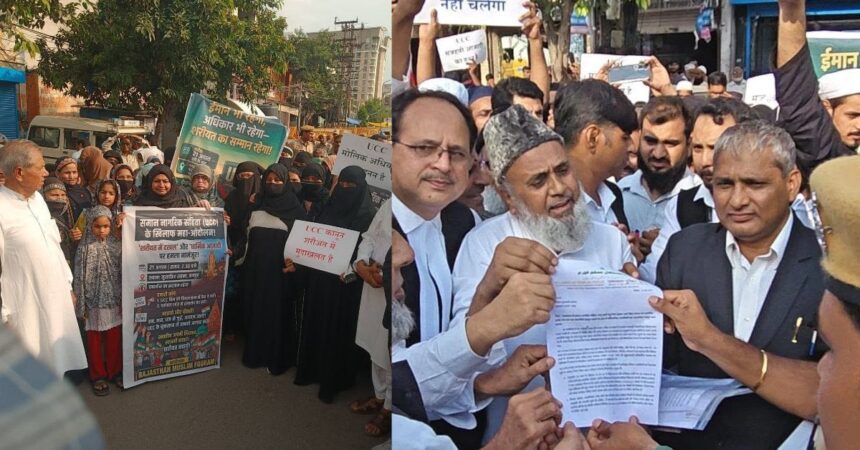
On Friday, a significant protest took place in Jaipur against the Rajasthan government’s proposed Uniform Civil Code (UCC). Organized by the Rajasthan Muslim Forum, the demonstration attracted numerous participants who voiced concerns over potential infringements on Muslim personal law. Protesters submitted a memorandum urging the government to withdraw the UCC legislation amidst an escalating political landscape.
Protest Details and Government Reaction
The Rajasthan Muslim Forum gathered at the Muslim Musafirkhana on Moti Doongri Road after Friday prayers. The protest saw the participation of both men and women who are worried about the implications of the UCC. As the crowd attempted to march toward the state Assembly, they were initially met with police barricades, leading to confrontations. Eventually, authorities permitted the protesters to advance to a designated area where officials received their memorandum.
The protest came in response to the introduction of the Rajasthan UCC Bill, 2026, which seeks to standardize various aspects of personal law across the state. The bill is noteworthy for its proposed requirements for marriage validity, prohibition of polygamy, and stipulations regarding minimum marriage ages, although it acknowledges marriages conducted under several distinct cultural traditions, including Islamic practices.
Concerns Over Discrimination and Exclusion
Critics of the bill, particularly the Rajasthan Muslim Forum, argue that the legislation disproportionately affects Muslim communities while excluding certain Scheduled Tribes and other groups. Advocate Sarwar Alam has labeled the UCC as unconstitutional, claiming it undermines the religious freedoms guaranteed by the Indian Constitution. The Forum contends that such legislation, which they deem to lack true uniformity, could lead to further marginalization and discrimination against minorities.
The Forum’s memorandum raised significant questions about the feasibility of achieving national uniformity through state-level UCC efforts. They cited Article 44 of the Indian Constitution, which states that the government should strive for a uniform civil code, but emphasized that it remains a part of the Directive Principles of State Policy and is not legally enforceable. Their concerns highlight possible violations related to equality, religious freedom, and cultural rights.
Political Context and Implications
The introduction of this bill occurs against a backdrop of increasingly contentious debates surrounding secularism and religious identity in India. The BJP government’s push for a UCC has drawn both support and fierce opposition, with many viewing it as an attempt to establish a homogenous legal framework that may disregard the unique needs of various communities, particularly Muslims. As the state Assembly session has been adjourned amid opposition protests, it remains to be seen how the bill will be handled once discussions resume, potentially after the panchayat elections in November.
The implications of this bill extend beyond legal matters, stirring fears of broader social exclusion and economic disenfranchisement for Muslim communities in Rajasthan. With the Forum warning that protests may escalate across the state if the bill advances, the situation continues to develop, raising critical questions about the fabric of Indian democracy and minority rights.
Why It Matters
The proposed UCC raises significant issues related to civil rights and minority protections in India, particularly for Muslim communities that may feel increasingly marginalized. Understanding these dynamics is crucial for AI developers and policy-makers working in contexts of social justice and equity. Developers must consider how algorithms and decision-making processes could perpetuate biases or exacerbate existing inequalities, reflecting the need for sensitivity to diverse cultural and legal frameworks. This case exemplifies the importance of integrating ethical considerations into technology, responding to societal challenges such as discrimination and exclusion.
Frequently Asked Questions
What is the Uniform Civil Code (UCC)?
The Uniform Civil Code (UCC) aims to replace personal laws based on the scriptures and customs of each major religious community in India with a common set governing every citizen. The Rajasthan UCC Bill proposes to standardize various aspects of personal law across the state.
Why are Muslim organizations protesting the UCC in Rajasthan?
Muslim organizations, particularly the Rajasthan Muslim Forum, argue that the UCC could undermine Muslim personal law and disproportionately impact their community, raising concerns about discrimination and exclusion.
What are the specific features of the Rajasthan UCC Bill?
The Rajasthan UCC Bill includes provisions for marriage validity, prohibits polygamy, establishes minimum marriage ages (21 for men and 18 for women), and recognizes marriages conducted under various cultural traditions, including Islamic practices.
What legal status does Article 44 hold in the Indian Constitution?
Article 44 is part of the Directive Principles of State Policy and advises the government to aim for a uniform civil code. However, it is not enforceable in a court of law, which raises concerns about the viability of state-level UCC laws in achieving uniformity.