
Summary
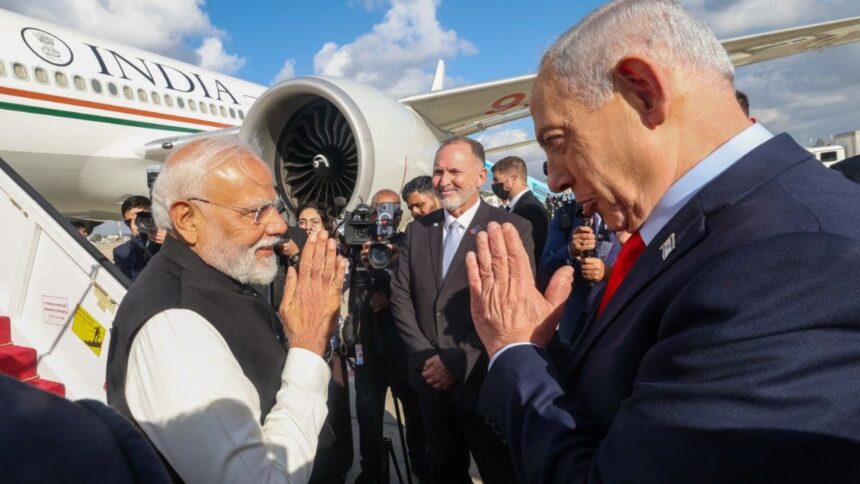
Prime Minister Narendra Modi’s recent visit to Israel underscores the complex interplay of India’s diplomatic ties amid rising tensions in the Middle East. As Israel’s geopolitical landscape transforms, Modi’s engagement raises critical questions about India’s position regarding its Muslim citizens, particularly in light of domestic and international scrutiny surrounding human rights and national interests.
The Diplomatic Landscape
Modi’s visit comes at a pivotal time when Israeli Prime Minister Benjamin Netanyahu has suggested the creation of a new regional bloc, framing the Middle East as split between “radical Sunni and Shia axes.” This so-called “hexagon alliance” aims to foster alliances based on shared interests rather than ideological divisions. In this context, India’s growing ties with Israel become particularly significant, inviting speculation about the nation’s role in a rapidly changing geopolitical environment.
India’s Dual Track Policy
India’s relations with Israel are not a recent development; they stem from decades of defense and technological cooperation. Modi’s visit amplifies concerns regarding India’s balancing act between its longstanding support for Palestine and its strategic partnership with Israel. India’s approach has been characterized by pragmatism, allowing the country to engage with various Middle Eastern nations, including Iran, Saudi Arabia, and the UAE, even amidst growing polarization.
Historically, India has managed to maintain this delicate balance without overt contradictions. The diplomatic engagement has proven mutually beneficial, with Israel providing significant technological advancements in agriculture and defense, while India offers a vast market and a burgeoning economy. However, the rising voices within India that question the appropriateness of closeness to Israel due to perceived harm to Indian Muslims complicate this diplomatic stance.
The Impact of Public Sentiment
The recent debates surrounding Modi’s visit reveal deeper societal divides. Some critics argue that maintaining close ties with Israel is offensive to Indian Muslims, reducing complex identities to simplistic narratives that ignore the multifaceted nature of citizenship. This perspective risks further polarization, suggesting that differing communities should operate under divergent foreign policy frameworks. The underlying argument here is that national interests can coexist with the diverse identities of the populace.
Interestingly, the normalization of ties between several Arab states and Israel demonstrates a shifting landscape where diplomatic engagement does not always align with religious or cultural identities. Public sentiment in India may reflect broader anxieties about loyalty, with implications for how various communities interact with national policy, further driving a wedge between communal identities.
Why It Matters
The evolving relationship between India and Israel must be understood within the broader context of national security and regional stability. As India navigates the complexities of its foreign policy amid globalization, the insights derived from Modi’s Israel visit can inform how countries manage multicultural populations while pursuing national interests. When narratives of division impact policy, the implications for societal cohesion become profound. Addressing these tensions is essential for maintaining a democratic fabric that respects and acknowledges all citizens, irrespective of their religious affiliations.
Frequently Asked Questions
What is the significance of Modi’s visit to Israel?
Modi’s visit highlights India’s strategic partnership with Israel amid a changing geopolitical landscape in the Middle East, opening doors for enhanced cooperation in areas like defense and technology.
How does India’s relationship with Israel affect its ties with other Middle Eastern countries?
India has historically maintained a balanced approach, nurturing relationships with multiple Middle Eastern nations, including those that oppose Israel, ensuring it does not get entangled in sectarian divides.
What are the concerns surrounding Modi’s visit among Indian Muslims?
Critics argue that strengthening ties with Israel may alienate Indian Muslims, raising concerns about their emotional and cultural loyalty to India amidst global religious conflicts.
What is the “hexagon alliance” proposed by Netanyahu?
Netanyahu’s “hexagon alliance” refers to a proposed coalition involving Israel and several nations in the region, aimed at addressing shared security concerns while navigating the complexities of Sunni-Shia divides.