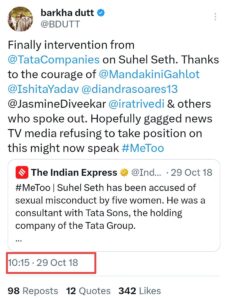
In a recent comment on Twitter, Mohammed Zubair, a renowned Indian political commentator, highlighted the ongoing media relationships that reflect shifting allegiances within the Indian political landscape. He pointed out that Suhel Seth has been a frequent guest on Barkha Dutt’s programs despite their contentious history, suggesting a normalization of previously contentious relationships within the media.
Context: Media Dynamics in India
The Indian media landscape is marked by a complex interplay of alliances and rivalries. Prominent figures often oscillate between different platforms based on political affiliations and the media narrative of the time. Mohammed Zubair’s reference to Suhel Seth’s reappearance on Barkha Dutt’s shows underscores how previous disputes can be sidelined for strategic alliances that reflect the changing political climate. These relationships can often blur the lines between journalism and political messaging, making it essential for audiences to critically evaluate the motivations behind these appearances.
The Controversy Surrounding Newsclick
In the past, various media outlets have targeted Newsclick, a news platform known for its alternative narratives that challenge conventional political discourse. The backlash against Newsclick was significantly amplified by what Zubair describes as “Godi media,” a term he uses to denote media that is perceived to be pro-establishment or biased toward the ruling party. Following a court order in favor of Newsclick, critiques arose highlighting how some media personalities failed to apologize or retract their earlier claims, raising questions about journalistic ethics and accountability.
Public Perception and Trust in Media
The relationship between media figures like Dutt, Seth, and their audiences is increasingly fraught with distrust. As public figures, their endorsement of one another can shape perceptions significantly. The lack of openness regarding past criticisms can lead to a cynical view of the media, where audiences feel manipulated or misled. Zubair’s observations challenge readers to question the reliability of media narratives and the motivations behind the alliances formed between media personalities and political entities.
Why This Matters
The political significance of these media dynamics is multifaceted. First, the intertwining of media and politics can either fortify or undermine democratic norms in India. When media figures prioritize relationships over accountability, they risk compromising their integrity and eroding public trust. Second, the behavior exhibited by figures like Suhel Seth can have ripple effects, influencing other media professionals and shaping public discourse. Such patterns of behavior can set precedents that may further complicate the pursuit of unbiased reporting in India.
Frequently Asked Questions
Who is Mohammed Zubair?
Mohammed Zubair is a prominent Indian journalist and political commentator known for his critical analysis of the media landscape and political discourse in India.
What does “Godi media” refer to?
“Godi media” is a colloquial term used to describe media outlets that are perceived as excessively supportive of the ruling party or government, often at the expense of journalistic integrity.
What happened with Newsclick?
Newsclick has faced significant media scrutiny and allegations, which culminated in a court ruling that favored the platform. Critics argue that many mainstream media outlets did not retract their unsubstantiated claims after the ruling.
Why are media personalities like Suhel Seth and Barkha Dutt significant?
Suhel Seth and Barkha Dutt are influential media figures in India. Their appearances and commentary can shape public opinion, making their alliances or disputes noteworthy in the context of Indian politics and media.